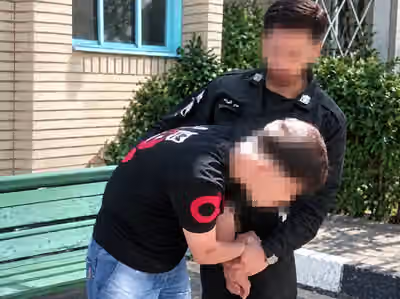
Nearly one-third of registered adoptions in Iran over the past decade were illegal, according to state welfare data, exposing a hidden child-transfer market that advocates say can leave babies vulnerable to sale, abandonment, domestic servitude and other forms of abuse.
Parisa Valentina Pouyan, director of the Pouya Helpers of Child Workers Institute, told Iran’s labor-focused ILNA news agency that baby-selling is a hidden and complex phenomenon driven not only by poverty but also by addiction, cultural pressures, weak oversight, lack of parenting education and failures in state protection systems.
“Buying and selling children is one of the most horrifying forms of social harm and one of the most damaging acts committed against children,” Pouyan said.
Her remarks followed renewed attention in Iranian media to the case of a mother accused of selling several of her newborns over different years for small sums, reviving concerns about underground markets for infants and the future awaiting children transferred outside legal adoption channels.
A recent analytical report by Iran’s State Welfare Organization, known as Behzisti, found that illegal adoption remains a serious challenge for the country’s child-protection and judicial systems.
According to the report, 18,240 adoption cases were registered from 2013 to 2024, of which 13,020, or 71 percent, were legal, while 5,224, or 29 percent, were recorded as illegal.
Behzisti is the main state body responsible for welfare and child-protection cases in Iran, including formal adoption procedures. Illegal adoptions take place outside that system, often through private arrangements, brokers or concealed transfers of newborns.
Pouyan said official and precise statistics on baby-selling do not exist because the practice is hidden. But she said poverty creates fertile ground for such cases, especially during wider social and economic crises.
Still, she warned against reducing the issue to poverty alone.
“Would every poor family sell its child?” she said. “If parents have sold a child once and their living conditions improve a little, does that mean they will never do it again?”
Pouyan said global experience shows baby-selling has become a lucrative trade in some places, and that poverty is only one driver. She cited addiction, sex work, cultural pressures and the possibility that a mother herself may have been a victim of child-selling as factors that can feed the trade.
She said the hidden nature of illegal transfers means the child’s future is often irrelevant to the transaction.
“In this kind of trade, parents who sell their baby or child do not care whether the buyers have the conditions and qualifications needed to become parents,” she said, adding that in illegal transfers “money comes first.”
Pouyan said she had personally been approached several years ago by someone seeking a child for a couple living abroad, both doctors, who wanted to adopt by finding a parent willing to sell a child. She said she rejected the request and warned she would report any such case.
According to Pouyan, the darker danger is that not all buyers are seeking parenthood.
In some cases, she said, children are bought or taken through illegal adoption channels for domestic labor or other forms of exploitation.
“I have seen a case in which a child was illegally adopted and, a few years later, became the family’s servant,” she said.
Pouyan said Iran’s response to baby-selling and illegal adoption is weakened by poor oversight, ineffective intervention by responsible agencies and possible misconduct inside institutions meant to protect children.
Students protesting at Tehran's Sharif University of Technology, in this undated file photo
Sharif University of Technology has issued preliminary expulsion orders for seven students, according to the student group United Students, in a move that rights advocates say reflects a broader postwar tightening of political and social control inside Iran.
The disciplinary committee at Sharif, widely regarded as Iran's leading technical university, handed down expulsion orders and, in several cases, multi-year bans from higher education, the group said.
The students named in the report include Reza Dalman, a master's student in computer engineering; Fatemeh Khakpour, an undergraduate chemistry student; Hossein Shadman, a master's student in industrial engineering; Sepanta Saeedi, an undergraduate computer engineering student; Masiha Bagheri, an undergraduate computer engineering student; Fariborz Kohanzad, an electrical engineering student; and Parnian Khodabakhshi, an undergraduate materials science and engineering student.
The expulsions come amid a crackdown that has continued since nationwide unrest in January and intensified during the recent war with the United States.
Rights groups say Iranian authorities have used the security climate to tighten control at home, with arrests, student disciplinary cases and executions rising sharply.
Iran has also carried out executions at record levels in recent months, fueling concerns that the political calm following the US-Iran memorandum of understanding could give authorities greater room to suppress dissent away from the battlefield.
United Students said disciplinary cases against three of the students — Saeedi, Shadman and Bagheri — centered on activity on social media. The other four cases were linked to protests in March, the group said.
The group also said detained student Ariana Koochak had been expelled.
Earlier this week, the Islamic Association of Sharif University students said families of several students had received calls from an unidentified number and reported that a number of students had been banned from entering the campus.
Sharif University has long held a special place in Iran's political and intellectual life. Often described as Iran's MIT, it is the country's most prestigious technical institution, with many graduates going on to pursue advanced degrees and careers at leading universities and technology companies abroad.
The university has also been a hotbed of student protest in recent years.
During the war, the campus was bombed in what officials said was an attack on research centers alleged to have dual-use applications.
The strike was condemned by Tehran and by rights organizations, which warned against attacks on civilian educational institutions.
The new expulsions suggest that even as Iran enters a formal diplomatic process with Washington, pressure on students and universities is continuing at home.
Members of the Iranian police attend a pro-government rally in Tehran, Iran, January 12, 2026. Stringer/WANA (West Asia News Agency) via REUTERS
UN experts on Friday welcomed the signing of a 14-point memorandum of understanding between the United States and Iran but warned that any final agreement that fails to address human rights in Iran would be “fundamentally incomplete.”
In a statement, the experts said the MoU focuses mainly on military withdrawal, reopening the Strait of Hormuz, nuclear commitments, sanctions relief and a $300 billion reconstruction fund, while the Iranian people are “barely visible” in the framework.
“A deal that serves geopolitical interests while leaving the Iranian people behind is not a peace agreement worthy of the name,” they said.
The groups of experts which includes the UN Special Rapporteur for Iran's human rights situation Mai Sato, accused Iranian authorities of using the war to intensify repression, saying thousands had been detained since late February, with many reportedly tortured, forcibly disappeared, subjected to mock executions or forced to confess on camera.
They said at least 156 people had been executed since the start of the war, including at least 42 on espionage and national security-related charges, many after proceedings in which confessions were reportedly obtained under torture or defendants were denied access to lawyers.
They also cited the seizure of assets belonging to at least 1,500 citizens, including hundreds of Iranians abroad, calling it a tool of punishment and transnational repression.
In recent days, many Iranians opposed to the Islamic Republic have voiced frustration over the signing of the US-Iran memorandum, fearing that Washington and Tehran are moving toward an agreement that would preserve the ruling system after months of war, repression, blackouts and sanctions.
After the January crackdown, in which security forces killed thousands of protesters and detained many more, both Donald Trump and Benjamin Netanyahu promised to support Iranians seeking to bring down the regime.
But the agreement has deepened concern among many anti-government Iranians that ordinary people paid the heaviest price while Tehran’s more hardline leadership survived and may now gain breathing space through diplomacy.
In their Friday statement, the UN experts urged all states involved in or mediating the next 60 days of negotiations to press for accountability, reparations, a moratorium on executions, the release of arbitrarily detained people, disclosure of the fate of the forcibly disappeared, restoration of open internet access and protection of civic space.
“The end of hostilities must not be mistaken for the restoration of rights,” they warned. “For the Iranian people, that work is yet to begin.”
Baluch women were beaten during protests over local mining projects in southeastern Iran, renewing attention on the Islamic Republic’s treatment of one of the country’s poorest and most heavily policed minorities.
The incidents were reported in Faryab county in Kerman province and in Taftan county in Sistan and Baluchestan, where residents had gathered to protest mining projects they say have damaged local livelihoods or excluded native communities from the benefits of natural resources.
The Baluch rights group Haalvsh said at least eight Baluch women were injured and six people, including three women, were arrested on Wednesday after forces attacked a protest over a chromite mine in Pashmoki, a village in Faryab county.
According to Haalvsh, residents were protesting what they described as the transfer of mining benefits to people with influence while local communities remain deprived of the economic gains. Videos published by the group show uniformed forces confronting women and other residents, with several women seen being pushed, struck or beaten.
Haalvsh said the detainees had been taken to an unknown location and their families had not received clear information about their condition or whereabouts.
The Pashmoki incident came less than 48 hours after Haalvsh reported another assault on Baluch women protesting activity linked to the Taftan gold mine in Sistan and Baluchestan province.
In that case, women in Sarsiah village said forces insulted, threatened and beat them after they objected to the mine’s impact on local water, farmland and daily life. Haalvsh said one woman was injured in the head after being struck with the butt of a weapon.
The immediate disputes are local, but the anger around them is rooted in a much wider sense of exclusion. Residents say mining projects are damaging water resources, disrupting villages and enriching others while Baluch communities remain poor.
Sistan and Baluchestan has long been one of Iran’s most deprived provinces. Its mostly Sunni Baluch population has faced discrimination, underdevelopment and heavy security pressure under the Islamic Republic. The region has repeatedly seen deadly crackdowns, including the 2022 “Bloody Friday” killings in Zahedan.
Human rights groups have also documented the disproportionate use of executions against Baluch prisoners, especially on drug-related charges. Amnesty International said Baluch people accounted for 29% of Iran’s drug-related executions in 2023 despite making up about 5% of the population. Iran Human Rights said Baluch prisoners represented 17% of drug-related executions in 2024, while forming an estimated 2% to 6% of Iran’s population.
Molavi Abdolhamid, the influential Sunni cleric in Zahedan, has repeatedly criticized the execution of Baluch prisoners. He said in 2023 that many people executed on drug-related charges had been accused of sales worth as little as $15 to $20, and that poverty, unemployment and lack of infrastructure had pushed some people in the region into smuggling fuel, goods or drugs as a lifeline.
That background is why the beatings at the mine protests have resonated beyond the two villages. The images show Baluch women, among the most marginalized voices in Iran, confronting security forces over the basic question of who benefits from the wealth beneath their land.
The Islamic Republic often frames unrest in Baluch areas through the language of security, smuggling or separatism. But the protests in Pashmoki and Sarsiah point to another reality: communities demanding water, livelihood, dignity and a say over local resources, and being met with batons, threats and arrests.
As Tehran and Washington move toward a memorandum to end the war and reopen the Strait of Hormuz, messages from inside Iran show anger that the deal speaks of uranium, Lebanon and money, while ordinary Iranians remain absent from the text.
The messages, sent to Iran International on Thursday, reflect grief, suspicion and political anger after details emerged of the memorandum between Tehran and Washington.
The agreement outlines a halt to the war, a 60-day negotiation period, steps toward reopening the Strait of Hormuz, possible oil waivers and discussions over frozen assets and sanctions relief.
But for many Iranians who responded, the central question was not what the Islamic Republic might receive, or whether Washington would enforce the terms. It was why ordinary Iranians appeared absent from the agreement.
“We gave our fallen, we endured more hunger and poverty, there was war, we moved further away from our dreams, we were hurt, we were killed unjustly, but uranium was the main issue,” one message said. “In these several clauses of the agreement, there was no word about the people of Iran.”
Another message described the memorandum as an agreement signed “over the bodies of Iran’s children,” referring to what the sender said were 42,000 lives lost.
The message reflected a broader anger among several respondents who saw the deal as a bargain made after months of bloodshed and repression.
Some directed their anger at US President Donald Trump, saying they had hoped Washington would side more clearly with the Iranian people. “Trump is a businessman who first sees his own profit and his country’s interests, and it does not matter to him what has happened or what will happen,” one message said.
Another sender wrote: “Tell Trump that your betrayal has remained so deeply in our hearts and minds that if one day America and Europe need the help of the people of Iran, not a single person will come toward you.”
Others focused on Mohammad Bagher Ghalibaf, the lead Iranian negotiator expected to sign the memorandum in Switzerland on Friday. Ghalibaf has defended the document and urged officials to focus on improving the economy, but one message accused him of speaking more about Lebanon than about Iranians.
“Mr. Ghalibaf, in the same speech where you said we should fix people’s economy, you spoke several times more about Lebanon than about the people of Iran, and said the first clause of the agreement is also Lebanon,” the message said.
The 14-point memorandum includes a provision on ending military operations on all fronts, including Lebanon, and ensuring Lebanon’s sovereignty and territorial integrity. It also includes provisions on the Strait of Hormuz, oil exports, frozen assets, sanctions and Iran’s nuclear program.
US officials have since sought to limit expectations, saying the memorandum does not provide Tehran with automatic access to frozen assets, immediate sanctions relief or direct US funding.
They said any economic benefit would depend on Iranian compliance and progress toward a final deal, particularly on nuclear issues.
Inside Iran, however, the messages show that many are judging the agreement less by its financial mechanisms than by what it signals politically.
Some saw it as proof that the Islamic Republic’s long confrontation with the United States had ended in failure. “We are not fooled by the regime’s propaganda,” one message said. “The current memorandum between Iran and America was a definite defeat for the Islamic Republic’s 47-year policy.”
Another urged patience and unity, framing the deal as part of a longer process of weakening the system. “Be patient, regime change is happening, although at a gentle speed,” the message said. “Just stay united and give each other hope.”
But several messages were more despairing than hopeful. One sender compared the moment to a scene in a war film where a soldier, after fighting through chaos, suddenly stands still in shock and cries.
“That is how we, the people of Iran, feel with the news of the negotiations,” the message said.
Another asked why no country had insisted that Iranians themselves had rights that should be part of any settlement. “Why was there no one anywhere in the world to say that we, the people of Iran, had the right to live?” the message said. “Why should the human rights of all people in the world be respected except those of Iranians?”
Iran players walk past Iranian fans holding official and pre-revolutionary flags, in Los Angeles, US, June 16, 2026
Iran’s World Cup match with New Zealand was not just a football game but a rare glimpse into the trauma and deep divisions many Iranians carry at home and abroad.
As Iran twice came from behind to draw 2-2 at SoFi Stadium in Inglewood, California, fans cheered different goals for different reasons. Some celebrated every Iranian attack. Others openly rooted against a team they view as inseparable from the Islamic Republic.
The divided reactions reflected a question that has become increasingly fraught since January 8-9, 2026, when the Islamic Republic launched a nationwide crackdown on anti-regime protesters that killed tens of thousands of unarmed civilians: can one support Team Melli without supporting the state it represents?
The trauma of those events continues to reverberate far beyond Iran's borders.
At SoFi Stadium, one fan wore a custom jersey marked "8-9," a reference instantly recognizable to many Iranians as the dates of the deadliest two nights in Iran's modern history.
"I felt proud to be Iranian, but with a mixed bag of emotions, carrying the weight of everything that the regime has done and what the people have suffered," actress and activist Nazanin Nour told Iran International.
Nour said she ultimately decided to attend the game despite her conflicted feelings because the regime has taken so much from Iranians worldwide, and she did not want it to deprive her of the joy of the sport as well.
"I think everybody's feelings are informed by their pain and trauma and everything that we've witnessed over the last not just few months but 47 years," she said. "It makes sense that everybody feels like this is a really weird time but still a time to be proud of who we are and where we come from."
A team added
Since the 2022 Woman, Life, Freedom protests, players have faced scrutiny over whether they sing the national anthem, meet state officials or publicly support protesters.
Supporters and critics alike increasingly view the national team through a political lens because it officially represents the Islamic Republic.
While some players and football federation officials have shown alignment with the state, others have faced pressure for expressing solidarity with anti-government protests or refusing to sing the national anthem.
Former Iranian national team goalkeeper and coach Mohammad Rashid Mazaheri has been held by Iranian authorities since late February 2026 after criticizing the leader in an Instagram post.
For many Iranians, his case is another reminder of how even prominent athletes can face severe repercussions—even death—for expressing dissent.
"We're a world away from past World Cups, when, regardless of politics, Iranians inside the country and across the diaspora were united behind Team Melli," said Holly Dagres, a senior fellow at the Washington Institute.
That unity was perhaps best illustrated in 1998, when Iran's victory over the United States sparked celebrations from Tehran to Los Angeles.
Pride and protest
Before kickoff, hundreds of protesters gathered outside SoFi Stadium waving anti-government signs and the pre-revolution Lion and Sun flag in a city home to one of the world's largest Iranian diasporas.
Despite FIFA's ban on the Lion and Sun flag, videos circulating online showed numerous fans displaying it inside the stadium.
Among those in attendance was activist Mersedeh Shahinkar, who was blinded in one eye after being shot directly in the eye by security forces during the 2022 protests. Shahinkar, who later fled Iran and now lives in the United States, arrived carrying a Lion and Sun flag.
Shahinkar confronted supporters of the Islamic Republic both inside and outside the stadium, where tensions at times spilled into verbal confrontations and some spectators called fans carrying Iran’s current flag "terrorists."
At times, Shahinkar pointed to the empty eye socket left after she was shot during the 2022 protests, a reminder of the price many Iranians have paid in opposing the state.
Iranian-American news anchor Shally Zomorodi later posted a video to Instagram with tears in her eyes, saying two men confronted her husband over his Lion and Sun logo.
"The hardest part of tonight," she wrote. "Two Iranian men saw my husband with the Lion Sun logo on his shirt and started cursing at him and tried to start a fight with Bruce."
But the atmosphere was not uniformly hostile, said Nour, who witnessed fans carrying Lion and Sun flags sitting near supporters displaying Iran’s official flag.
"I just saw people enjoying a game and being respectful of each other's opinions," she said.
Inside the stadium, boos rang out during the national anthem while many fans appeared to cheer individual players rather than the state they represent.
After the match, Iranian goalscorer Ramin Rezaeian pushed back when asked by a US journalist about fans whistling and booing during the national anthem.
"That's none of your business," he said. "What happens between Iranians is our own matter, and we will resolve it ourselves."
The same arguments played out far from California.
In North Vancouver, home to a large Iranian Canadian community, some crowds—even those displaying Iran's pre-revolutionary flag—erupted in cheers when Iran scored against New Zealand.
A sign of just how complicated the issue can be.
"We're here for the players only," Zina Monjazeb of Los Angeles told Reuters. "We're not here supporting the regime, at all."
Others rejected that distinction entirely.
"We believe that this is not the Iranian team. This is the Islamic regime," Naderi Alizadeh, 39, of San Diego, told Reuters.
In one scene captured on social media, Iranian player Mehdi Taremi is seen handing his shirt to a fan displaying the Lion and Sun flag.
For some Iranians, Team Melli remains a source of national pride distinct from the state it represents. For others, the jersey has become inseparable from the government behind it.
Ninety minutes of football did not resolve the argument. But for one night, it revealed just how deeply it now runs.