• العربية
  • فارسی
Brand
  • Iran Insight
  • Politics
  • Economy
  • Analysis
  • Special Report
  • Opinion
  • Podcast
  • Iran Insight
  • Politics
  • Economy
  • Analysis
  • Special Report
  • Opinion
  • Podcast
  • Theme
  • Language
    • العربية
    • فارسی
  • Iran Insight
  • Politics
  • Economy
  • Analysis
  • Special Report
  • Opinion
  • Podcast
All rights reserved for Volant Media UK Limited
volant media logo

US prepares IAEA resolution condemning Iran despite ongoing peace talks

Jun 5, 2026, 18:24 GMT+1

The United States is preparing a draft resolution condemning Iran ahead of next week’s meeting of the UN nuclear watchdog’s Board of Governors, Reuters reported on Friday citing diplomats, in a move that could complicate wider negotiations between Washington and Tehran.

The draft is being prepared as the two sides negotiate an extension of their ceasefire, which could open the way for talks on Iran’s nuclear program and other disputed issues.

Diplomats said the resolution, if formally submitted to the International Atomic Energy Agency’s board, would increase pressure on Iran at a sensitive moment in the broader US-Iran diplomatic track.

Most Viewed

As US talks stall, Iran moderates warn of renewed unrest
1
INSIGHT

As US talks stall, Iran moderates warn of renewed unrest

2
EXCLUSIVE

Iran sidelines ultra-hardliners from pro-government nightly rallies

3
INSIGHT

Tehran hardliners demand escalation as Trump says talks are progressing

4
EXCLUSIVE

Iran turns to Iraq’s Umm Qasr as new hub to bypass US blockade

5

Stolen Revolution: new book traces Iran’s path from revolution to mafia state

Banner
Banner
•
•
•

Spotlight

  • Can Trump crack Iran's negotiating playbook?
    PODCAST

    Can Trump crack Iran's negotiating playbook?

  • Explained: Iran's frozen assets around the world

    Explained: Iran's frozen assets around the world

  • Iran turns to Iraq’s Umm Qasr as new hub to bypass US blockade
    EXCLUSIVE

    Iran turns to Iraq’s Umm Qasr as new hub to bypass US blockade

  • As US talks stall, Iran moderates warn of renewed unrest
    INSIGHT

    As US talks stall, Iran moderates warn of renewed unrest

  • Iran's services imports surge as goods trade slumps
    ANALYSIS

    Iran's services imports surge as goods trade slumps

  • Citizens report growing use of children in Iran security activities
    VOICES FROM IRAN

    Citizens report growing use of children in Iran security activities

More Stories

Explained: Iran's frozen assets around the world

Jun 5, 2026, 18:08 GMT+1
•
Maryam Sinaiee
Explained: Iran's frozen assets around the world
100%

Access to frozen assets has emerged as one of Tehran's key demands in negotiations with Washington, with Iranian officials seeking the release of at least part of the tens of billions of dollars held abroad.

According to recent media reports, negotiators are discussing a package worth roughly $12 billion that could become available if a preliminary agreement with the United States is reached.

The issue matters because even partial access to blocked funds could affect Iran's currency market, imports, government finances and broader economy.

Iranian officials estimate that more than $100 billion in assets remain inaccessible because of sanctions, banking restrictions and legal disputes that have accumulated over decades. Not all of that money would necessarily become available even in the event of an agreement, as some assets remain tied up in court cases and other restrictions unrelated to sanctions.

Iranian Parliament Speaker Mohammad Bagher Ghalibaf recently traveled to Qatar, where discussions reportedly touched on the release of frozen Iranian funds.

Saeed Ajorlou, a member of the media team accompanying Iran's negotiating delegation, said in a televised interview on June 2 that the talks had been successful. He stated that once a framework agreement receives final approval, a portion of Iran's blocked assets should become available to the Central Bank of Iran in a manner that could not easily be reversed.

He also indicated that Tehran is seeking guarantees that access to the funds will continue and has linked the release of assets to the implementation of any future agreement.

Why the funds matter

A large share of Iran's blocked assets consists of oil revenues accumulated in foreign banks after the United States withdrew from the 2015 nuclear agreement in 2018 and reimposed sweeping sanctions.

Secondary sanctions made it difficult for countries purchasing Iranian oil to transfer payments directly to Tehran, causing substantial sums to accumulate in overseas accounts.

Economists say that even partial access to these resources could provide a significant boost to Iran's economy.

One immediate effect would be an increase in the Central Bank's foreign currency reserves, strengthening its ability to manage exchange-rate volatility. Additional funds could also be used to finance infrastructure projects, pay government obligations and support imports of essential goods, industrial equipment, raw materials and technology needed by domestic industries.

South Korea

South Korea once held one of the largest pools of frozen Iranian funds.

Roughly $6 billion in oil revenues accumulated in two South Korean banks before being transferred to accounts in Qatar in 2023 as part of a prisoner-exchange agreement between Tehran and Washington.

Although Iranian officials initially described the funds as released, access has remained subject to significant restrictions and the money has largely remained beyond Tehran's direct control.

Iraq

Iraq represents another major source of Iranian claims.

Much of the money stems from Iraqi purchases of Iranian natural gas and electricity. While neither side has publicly confirmed an exact figure, Iranian officials have repeatedly said that outstanding payments amount to several billion dollars.

Some of these funds have already been used for humanitarian purchases under arrangements approved by the United States. Estimates suggest that Iran could eventually gain access to between $10 billion and $12 billion held in Iraq if restrictions are eased.

China, India and Japan

China and India present a more complicated picture.

Iranian officials often avoid describing funds held in those countries as formally frozen, arguing that mechanisms exist to use at least part of the money for trade and imports.

Nevertheless, transactions remain difficult because banks and intermediaries facilitating such transfers risk exposure to US sanctions.

Iranian estimates place holdings in China in the tens of billions of dollars, while funds in India are believed to total roughly $7 billion.

Japan also holds Iranian funds linked to oil sales. Estimates generally range from $1.5 billion to $3 billion, although the exact amount remains unclear. Japanese authorities have occasionally allowed limited payments for humanitarian imports and Iran's obligations to international organizations, but most of the money remains inaccessible.

Europe

In Europe, Iranian assets are spread across multiple countries and financial institutions. Their status is shaped not only by sanctions but also by legal disputes, court rulings and anti-money-laundering regulations.

Total Iranian assets affected by these issues are estimated at anywhere from several billion dollars to as much as $20 billion.

One of the most prominent disputes involves approximately $1.6 billion to $2 billion connected to accounts belonging to Iran's central bank in Luxembourg. These assets have been tied up in litigation involving efforts by holders of US court judgments to obtain compensation related to terrorism cases.

While the exact amount of Iranian assets that could ultimately be released remains uncertain, access even to a fraction of these funds could strengthen Iran's foreign-exchange reserves, ease pressure on imports and provide the government with a significant financial cushion.

For that reason, frozen assets have become one of the most important economic components of the ongoing negotiations between Tehran and Washington.

Iran sentences another January protest detainee to death

Jun 5, 2026, 18:06 GMT+1

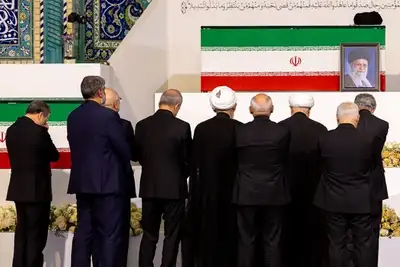
Ali Kamali, a detainee from Iran’s January 2026 protests, has been sentenced to death by Branch 26 of Tehran’s Revolutionary Court on the charge of moharebeh, or “waging war against God,” according to the US-based rights group HRANA.

HRANA said the sentence, issued in late May by Judge Iman Afshari, is currently under review by the Supreme Court.

Kamali, who holds Malaysian residency, was arrested in Tehran on January 12 and is being held at the Greater Tehran Prison.

Khamenei aide ties US deal to release of $24 billion in frozen assets - CNN

Jun 5, 2026, 17:42 GMT+1

Mohsen Rezaei, a military aide to Iran's supreme leader, told CNN any US-Iran peace deal depends on Washington releasing $24 billion in frozen Iranian assets, warning that renewed fighting would push the United States into a “dark corridor.”

“If he (Trump) wants to reach an agreement with Iran, this $24 billion is a test of trust that Iran wants to have with Trump – this is a test that America must pass and the path will be opened,” he said in the rare interview with CNN.

“This is our own money, not America’s money.”

He also warned that Tehran will “drag the war” beyond the Persian Gulf if the US resumes the conflict, potentially expanding military operations from the Strait of Hormuz to the Indian Ocean, the Bab al-Mandab Strait, the Red Sea and the Mediterranean Sea.

“We will give another dimension to the war by attacking these other American bases that we have been attacking so far,” he said. "The possibility of war is low.”

US sanctions Iranian LPG smuggling, shadow banking networks

Jun 5, 2026, 16:50 GMT+1

The US Treasury on Friday sanctioned a network of individuals, companies and vessels accused of smuggling Iranian LPG to Asia by disguising it as Omani fuel, in the latest move under Washington’s “Economic Fury” pressure campaign against Tehran.

The Treasury Department said the network used front companies in the United Arab Emirates and China, foreign bank accounts and Iran’s shadow fleet to move millions of barrels of Iranian-origin LPG while concealing its source and evading US sanctions.

“Iran’s economy is floundering and its military is decimated,” Treasury Secretary Scott Bessent said, adding that the department would continue targeting Iran’s shadow fleet, shadow banking networks and access to global trade.

The sanctions target Afghan national Sarbaz Abdul Zada and Turkish national Mohammad Shakol Mihandoust, also known as Haji Shakoor, whom Treasury accused of operating UAE-based front companies that exported millions of barrels of Iranian LPG to South and East Asia. Those companies include Butani Trading LLC, Dundlod Trading FZE and ADH Energy FZE.

Treasury said ADH Energy FZE was used in March 2026 to sell and export millions of barrels of Iranian LPG to Bangladesh. It also cited the LPG SEVAN, saying the vessel transported 750,000 barrels of LPG to Bangladesh between August and November 2025.

The department also sanctioned several LPG tankers, including MD 23, GLENDALE, AMIR GAS, GAS LAGOON, MILE and GAZ GMS, saying they had transported hundreds of thousands to millions of barrels of Iranian LPG in recent years.

In a parallel action, OFAC designated Iranian exchange house Mehrdad Geramian Nik and Partners Company and its leadership, accusing them of moving hundreds of millions of dollars in foreign currency on behalf of sanctioned Iranian banks. Treasury said Iran’s foreign exchange system relies on brokers and front companies abroad to conceal Iranian links and bypass sanctions.

The sanctioned exchange house had contracts with Bank Tejarat, Bank Mellat and Bank Pasargad, and by early 2026 held tens of millions of dollars in foreign currency on behalf of sanctioned Iranian bank customers, Treasury said.

The move blocks any US-based property of the sanctioned individuals and entities and generally bars US persons from dealing with them. Treasury warned that foreign persons and financial institutions could also face sanctions exposure for activity involving blocked parties.

Cleric calls Hormuz ‘Moses’ staff,’ says it must not fall into enemy hands

Jun 5, 2026, 16:16 GMT+1

A senior Iranian cleric described the Strait of Hormuz as Iran’s “staff of Moses,” saying Tehran must not allow its leverage over the waterway to fall into the hands of “enemies of Islam.”

Ahmad Mahmoudi, the Friday prayer leader of Isfahan, said during his sermon that “the clock and history do not go back,” adding that the United States had failed to achieve its aims through what he called the blockade of the Strait of Hormuz.

“We have said this many times and we repeat it again: the Strait of Hormuz is the staff of Moses,” Mahmoudi said. “This Moses-like staff must not be handed to the enemies of Islam.”

Mahmoudi also accused Iran’s adversaries of trying to separate Lebanon's Hezbollah from the Islamic Republic, saying Tehran had shown “in words and action” that it would not allow that to happen.

He said Iran’s central command center Khatam al-Anbiya Headquarters had formally warned that if Israel attacked Beirut’s Dahiyeh district, Iran would fire toward Israel in response.

“Forty-four years have passed since the formation of the resistance, and this path will continue,” Mahmoudi said. “We will not back down.”