• العربية
  • فارسی
Brand
  • Iran Insight
  • Politics
  • Economy
  • Analysis
  • Special Report
  • Opinion
  • Podcast
  • Iran Insight
  • Politics
  • Economy
  • Analysis
  • Special Report
  • Opinion
  • Podcast
  • Theme
  • Language
    • العربية
    • فارسی
  • Iran Insight
  • Politics
  • Economy
  • Analysis
  • Special Report
  • Opinion
  • Podcast
All rights reserved for Volant Media UK Limited
volant media logo

Iran will negotiate or face consequences, Trump says

Apr 21, 2026, 06:21 GMT+1

Iran will negotiate or face consequences if it refuses talks, US President Donald Trump said on Monday.

“They’re going to negotiate and if they don’t, they’re going to see problems like they’ve never seen before,” he said in a John Fredericks radio interview, adding that the Iran war is "very close to being over."

Trump said any future agreement would ensure Iran does not obtain a nuclear weapon.

He added that Washington would not allow Tehran any path to acquiring such capabilities.

Most Viewed

Ghalibaf defends Iran-US talks amid hardline backlash
1
INSIGHT

Ghalibaf defends Iran-US talks amid hardline backlash

2
INSIGHT

Iran diplomacy wobbles as factions compete to avoid looking soft on US

3
VOICES FROM IRAN

Bread shortages, soaring prices strain households in Iran, residents say

4
ANALYSIS

The politics of pink: how Iran uses cuteness to rebrand violence

5

War-hit homeowners feel abandoned as Iran’s reconstruction aid fades

Banner
Banner

Spotlight

  • Lights out, then gunfire: Witnesses recount Mashhad protest crackdown
    VOICES FROM IRAN

    Lights out, then gunfire: Witnesses recount Mashhad protest crackdown

  • Family told missing teen was alive, then received his body 60 days later
    EXCLUSIVE

    Family told missing teen was alive, then received his body 60 days later

  • Is Iran entering its Gorbachev moment?
    INSIGHT

    Is Iran entering its Gorbachev moment?

  • Iran crackdown reaches cemeteries as graves of slain protesters defaced
    EXCLUSIVE

    Iran crackdown reaches cemeteries as graves of slain protesters defaced

  • Iran diplomacy wobbles as factions compete to avoid looking soft on US
    INSIGHT

    Iran diplomacy wobbles as factions compete to avoid looking soft on US

  • The politics of pink: how Iran uses cuteness to rebrand violence
    ANALYSIS

    The politics of pink: how Iran uses cuteness to rebrand violence

  • Bread shortages, soaring prices strain households in Iran, residents say
    VOICES FROM IRAN

    Bread shortages, soaring prices strain households in Iran, residents say

•
•
•

More Stories

Iranian tanker nears Kharg after crossing blockade line - TankerTrackers

Apr 21, 2026, 05:54 GMT+1

An Iranian crude carrier is nearing Kharg Island after crossing the blockade line on its return voyage, TankerTrackers said on Tuesday.

The very large crude carrier departed Iran in late March and transferred two million barrels of crude to another tanker near the Riau Archipelago in Indonesia, before sailing back toward Iran.

“She’ll reach Kharg Island tomorrow,” TankerTrackers said.

Seized Iranian ship likely carried dual-use goods - Reuters

Apr 21, 2026, 05:20 GMT+1

The Iranian-flagged container ship Touska, seized by US forces on Sunday, was likely carrying items Washington considers dual-use and potentially usable by the military, Reuters reported on Monday, citing maritime security sources.

The sources, speaking on condition of anonymity, said initial assessments pointed to dual-use cargo on board following the vessel’s voyage from Asia.

The small container ship belongs to the Islamic Republic of Iran Shipping Lines, (IRISL) which is under US sanctions.

Ship-tracking data on Marine Traffic showed the vessel was boarded off Iran’s Chabahar port in the Gulf of Oman and last reported its position at 1308 GMT.

US Central Command said the crew had failed to comply with repeated warnings over a six-hour period and that the vessel was violating a US blockade.

Seized Iranian container ship likely carrying dual-use items — Reuters

Apr 21, 2026, 04:58 GMT+1

The Iranian-flagged container ship Touska, boarded and seized by US forces on Sunday, is likely carrying items that Washington considers “dual-use” and potentially usable by the military, Reuters reported citing maritime security sources said.

The small container vessel, part of the Islamic Republic of Iran Shipping Lines (IRISL) group under US sanctions, was intercepted off the coast of Iran’s Chabahar port in the Gulf of Oman.

US Central Command said the ship’s crew failed to comply with repeated warnings over a six-hour period and that the vessel was in violation of a US naval blockade.

Reuters cited anonymous maritime security sources as saying preliminary assessments suggested the vessel was likely carrying dual-use items following a voyage from Asia.

Is Iran entering its Gorbachev moment?

Apr 21, 2026, 04:48 GMT+1
•
Ashkan Safaei

The idea of an “Iranian Gorbachev” has surfaced before in the Islamic Republic, but this time the conditions may be different.

At the peak of the Reform Movement in the late 1990s, when Iranian president Mohammad Khatami promoted political openness and civil society, hardliners labeled him Iran’s Gorbachev.

Hardliners like Hossein Shariatmadari and Hassan Abbasi used the title to demonize him, while opposition groups clung to the hope that he might accelerate the regime's collapse—a feat they themselves had been unable to achieve.

In reality, neither Khatami nor his inner circle accepted such a role. They repeatedly stressed that their reforms were intended to strengthen the system, not dismantle it. The structure of power at the time also made a true "Gorbachev moment" nearly impossible.

Now-slain Supreme Leader Ali Khamenei controlled the pace of reform, restraining both reformists and hardliners and preventing the political system from tipping into crisis.

Iranian society in the late 1990s was also not prepared for a total rupture with the state. A significant portion of the population still believed reform was possible. The generation shaped by the 1979 revolution remained politically active and hopeful.

Three decades later, the situation appears markedly different. A new generation, deeply disillusioned with the system, appears to settle for nothing less than regime change.

Over the past three years the Islamic Republic has endured repeated foreign military strikes. Ali Khamenei, referred to by many officials as the “system,” has been removed from the scene. Mojtaba, his son, lacks the authority that allowed his father to hold competing factions together during moments of crisis.

It is in this environment that an individual—or individuals—may unintentionally become "Iran’s Gorbachev." One possible candidate is Mohammad Baqer Ghalibaf.

During the 40-day memorial of Ali Khamenei, Ghalibaf traveled to Islamabad to meet with the Vice President of the country that helped kill the Supreme Leader.

Signs suggest that the remnants of the regime, in a desperate attempt to remain in power, may be prepared to make concessions that strike at the ideological foundations of the Islamic Republic.

US President Donald Trump’s demands—surrendering enriched uranium, permanently ending enrichment, and disarming Hezbollah—strike at core elements of the Islamic Republic’s identity. Accepting them could alienate the ideological base that has long defended the system.

Even without an official agreement, hints of retreat have already triggered anger among loyalist forces. Aggressive reactions from accounts linked to ultrahardline figures, accusing officials of "sedition" and a "coup," suggest tremors within the regime’s core supporters.

When a Jalili-aligned account writes, “If these are the Leader's orders, release a video of him saying so,” it signals how deeply trust in the central authority has eroded.

Another example of frustration within the regime’s ideological base appeared in a tweet warning: “Alas for the public’s rage and disillusionment when they learn what has been agreed upon and what is yet to come.”

During the final years of the USSR, the policies of Glasnost (Openness) and Perestroika (Restructuring) distanced the Soviet system from its founding ideals. When transparency exposed the privileges of party elites, the ideological base lost faith. Many refused to defend the system when it needed them most. The "Evil Empire" collapsed with startling speed.

If those in power in Tehran abandon uranium enrichment and withdraw support from Hezbollah, there is no guarantee that their ideological base will mobilize in their defense—or shoot protesters as they did in January.

Without Ali Khamenei to frame such a retreat as "Heroic Flexibility," Ghalibaf and his allies, in their struggle to preserve the system, could inadvertently become the Gorbachevs of Iran.
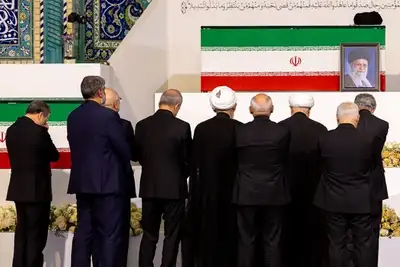

Trump says removing ‘nuclear dust’ after Iran strikes will take time

Apr 21, 2026, 04:42 GMT+1

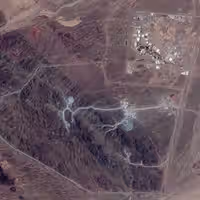
President Donald Trump said clearing debris from Iranian nuclear facilities struck by the United States would be “a long and difficult process,” insisting the sites had been completely destroyed.

“Operation Midnight Hammer was a complete and total obliteration of the Nuclear Dust sites in Iran,” Trump wrote on TruthSocial. “Therefore, digging it out will be a long and difficult process.”

Trump also criticized CNN and other media outlets, accusing them of undermining the military operation.