Pahlavi calls for tighter sanctions to hasten Tehran’s fall
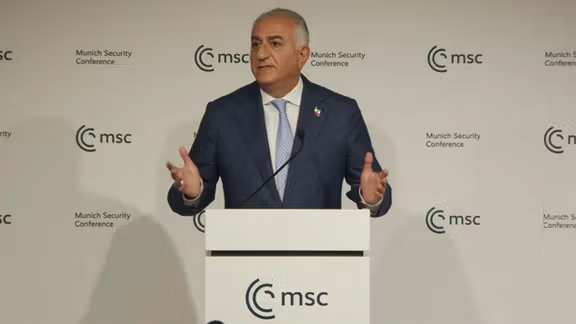

Further restricting the Islamic Republic’s access to revenue would weaken its ability to sustain its security forces and prolong its rule, Iran's exiled Prince Reza Pahlavi said on Saturday on the sidelines of Munich Press Conference.
“One way to weaken the regime even further is to impose more restrictions so that their source of revenue is cut off so they can no longer sustain their own elements,” he said, arguing that financial pressure would accelerate its collapse.
Pahlavi described the government as fragile and said it would attempt to circumvent sanctions, adding that monitoring enforcement is the responsibility of the international community.
“Any source of revenue to the regime will contribute to its ability to sustain itself a little bit longer, but at the end it will fall,” he said, urging faster action to limit what he called the negative regional consequences of its continued existence.
Instability across the Middle East is rooted in radical Islamist movements, including forces linked to Tehran, Prince Reza Pahlavi argued and said Iran’s current leadership poses a threat both at home and beyond its borders.
“This regime has only one purpose, is to export this ideology. It is a threat to its own people,” he said, adding that neighboring countries understand the consequences of its policies.
A future Iranian government committed to peaceful relations, Pahlavi said, would be welcomed in the region. “The only way to eliminate all the problems at once is for this regime to be no longer there and instead have a country where its people… will prove that unlike this regime, there are peacemakers and they believe in stability first and foremost,” he said.
Democracy is about inclusion, not eliminating options in advance, exiled Prince Reza Pahlavi said at a press conference on the sidelines of the Munich Security Conference, arguing that Iran’s future political system should be decided by voters rather than predetermined by political factions.
“Democracy is not about exclusion, it’s about inclusion, unless you are not in conformity with democratic principles,” Pahlavi said, adding that both republics and constitutional monarchies can succeed or fail depending on how they are practiced.
Responding to criticism that he does not represent all Iranians, Pahlavi said he does not claim unanimous support but argued that his name has been widely chanted inside Iran. “I’m not saying that I have 100% of people on my side. Of course, I have my enemies,” he said.
He said groups that do not adhere to his four stated principles—including separatists, pro-regime reformists and the MEK—are not part of his coalition. However, he described his supporters as diverse, including republicans and monarchists, people across the political spectrum and representatives of ethnic and religious communities.
“My position is neutral towards the outcome,” he said, adding that Iranians should determine their preferred system “by the ballot box” in a free election whose results all sides respect.
Pahlavi also criticized the Islamic Republic’s electoral system, saying there are no genuine free elections in Iran and that presenting them as such is “a mockery of democracy.”

Iranians continue to resist despite a sweeping crackdown, Prince Reza Pahlavi said, warning that delays could cost more lives.
“When my compatriots came to the streets, they were only met with this brutal genocidal level, industrial level massacre,” Pahlavi said, adding that many were forced to retreat but “people are still out there chanting” in recent nights.
He said tens of thousands are imprisoned, and accused authorities of continuing arrests, threats and executions, including targeting hospital workers and nurses.
“The importance of strike to neutralize the regime forces of repression is the element that could get people back into the streets,” he said, arguing that negotiations with Iran would not yield results and that “every day that goes by, more people could die.”
Stabilizing the country and preventing chaos would be the top priorities in the first 100 days of a post-Islamic Republic transition, Prince Reza Pahlavi said, calling for broad participation and defections from within the system.
He said the immediate focus during a transition would be to “stabilize the country, stabilize the economy” and ensure security, arguing that encouraging “maximum defections” would help avoid the kind of collapse seen in Iraq after Saddam Hussein.
“A lot of the elements that can be part of the solution are the kind of people who have the guns in their hands that can now join,” he said.
Those “criminally responsible” and with “the blood of people on their hands” would face accountability in court, he added.
Millions of Iranians have chanted his name and called for his return, exiled Prince Reza Pahlavi said on Saturday at the Munich Security Conference, describing the calls as both humbling and a responsibility.
“Millions of Iranians chanted my name and called for my return. That humbles me and gives me a lot of responsibility at the same time to answer their call and to be the leader of this transition as they have asked for,” he said at a press conference.
Pahlavi added that anyone who agrees with “those four core principles, irrespective of their political affiliation or viewpoints, can be part of this national struggle for freedom.”
He outlined a roadmap in which a transitional government would prepare the ground for a constitutional assembly elected by Iranians to determine the country’s future system. “At the end of this process, once the constitution is approved and the nation votes in a referendum to adopt it, we will have the election of the first new parliament and the first new government of that future democracy,” he said, adding that the temporary government would then hand over power to elected officials.