Mass killings reported as security forces use live fire on Iran protesters
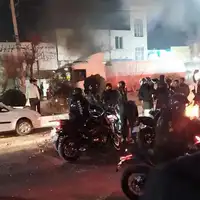
Iran's security forces are using lethal force against protesters nationwide, informed sources told Iran International, with preliminary estimates pointing to mass casualties as a sweeping crackdown unfolds amid a near-total internet shutdown.
Footage sent to Iran International from Kahrizak, south of Tehran, shows several dead bodies in body bags. According to eyewitness accounts accompanying the videos, dozens of bodies are visible at the site, with additional bodies reportedly located in another nearby industrial shed.
Videos earlier sent to Iran International from Fardis, Karaj, and Alghadir Hospital in eastern Tehran showed similar scenes of dead bodies falling on the ground, pointing to an unfolding mass killing that is not confined to a limited number of cities.
The internet shutdown that started on January 8 have made it impossible to obtain a full picture of events on the ground. However, the volume and consistency of incoming accounts suggest that lethal force is being widely used to disperse protesters.
The most conservative estimates indicate that at least 2,000 people have been killed over the past 48 hours. A doctor in the northern city of Rasht told Iran International that one hospital alone received at least 70 bodies.
Iran's security forces are using lethal force against protesters nationwide, informed sources told Iran International, with preliminary estimates pointing to mass casualties as a sweeping crackdown unfolds amid a near-total internet shutdown.

According to eyewitness accounts accompanying the videos, dozens of bodies are visible at the site, with additional bodies reportedly located in another nearby industrial shed.
Videos earlier sent to Iran International from Fardis, Karaj, and Alghadir Hospital in eastern Tehran showed similar scenes of dead bodies falling on the ground, pointing to an unfolding mass killing that is not confined to a limited number of cities.
The internet shutdown that started on January 8 have made it impossible to obtain a full picture of events on the ground. However, the volume and consistency of incoming accounts suggest that lethal force is being widely used to disperse protesters.
The most conservative estimates indicate that at least 2,000 people have been killed over the past 48 hours.
A doctor in the northern city of Rasht told Iran International that one hospital alone received at least 70 bodies.
Sources describe particularly intense violence in areas including Fardis in Karaj, and parts of Tehran, while stressing that similar reports are emerging from many other locations across the country including the western provinces of Ilam and Kermanshah.
Despite the near-total internet blackout, videos and messages continue to reach Iran International through limited channels, including Starlink users. These users are largely based in major cities and more affluent areas, leaving large parts of the country with little visibility. Even so, journalists say they are receiving credible information indicating that mass protests are continuing nationwide.
Independent verification remains extremely difficult under current conditions.
A White House official said on background on Wednesday that the United States will respond with force if Iran violently kills peaceful protesters, citing recent military operations as evidence of the Trump administration's resolve.
"The President has been clear: If Iran shoots and violently kills peaceful protesters, which is their custom, they will get hit very hard," the official told Iran International.
"The President has demonstrated with Operation Midnight Hammer and Operation Absolute Resolve that he means what he says," the official added.
US President Donald Trump at White House, File Photo
According to information received by Iran International, Iranian-backed Iraqi militias began recruiting fighters four days ago to help the Islamic Republic’s forces suppress protests in Iran.
So far, around 800 Iraqi Shiite militiamen have been deployed, almost all of them members of Kataib Hezbollah, Harakat al-Nujaba, Sayyid al-Shuhada and the Badr Organization.
The information indicates that Iraqi government officials are aware of the mobilization of forces to assist Tehran. The transfer of these fighters is said to be taking place through the Shalamcheh, Chazabeh and Khosravi border crossings, under the cover of “pilgrimage trips to the holy shrine of Imam Reza in Mashhad.”
In practice, the forces reportedly gather at a base linked to Khamenei base in Ahvaz before being dispatched to various regions to take part in the violent crackdown on demonstrations.
Reza Moradi, a 17-year-old protester from the city of Azna in Lorestan province, died in hospital on Monday after being shot by security forces during demonstrations in western Iran last week, a source close to the family told Iran International.
The source told Iran International that Reza was shot by security forces during the protests on Thursday, January 1, 2026 in front of Azna’s central police station.
Security forces shot him with two bullets, one to the head and another to the lower torso, the source added.
The source said Reza was from the Abdolvand tribe, part of Iran’s Lur minority.
Video evidence verified and analyzed by Iran International from the evening of January 1 shows Reza unconscious and bleeding from the side of his head. Two sources identified the teenager in the footage as Reza.
After he was shot, citizens at the scene transferred him to Valian Hospital in Aligudarz. The source said the hospital was under heavy security and visits were not allowed, adding that only once, after repeated insistence, was Reza’s mother allowed to see him briefly.
Reza Moradi at Valian Hospital in Aligudarz, Lorestan, Iran.
The source said Reza died in hospital on Monday around 10am local time.
The source added that the family has approached several state institutions on Monday, including the police and the Revolutionary Guards, to receive Reza’s body, but authorities have so far refused to hand it over to family for burial.
Reza was the eldest child in the family and his father is a labourer, the source said.
“The family’s financial situation was poor," the source said adding that Reza dropped out of school and worked as an auto body repair and paint apprentice.
Asked about Reza’s motivation for joining the protests, the source said it was due to “poverty, hardship and rising prices,” adding that he was interested in sports, particularly wrestling.
Australia condemns violence by Iranian authorities and urges Tehran to respect the rights of peaceful protesters, a Department of Foreign Affairs and Trade spokesperson told Iran International.
Canberra said it continues to strongly advocate for the human rights of the Iranian people and reiterated that Iran remains a “do not travel” destination due to a volatile security situation and a high risk of detention, adding that Australia’s consular assistance capacity is extremely limited.
The government said it has taken strong action against Iran, including expanding its autonomous sanctions framework and sanctioning 200 Iran-linked individuals and entities since September 2022, nearly 100 of them linked to the Islamic Revolutionary Guards Corps.