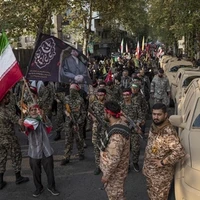
The commander of the Revolutionary Guards' Quds Force, Ismael Qa'ani, pays tribute to slain Hamas commander Yahya Sinwar at the Palestinian group's office in Tehran, Iran, October 2024
While top officials in Tehran remain silent on the Gaza–Israel peace deal, Iranians across the political spectrum have flooded social media, some hailing Hamas’s “victory” while others condemned Iran’s costly involvement.
The Iranian Foreign Ministry on Thursday reaffirmed its support for ending what it called the “genocide in Gaza,” urging the withdrawal of Israeli forces, unhindered humanitarian access and the realization of Palestinian rights.
The statement also called for “global vigilance against Israel’s actions,” stressing that ending the war does not absolve the international community of its duty to “pursue justice and prosecute those responsible for war crimes and crimes against humanity in Gaza.”
Hardline media its their supporters have largely portrayed the peace deal as a triumph for Hamas and Iran’s armed allies in the region.
‘The Resistance has won’
“The myth of Israel’s deterrence has been shattered,” conservative journalist Mehran Karimi wrote on X. “Despite its crimes, the enemy has been forced to accept the Resistance Front’s conditions, and Palestine has become the world’s foremost issue.”
Another user, Mahmod Sakavandi, argued that the agreement was a sign of the Palestinians’ upper hand. “Israel was forced to sit at the table, he wrote, “and every time the enemy negotiates out of weakness, the resistance has won.”
Others, however, see Hamas’s actions as reckless and catastrophic.
“Gaza has been destroyed; over 70,000 people killed, hundreds of thousands injured or disabled, and a million displaced,” activist M. Yousefinejad posted on X. “Was Hamas’s move on October 7 rational?”
‘Ungrateful’
Some also criticized Hamas for failing to acknowledge Tehran’s support in its post-agreement statement.
“Iran bore the greatest cost for Palestine and Gaza,” financial consultant Mohammad-Hossein lamented on X. “Hamas in its statement thanked Egypt, Turkey, Qatar and even Trump—but not Iran. Why did we involve ourselves with these vile ingrates?”
A different camp drew lessons from Hamas’s shift toward negotiation.
“If Trump’s Gaza peace deal is being called a victory for the Resistance, then our government too should reach a direct deal with the United States and bring such a victory to the Iranian people,” reformist journalist Amir-Hossein Mosalla wrote on X.
Blaming Khamenei
A user going by the name Mohammad-Hossein commented that “the courage required for peace is greater than the bravery needed for war.”
“But fools turn the likes of Yahya Sinwar and Saeed Jalili into heroes, and the likes of Khalil al-Hayya and Mohammad-Javad Zarif into traitors,” he added.
A growing number of users placed responsibility for Gaza’s devastation—and the region’s broader instability—on Supreme Leader Ali Khamenei.
One wrote: “Hamas accepted Trump’s peace plan. What remains is Khamenei’s utter humiliation for his direct and indirect support of the October 7 operation, which led to death, displacement, and suffering for thousands.”
Another, identifying as Saman, went further: “As long as the Islamic Republic exists and Ali Khamenei is alive, there will be no peace—not in Gaza, not in Yemen, not in Syria.”
Hardline lawmakers in Iran have once again turned to impeachment, targeting four ministers in President Masoud Pezeshkian’s cabinet, in what critics say is a bid to stall the government rather than to offer alternatives.
On Thursday, Ahmad Bigdeli, a member of parliament from Khodabandeh, told Khabar Online that hardliners had tabled motions against Energy Minister Abbas Aliabadi, Roads and Urban Planning Minister Farzaneh Sadegh, Agriculture Minister Gholamreza Nouri and Labor Minister Ahmad Maydari.
Bigdeli called the move “untimely and most probably ineffective and symbolic,” echoing the outcome of the only successful impeachment to date during Pezeshkian's term: that of Economy Minister Abdolnasser Hemmati in March.
The move against Hemmati was widely viewed as pointless, as he was replaced by Ali Madanizadeh, whose economic policies closely mirror his predecessor’s.
‘Destabilizing’
Over the past year, hardliners have made their presence felt in scattered episodes—from the ousting of Vice President Mohammad Javad Zarif to parliamentary scuffles over leadership—but have repeatedly disappointed their grassroots by settling for short-term wins.
Lacking both strategy and leadership, they now appear more intent on limiting Pezeshkian’s room to maneuver than on offering alternatives.
“Hardliners are using impeachment as a tool to pressure the Pezeshkian administration,” moderate journalist and politician Mohammad Sadegh Javadihesar said. “Such moves destabilize the government while the country is at war.”
Moderate political activist Ali Bagheri added a warning: “Impeaching four or five ministers will break the government’s back,” he told the moderate daily Etemad. “When the administration is destabilized, even local officials in small towns cannot fulfill their responsibilities.”
Even some conservatives distanced themselves from the move against the executive.
“Radical MPs are targeting the administration for political gain,” conservative MP Jalal Rashidi Kochi said. “There’s no doubt some ministers are unfit for their roles, but I wish Pezeshkian would take the initiative to replace them.”
‘Costly for people’
The episode underscored how hardliners appear to lack a coherent plan of their own.
The renewed brinkmanship also reflects a deeper struggle within the conservative camp, which has failed to reclaim dominance since the death of hardline president Ebrahim Raisi in a helicopter crash last year.
Its cohesion further eroded after the death of ultraconservative cleric Mohammad Taghi Mesbah Yazdi, founder of the influential Paydari Party.
His would-be successor, former nuclear negotiator Saeed Jalili, largely avoids the spotlight, leaving the faction without a unifying figure.
“Hardliners thought Raisi’s administration would last forever and keep them in power,” moderate journalist Hamidreza Jalaipour told Khabar Online.
Condemning their rhetoric—including threats to exit the nuclear non-proliferation treaty and shut down the Strait of Hormuz—he said: “They are victims of their own illusions, for which the country pays a high price.”
US President Donald Trump on Thursday said Iranian authorities had been in contact to express their desire to pursue peace and to strongly back a deal he reached aimed at winding down the war in Gaza.
Speaking at a cabinet meeting in the White House, Trump said he hoped a resolution to the lingering impasse over Iran's nuclear program could unleash support for Iran to rebuild after US-Israeli attacks in June but Iran could not gain nuclear arms.
"I think the attack was very important on Iran, because let's say that didn't happen, they'd probably, by now, have a nuclear weapon, numerous nuclear weapons, and therefore, even if we signed a deal, there'd be a big dark cloud over it, and it wouldn't be the same thing."
US planes and submarine-launched missiles attacked three key Iranian nuclear sites on June 22, capping off a surprise Israeli military campaign against the Islamic Republic which battered its arch-foe. Trump imposed a ceasefire two days later.
"So Iran is different, but Iran wants to work on peace now they've informed us, and they acknowledge that they are totally in favor of this deal. They think it's a great thing. So we appreciate that, and we'll work with Iran," Trump added.
"As you know, we have major sanctions on Iran and lots of other things. Who would like to see them be able to rebuild their country too, but they can't have a nuclear weapon."
'Palestinians' fundamental rights'
Iran has been more measured in its public response, voicing general support in a statement on Thursday for a resolution to the two-year-old conflict in Gaza.
"The Islamic Republic of Iran has always supported any initiative that entails ending the genocidal war, the withdrawal of occupying forces, the entry of humanitarian aid, the release of Palestinian prisoners and the realization of the fundamental rights of the Palestinian people," the foreign ministry said.
A standoff over Iran's nuclear activities continues even after Trump has repeatedly asserted the June attacks "obliterated" the program.
Iran's foreign minister Abbas Araghchi said this week that several rounds of indirect talks with US special envoy Steve Witkoff brought a deal within reach in late May, but that Iran would not relinquish what it sees as its right to enrich uranium.
"There is NO solution but a negotiated outcome,” he wrote on X.
Iran's foreign ministry on Thursday appeared to back a preliminary deal to end the two-year-old war in Gaza clinched by US President Donald Trump, saying Tehran has long supported any agreement to end the fighting and secure Palestinian rights.
"The Islamic Republic of Iran has always supported any initiative that entails ending the genocidal war, the withdrawal of occupying forces, the entry of humanitarian aid, the release of Palestinian prisoners and the realization of the fundamental rights of the Palestinian people," the ministry said.
"The Ministry of Foreign Affairs reiterates that stopping the crimes and genocide in Gaza does not absolve governments and competent international bodies of their shared legal, humanitarian and moral duty to pursue justice by identifying and prosecuting the perpetrators and commanders responsible for war crimes, genocide and crimes against humanity in the Gaza Strip with the aim of ending the decades-long impunity of the Zionist regime."
Tehran has backed long backed Palestinian Hamas and Islamic Jihad militants who sparked the latest round of fighting with a surprise attack on Israel on Oct. 7, 2023 which killed 1,200 and captured 251.
An Israeli ground incursion and air attacks have killed over 67,000 Palestinians and devastated the coastal enclave.
The combat ignited a region-wide conflagration pitting Israel backed by the United States against Iran and its armed allies in the region, but Tehran and its affiliates took heavy blows.
The Assad dynasty which was Tehran's oldest ally was overthrown by Sunni Islamist militants, Hezbollah in Lebanon was battered by a coordinated Israeli attack via booby-trapped communication devices while its leader Hassan Nasrallah was assassinated in a bomb attack and Iran itself was pounded in a June war.
Launched by Israel on June 13 after two months of US-Iran nuclear talks appeared to stall, the shock military campaign killed Iranian nuclear scientists along with hundreds on Iranian military personnel and civilians.
Iran retaliated with ballistic missiles and drones which killed 31 Israeli civilians and an off-duty soldier.
The United States joined the campaign with air attacks on three key nuclear facilities at Fordow, Natanz and Isfahan which Trump said had "obliterated" Iran's nuclear program.
An impasse over Iran's nuclear activities, which Tehran insists are peaceful, lingers.
Israeli officials have repeatedly mooted the possibility of renewed strikes on the Islamic Republic, which has asserted its readiness to confront any attack.
President Donald Trump said US attacks on Iran nuclear sites in June had paved the way for a deal agreed by Hamas and Israel to wind down the war in Gaza and expressed hope Tehran would join a Mideast peace.
"Iran was about one month, maybe two months, away from having a nuclear weapon. And if I allowed that to happen, this deal would not have been possible," Trump told Fox News in a phone interview on Wednesday evening.
"It's a very much different Iran. And frankly, we've had some very good conversations. And as you saw, they blessed the deal. They put out a few hours ago a statement that they agree with the deal, and they blessed the deal," he added, without elaborating. "That's a tremendous thing."
Tehran had not published any official reaction to the announcement by the United States, Hamas and Israel that the parties had agreed to the release of hostages held in Gaza in exchange for a partial pullback of Israeli forces and the freeing of Palestinian political prisoners.
US planes and submarine-launched missiles attacked three key Iranian nuclear sites on June 22, capping off a surprise Israeli military campaign against the Islamic Republic which battered its arch-foe.
Tehran denies seeking a nuclear weapon, called the attacks illegal and has vowed to resist what it calls Israeli aggression. Still, officials have long said they would support any peace deal agreed by Palestinians.
Iran has backed Palestinian militants and armed affiliates throughout the Middle East it calls a "Resistance Axis" opposed to Israel and the United States.
"I believe if they had a nuclear weapon, there would be a whole different even if we made the deal, it would have, literally, a very dark cloud over it because of what could potentially happen," Trump added.
"And by the way, I believe Iran is going to be actually a part of the whole peace situation," he added.
An Iranian lawmaker said Iran-aligned armed groups remain active against Israel and the United States despite the new ceasefire in Gaza, Iranian media reported on Thursday. Iran has otherwise largely remained silent on the new Gaza ceasefire.
“Groups in the resistance front are today stronger and more active than two years ago against America and Israel,” Behnam Saeedi, secretary of parliament’s national security commission, told Didban Iran, referring to militias backed by Tehran in Lebanon, Yemen, Iraq and Gaza.
Saeedi dismissed US President Donald Trump’s peace initiative as unreliable. “Any plan that takes sovereignty away from the Palestinian people is doomed to fail,” he said.
Israel and Hamas reached an agreement on a ceasefire after two years of war in Gaza, with terms set out in a 20-point US proposal presented by Trump and backed by Egypt, Qatar and Turkey. The plan would see the release of Israeli hostages held in Gaza, the freeing of Palestinian prisoners, the withdrawal of Israeli troops from parts of the enclave, and the entry of aid.
Israel’s government is meeting later Thursday to vote on the deal, which is widely expected to pass. If approved, a truce will go into immediate effect and the release of hostages is due to begin within days. Families of hostages in Israel and residents in Gaza have already staged celebrations at the news.
While regional leaders from Egypt to Qatar hailed the breakthrough, Iranian state officials and media have so far shown little reaction to the Gaza agreement.
Iran’s only public comment came from government spokeswoman Fatemeh Mohajerani, who said Tuesday Tehran would support any lasting peace that benefits Palestinians. Trump said Iran had sent “a very strong signal” it wanted to see progress toward an agreement.