Tehran stock market sees record capital flight amid post-war uncertainty
Tehran Stock Exchange
Iranian investors withdrew over 132 trillion rials—nearly $145 million—from Tehran’s stock market on Wednesday alone, marking a historic record amid deepening mistrust following the recent conflict with Israel.
The selloff came as the Tehran Stock Exchange plunged for a fourth consecutive trading day after the ceasefire. The main index dropped by 57,000 points to 2.73 million.
On Tuesday, individual investors pulled out 64.78 trillion rials—around $71 million—in a single trading day, according to Iranian media.
That followed a deep-in-red opening on Saturday, the first trading day after the 12-day war, when 99% of listed stocks declined and the market lost 62,503 points.
The panic coincided with a cyberattack on Sepah and Pasargad banks that further fueled public distrust in the financial system.
In the days following, large sums were moved abroad through exchange shops. To stem the outflow, multiple exchanges experienced technical disruptions beginning Monday, Iran International previously reported.
During the war, currency and gold markets were largely inactive, but they resumed trading this week with both the US dollar and gold prices climbing.
The Tehran bourse has historically been sensitive to geopolitical stress, but recent market behavior suggests a deeper crisis of confidence—compounded by economic mismanagement, financial sector instability, and the Islamic Republic’s response to external shocks.
IAEA inspectors were still on the ground in Iran as of Wednesday and had not been instructed to leave, a diplomat familiar with the agency’s operations told the Associated Press, after Tehran enacted a law suspending cooperation with the UN nuclear watchdog.
The IAEA said it was awaiting formal clarification from Iranian authorities on what the suspension will mean in practice.
“We are aware of these reports. The IAEA is awaiting further official information from Iran,” the UN nuclear watchdog said in a statement.
On Wednesday, Iranian state media announced that President Masoud Pezeshkian had enacted the law, following its approval by parliament and the Guardian Council.
The law mandates a halt to cooperation under the safeguards agreement tied to the Nuclear Non-Proliferation Treaty (NPT), unless Iran’s demands—such as security assurances for its nuclear sites and scientists—are met.
The move follows a sharp escalation in Iranian criticism of the IAEA, particularly after a resolution passed by the agency’s Board of Governors was cited by Tehran as paving the way for Israeli and US strikes on its nuclear sites last month.
Iranian newspaper calls for arrest and execution of IAEA chief
Iran’s hardline newspaper Kayhan, overseen by Iran's Supreme Leader Ali Khamenei, published an editorial last week accusing IAEA Director General Rafael Grossi of working as an Israeli agent. The paper said Grossi should be arrested and executed if he enters Iran.
The comments triggered swift condemnation from France, Germany, and the United Kingdom. “We condemn threats against the Director General of the IAEA, Rafael Grossi,” the three governments said in a joint statement on Monday. They reaffirmed their full support for the agency and its mandate.
Judiciary signals possible in absentia prosecution of Grossi
On Wednesday, a senior Iranian judicial official suggested Grossi could face trial in absentia for his alleged role in facilitating the attacks. Deputy judiciary chief Ali Mozaffari said the case was under review by the judiciary’s international affairs office and that legal teams were compiling evidence to seek damages.
He accused the IAEA chief of “deceptive actions and falsified reports” that, in Tehran’s view, laid the groundwork for foreign aggression.
Officials press IAEA to condemn strikes
Iranian officials have also criticized the IAEA for failing to condemn the attacks on Iran’s nuclear facilities. Foreign Ministry spokesman Esmail Baghaei told the Hindustan Times over the weekend that Tehran had expected a clear denunciation from the IAEA leadership and Board of Governors.
“We are not hostile to any person at the international organizations, IAEA being one of them,” Baghaei said. “The point is that, yes, we are outraged—our people are really unhappy and angry about the IAEA’s position.”
He accused Grossi of including “concepts” in his latest report that allowed Western nations to push through the resolution. Although Grossi told CNN there was no evidence of an Iranian weapons program, Tehran claims the report provided cover for the subsequent attacks.
Atomic Energy Organization head Mohammad Eslami echoed the criticism Wednesday, saying the strikes would not deter Iran’s nuclear development. “The nuclear industry cannot be destroyed by bombing,” he said. “The path forward is open.”
Iran's Islamic Revolutionary Guards Corps (IRGC) says it has killed or detained 52 people in southeastern Iran, describing the targets as Israel-linked terrorist elements.
“Five individuals mainly foreign nationals involved in drone sabotage operations remain at large,” the statement said, adding that the accused were working with Israeli intelligence services.
There was no mention of the numbers of killed or arrested, nor names or details of the operations.
It followed reports on Tuesday by state-linked Tasnim news agency which said two were killed and 50 arrested in operations over the past fortnight in Sistan-Baluchestan province.
“The operation targeted elements affiliated with terrorist groups in the east, aiming to spread insecurity and conduct sabotage against key infrastructure and economic assets,” the Quds Base said.
The announcements come amid an intense crackdown which has taken place across Iran since the outbreak of war between the Islamic Republic and Israel, which has seen over 700 people arrested on allegations of working with Israel.
The southeastern province, notorious for having been especially restive since the 2022 Zahedan massacre, has again been the focus of the latest crackdowns.
According to the Halvash website, security forces stormed the village of Gunich in Khash County on Tuesday, firing at protesting residents.
One woman, identified as Khan-Bibi Bameri, was killed. Eleven other women, including four under the age of 18, were seriously wounded. Two of the injured remain in critical condition in intensive care at Khomeini Hospital in Khash, the report said.
Another woman named Reyhaneh Bameri, who was pregnant, lost her fetus after being kicked and shot with pellets by agents, Halvash reported.
“Security personnel opened fire without warning on villagers protesting their conduct,” the rights group said in a statement.
“This crime occurred despite the absence of any men in the village," they added, citing eyewitnesses.
The mayor of Tehran has proposed to pay up to 80 million rials ($88) per square meter for the repair of homes damaged in the recent Israeli attacks in the capital, less than one tenth of the market value.
“It has been proposed to allocate up to eight million tomans per square meter for repairs. Priority will be given to homes that can be repaired so that people can return to normal life as quickly as possible,” Tehran mayor Alireza Zakani said Wednesday.
According to local real estate data, the average price per square meter of housing in Tehran is roughly $1,000, making the government’s proposed compensation less than one-tenth of what would be needed to rebuild homes to market standards in Iran's capital.
Around 3,500 housing units in Tehran were damaged in the Israeli strikes, the Ministry of Roads and Urban Development said Saturday, adding a new layer of financial burden for the population already in the midst of a dire financial crisis.
Zakani did not address compensation plans for affected residents outside Tehran.
No official has yet outlined how damages will be redressed in other cities, even as reports of widespread destruction continue to emerge as the internet blackout imposed during the war, begins to ease.
By contrast, Hezbollah’s secretary-general Naim Qassem said last year that the Islamic Republic paid between $12,000 and $14,000 to each Lebanese family whose home was destroyed in Israeli airstrikes on southern Beirut and elsewhere.
The payments included an initial $300–400 in cash, followed by larger sums for rent and household goods.
"We thank the Islamic Republic of Iran, led by Imam Khamenei, the state, the people, and the blessed Islamic Revolutionary Guard Corps for providing this generous support in the displacement process," Qassem said in a speech in December.
Around $50 million, he said, had been disbursed to 233,500 registered displaced families, and projected the figure could reach $77 million. These transfers, he clarified, were in addition to Iran’s broader military and financial support for Hezbollah.
Despite those payouts, the newspaper Asharq Al-Awsat recently reported that Hezbollah has paused compensation payments in the Dahieh district of Beirut due to funding shortages.
The Islamic Republic has a long history of financing Hezbollah’s reconstruction projects, including after the 2006 war, often drawing criticism for favoring regional allies over its own citizens.
Iran may try IAEA Director General Rafael Grossi in absentia over his alleged role in enabling attacks on the country’s nuclear facilities, a senior judiciary official said on Wednesday, according to state media.
Ali Mozaffari, deputy head of Iran’s judiciary, said the matter would be examined by the judiciary’s international affairs office.
He accused Grossi of “deceptive actions and falsified reports” that, in Iran’s view, helped pave the way for recent strikes on nuclear facilities. Judicial bodies are compiling evidence related to what Iran describes as foreign aggression and may seek redress, Mozaffari added.
His comments follow a wave of criticism directed at the International Atomic Energy Agency from Iranian officials and media. A hardline Iranian newspaper called for Grossi’s arrest and execution, accusing him of acting as an Israeli agent.
Britain, France and Germany condemned those threats on Monday and expressed full support for Grossi and the IAEA in fulfilling its mandate.
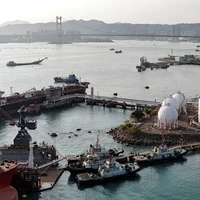
Iran loaded naval mines onto vessels in the Persian Gulf last month, intensifying concerns in Washington that Tehran was preparing to close the Strait of Hormuz, two sources briefed on classified intelligence told Reuters on Tuesday.
“The loading of the mines... suggests that Tehran may have been serious about closing one of the world’s busiest shipping lanes,” the officials told Reuters, speaking on condition of anonymity.
Reuters also reported that Iran’s military “could have also simply been making necessary preparations in the event that Iran’s leaders gave the order.”
The activity was detected after Israel launched missile strikes on Iranian territory on June 13, the officials said.
The Strait of Hormuz is a strategically vital waterway bordered by Iran, the United Arab Emirates, and Oman. Roughly one-fifth of the world’s oil and gas trade passes through the route.
Iran’s parliament approved a measure to close the strait last month following US airstrikes, state media reported. The measure was not binding, and the final decision rests with Iran’s Supreme National Security Council, the country’s highest security authority, a lawmaker said last month.
Iran has long threatened to shut the strait but has never followed through. A closure would likely disrupt global energy markets and risk triggering a broader conflict.
A White House official said the waterway remains open and credited President Trump’s military operations, pressure campaign, and efforts to restore maritime security.