Kremlin warns US use of tactical nuclear weapons in Iran would be catastrophic
The potential use of tactical nuclear weapons by the United States in Iran would be a catastrophic development, the Kremlin said, according to a report by Russia’s TASS news agency.
The Israeli military said on Friday it struck dozens of military and industrial targets in and around Tehran overnight, including the headquarters of SPND, Iran’s organization for nuclear weapons research and development.
Over 60 Israeli Air Force fighter jets carried out the strikes, guided by precise intelligence, and dropped around 120 munitions, the military said. The targets included missile manufacturing sites, facilities producing raw materials for missile engines, and key installations tied to Iran’s nuclear weapons program.
Among the sites targeted was the SPND building, established in 2011 by Mohsen Fakhrizadeh, regarded as the founder of Iran’s nuclear weapons project.
Tasnim News Agency, affiliated with Iran’s Islamic Revolutionary Guard Corps, reported earlier that SPND was among the sites hit in the initial wave of Israeli strikes on June 15.
Israel’s airstrike on Iran’s state broadcaster IRIB may raise legal questions for scholars of war, but for many Iranians, it felt like a long-overdue punch to the face of the Islamic Republic.
IRIB is seen by many not just as biased, but as a tool of repression—tied to psychological coercion, disinformation, and forced confessions.
“I’m filled with bizarre emotions about the destruction of IRIB,” wrote former political prisoner Nazila Maroofian on X.
She recalled being taken from Evin Prison, at 22, to IRIB’s headquarters and forced to record a confession.
“They sat me in front of the camera. ‘Say you were paid by Israel’—cut. ‘Say you were paid by the US’—cut. ‘Say you were instigated and now regret it’—cut,” she wrote.“But the video wasn’t aired because I was weeping the entire time.”
Programs like the 8:30 Special News Bulletin regularly air such confessions. The show has featured jailed activists, protesters, and even foreign nationals like French citizens Cecile Kohler and Jacques Paris.
In some cases, families of protesters killed by security forces were pressured to claim their loved ones died by suicide or illness.
The program’s producers, Ameneh Sadat Zabihpour and Ali Rezvani, were sanctioned by the United States in 2023 for working with intelligence agencies to stage confessions.
‘A dream came true’
“The strike was what all of us fantasized to bring upon this brutal, lie-ridden organization,” a user with the handle @_Alone_Crony posted on X. “I’m glad our dream came true.”
“A number of IRIB employees have sadly lost their lives due to underlying health conditions, falls from heights, and suicides caused by mental health issues,” another user, @ayazi_kamran, wrote, mocking state denials of violence.
Still, some warned of the precedent.
“I believe the state radio and television are damaging to the country. But that’s one thing—and Israel’s attack on the organization is another,” journalist Ehsan Bodaghi posted.“Today they say it was a military-linked media site; tomorrow they’ll use the same logic for hospitals, schools, sports clubs. Exactly like Gaza.”
A journalist preparing dissident Ruhollah Zam for "confessions" to be aired by IRIB days before his execution
A broadcast interrupted
The strike came about an hour after Israel’s defense ministry posted a warning on X, urging residents of Tehran’s upscale District 3 to evacuate. Israel’s military said the target was a facility used “to advance military operations under civilian activity.”
Among the most dramatic moments was the live broadcast by anchor Sahar Emami, reading a statement just as the building was struck.“What you heard,” she improvised, “is the sound of the aggressor [attacking], the sound of the aggressor that has attacked the truth.”Her delivery as dust filled the studio made her an instant hero for the government and its supporters—who called her a “lioness.”
Moments later, she had to flee live on air. The clip went viral—almost instantly iconic—and triggered a wave of mostly celebratory reactions online.
Echoes and aftermath
“I’m delighted because the IRIB was not the people's voice. It was the voice of those who rule,” said one viewer in a recorded message sent to Iran International within hours of the attack.
“Maybe now, with their propaganda apparatus and abominable voice silenced, they’ll feel the pain we felt—those of us with no voice and nowhere to be heard.”
“The IRIB is loathed by all Iranians except for a small percentage,” a user named Fatemeh Vallinia posted on X. “People would rejoice no matter who targeted it—whether it was a bolt from the sky or a strike from this usurping attacker!”
Despite the damage, literal and figurative, the state’s propaganda machine remains intact.
The day after the strike, state and IRGC-affiliated media aired a video of an alleged Mossad agent arrested in Alborz Province. The man claimed he had trained for ten years and built explosives in his workshop before being captured.
“Iran has the right to defend itself, and the peoples of the region and the free people of the world have the right to stand with the great leader and with Iran in one trench.” Hezbollah leader Sheikh Qassem said in a statement on Thursday.
"We in Hezbollah and the Islamic Resistance are not neutral between Iran's legitimate rights and independence and the falsehood of America and its aggression, and with it the cancerous tumor of Israel and the arrogant powers."
Iran-backed Hezbollah has stayed out of the clash between its patron Iran and nemesis Israel after a conflict with the Jewish State last year left the group battered and its charismatic leader Hassan Nasrallah dead.
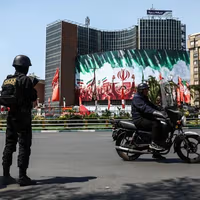
Street placards depicting slain senior military commanders and a public funeral mourning personnel killed in air attacks marked the increasingly visible toll of an Israeli military campaign.