Supreme Leader Ali Khamenei has established a special team to determine the Islamic Republic’s nuclear negotiation policies with the United States, a senior Iranian lawmaker said Sunday.
Esmaeil Kowsari, a member of parliament’s national security and foreign policy committee, said the foreign ministry’s delegation must consult with this team before each round of talks.
“They seek views and head into negotiations within a defined framework,” the former Revolutionary Guards general said.
He added that negotiators are also required to deliver a detailed report to Khamenei’s team upon returning from each round.


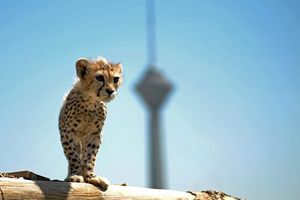
Iranian wildlife authorities are continuing of a round-the-clock search for a missing brown bear cub that escaped from a wildlife clinic in Tehran’s Pardisan Park last week, officials said on Sunday.
Gholamreza Ebdali, director general of the Wildlife Conservation Office at Iran’s Department of Environment, said the three-month-old cub has been spotted at multiple locations within the 225-hectare park, but has not yet been captured.
“We are certain the cub is alive. We’ve seen tracks in three or four places inside the park,” Ebdalitold IRNA, Iran’s state news agency, ruling out speculation he had been stolen.
“But because it is small and the park is full of trees and undergrowth, it can easily hide.”
The bear cub, weighing around three kilograms, went missing in the early hours of Thursday, May 29, after reportedly escaping during a routine procedure involving other rescued animals recently brought to the park’s clinic.
Thermal night vision cameras and live traps have been deployed in the search, but the presence of other animals, such as stray cats, has complicated efforts. “Despite the use of night vision and heat-sensing cameras, we haven’t had success yet,” he said.
Authorities believe the cub is surviving by feeding on seasonal fruits in the park, such as mulberries and apricots. “It’s no longer dependent on milk and can feed on available fruits, so we are not worried about its nutrition,” Ebdali added.
The missing bear is one of two cubs found last month in the southern province of Fars. Their mother had been killed by a poacher and her body was discovered in the Abraj region of Marvdasht.
The orphaned cubs were transferred to the Pardisan wildlife clinic late in May for rehabilitation and eventual release back into the wild.
Following the escape, park access was temporarily restricted during early search operations, but has since reopened to the public.
Environmental officials say the search will continue until the cub is safely recovered.

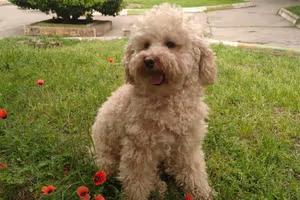
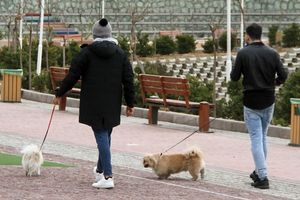
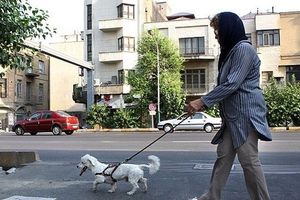
Authorities in the Iranian city of Isfahan have banned all forms of dog walking in public, marking a new escalation in the Islamic Republic’s campaign against dog ownership.
Mohammad Mousavian, Isfahan’s public and revolutionary prosecutor, announced the sweeping ban on Saturday, saying: “Dog walking is a violation of public rights and a threat to the health, comfort, and peace of citizens.”
“Any form of dog walking in the city — whether in parks, public spaces, or vehicles — is prohibited and will be dealt with seriously.”
Mousavian ordered law enforcement to impound vehicles carrying dogs and to shut down shops and unauthorized veterinary clinics related to pet care.
“This is in response to serious public demands,” he said, directing the police and cybercrime units to take down social media accounts advertising the sale of dogs and prosecute their owners.
The crackdown reflects a broader trend across Iran, where the clerical establishment has increasingly targeted dog ownership as a sign of Western influence.
While keeping working dogs in rural areas has long been accepted, urban pet ownership is a more recent phenomenon.
Parliamentarians previously proposed a bill to ban the sale and ownership of dogs as pets, citing public health — a move that included possible jail time and hefty fines. Though the bill was never passed, enforcement has continued through municipal orders and police action.
Pet owners in Tehran have reported fines, harassment, and even eviction threats. The Islamic Republic has no clear regulations governing dog ownership, which leaves citizens vulnerable to arbitrary enforcement and ongoing legal uncertainty.
The Islamic Penal Code, particularly Article 688, reinforces this prohibition by penalizing actions deemed threatening to public health, citing potential health risks associated with the possession of dogs. Violations may result in legal consequences, as neighbors have the ability to file complaints against such practices.
A member of Iran’s parliamentary foreign policy committee said a temporary nuclear agreement could be reached if the United States moderates its position in the talks.
“If the Americans show some retreat in their stance, there is a possibility of reaching a temporary understanding,” said Vahid Ahmadi in an interview with ISNA published Sunday.
He added that negotiations remain limited to Iran’s nuclear program and sanctions relief, but sharp disagreement continues over demands for zero enrichment.
“There is no way we will accept shutting down enrichment,” he said, adding that Iran insists on benefiting from all peaceful applications of nuclear technology.

A conservative Iranian daily warned Sunday that any military strike or use of the JCPOA snapback mechanism by the West would alter Iran’s defense posture.
The Khorasan paper wrote Iran “can produce 10 atomic bombs” and possesses intercontinental ballistic missiles.
“If the snapback mechanism is activated, it means all of Iran’s cooperation with the IAEA has yielded nothing,” the editorial added. “And if the US or Israel attacks, conventional weapons will no longer suffice for the survival and security of the Islamic Republic.”
The paper urged Western powers to approach Iran “with respect and on equal footing.”
Iran will take action against any "improper initiative" by European states, said Iranian Foreign Minister Abbas Araghchi in a phone call with IAEA Director General Rafael Grossi on Saturday.
The call followed the agency’s latest report on Iran and came ahead of the IAEA Board of Governors meeting.
Araghchi said all of Iran’s nuclear activities remain under IAEA monitoring with no deviation, and urged Grossi to “reflect the realities in a way that prevents certain parties from misusing the Agency to advance their political aims.” He warned that responsibility for consequences will lie with those parties.