Abdoljalil Eiri, a member of Iran’s parliament and part of the investigative team dispatched to Rajaei port, warned that “there are concerns about the possibility of similar incidents in other ports across the country,” following last week's deadly explosion in Bandar Abbas.
The MP said the fire at the country’s largest container port was made worse by malfunctioning emergency systems. “The fire hydrants did not work properly in the first minutes of the incident, and this prevented the blaze from being contained in time,” Eiri said.
He cited “management and infrastructure weaknesses, especially in firefighting equipment,” as playing a major role in the disaster and said those failings are being examined in a report to be read in parliament.
He emphasized that a full and documented investigation is still underway: “Until detailed and documented reports are provided, we cannot definitively judge the causes of the incident.”
Iraqi Prime Minister Mohammed Shia al-Sudani said his country supports the ongoing negotiations between Iran and the United States over Tehran's nuclear program, and emphasized Iraq's balanced ties with both nations.
"Iraq has good relations with both Iran and the United States," Sudani said in an interview with US broadcaster Tim Constantine.
He also said Baghdad was not just a host of the upcoming Arab League summit but would act as a proactive player in seeking solutions for regional crises.

A senior Islamic Revolutionary Guard Corps (IRGC) official said Iran’s missile technology continues to advance without interruption, despite Western support for Israel.
“The development of Iran’s missile technology is progressing without pause,” said Brigadier General Ali Balali, senior adviser to the commander of the IRGC Aerospace Force, according to state media.
Balali also said that Western military support for Israel “failed to block the success of Iran’s missile operations,” in an apparent reference to Tehran’s missile attacks on Israeli territory last year.
Speaking to students in northeast Iran, Balali said the country remains committed to strengthening both its missile and space programs through domestic knowledge.

A manager at Sina Marine and Port Services said the company bears no blame for the deadly explosion at Iran’s Shahid Rajaei port last week, which killed at least 70 people and injured hundreds more.
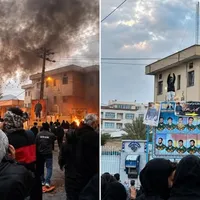
“It was a terrible incident, but our company had no responsibility,” the HR manager told mourners at a funeral for one of the victims, according to footage published by Iranian media. “In our section, 25 were injured, 10 confirmed dead, and six are still missing.”
The manager added that three employees — two women and a man with three children — were among the dead or missing. “We were right next to the blast point. All we saw was rubble and bloodied faces,” he said.
“Many companies were present at the site,” he added, declining to speculate on the cause. “It must be examined by experts.”
The April 26 blast at Bandar Abbas’s Shahid Rajaei port destroyed the Sina yard, a large container terminal operated by Sina Marine, a subsidiary of the US-sanctioned Mostazafan Foundation, which is overseen by Iran’s Supreme Leader and has close ties to the IRGC.

The administration of Iranian President Masoud Pezeshkian is preparing to disqualify wealthier citizens from the country’s long-running cash handout program to save government funds as economic headwinds mount.
The program has persisted, with various reforms, for 15 years despite being blamed for distorting the economy and stoking inflation.
Now, Pezeshkian’s government is poised to introduce its own changes to ease the strain on a budget hollowed out by years of sanctions and economic mismanagement.
The proposed exclusion of wealthier households signals a shift towards a more needs-based support system as Iran grapples with persistent economic challenges.
About 30 percent of Iranians live below the poverty line. By removing roughly 18 million recipients from the program, the government aims to reduce fiscal pressure and redirect funds toward low- and middle-income families hardest hit by years of 30-40 percent annual inflation.
In the current fiscal year Pezeshkian’s government has allocated 3,240 trillion rials or about $4 billion at the current open market exchange rate, for cash subsidies.
The figure is separate from the extensive indirect subsidies provided to keep prices of fuel, electricity, water, essential foods, and medicine low.
Since the introduction of the latest subsidy reforms by former president Ebrahim Raisi's administration in May 2022, the rial has devalued by around 185 percent, from 280,000 to approximately 800,000 rials per US dollar as of April 27, 2025.
Consequently, the real value of monthly cash payments has fallen dramatically, now worth just about $3.74 to $5 per person for target groups.
Origins of Iran's cash subsidy program
The cash subsidy system began in 2010 under the populist government of Mahmoud Ahmadinejad, building on a controversial proposal made by his reformist opponent Mehdi Karroubi during the disputed 2009 presidential election.
Karroubi had promised a universal cash payment of 500,000 rials (around $50 at the open market exchange rates at the time) per person without a clear funding plan, drawing sharp criticism over its potential inflationary effects.
Ahmadinejad’s administration launched the Targeted Subsidy Reform Plan in late 2010, paying 450,500 rials (about $40) monthly to each citizen.
Funded by cuts to energy and utility subsidies, the program initially boosted Ahmadinejad’s popularity but quickly lost value as inflation and currency devaluation took hold. By August 2013, the real value of the handout had dropped to about $15 per person.
Rouhani’s response: the livelihood subsidy
Hassan Rouhani’s moderate administration (2013–2021) attempted several times to remove higher-income households from the universal program, but efforts faltered due to the absence of a transparent tax database.
As economic pressures mounted, the government introduced an additional "livelihood subsidy" in late 2019 after a sharp increase in fuel prices triggered widespread unrest.
This new subsidy targeted lower-income groups, offering payments based on household size to about 60 million Iranians.
Single-member households received 550,000 rials per month (just over $4 at the time), with smaller amounts paid per person to members of larger families.
Raisi’s changes: new tiers and e-vouchers
Facing deepening economic challenges, Ebrahim Raisi’s hardline government restructured the cash subsidy system in May 2022.
Monthly payments to the highest-income 10 percent of the population were eliminated, while remaining recipients were divided into two groups: the poorest 30 percent received 4 million rials (around $14) monthly, and the middle 60 percent received 3 million rials (about $11).
To further curb inflationary pressures, in February 2023 Raisi’s administration introduced a voluntary scheme allowing families to receive their subsidies as store credit instead of cash.
Participants could use their credits to purchase a list of 11 subsidized essential food items such as rice, cooking oil and dairy products from designated stores.
French Foreign Minister Jean-Noël Barrot said Thursday that France supports the US effort to negotiate a new nuclear agreement with Iran, but stressed it must be stronger than the original 2015 accord and cover more than just uranium enrichment.
“We are encouraging the discussion the US opened with Iran,” Barrot said at the Atlantic Council, calling diplomacy the only viable path. “There is no military solution to this issue.”
Barrot said France expects a “robust and protective” deal that includes limits on Iran’s ballistic missile program and regional activities, not just its nuclear work. “We have a clear idea of what might be a robust and protective deal for us,” he said.
He added that France and the US have coordinated closely on both “substance and timing,” and noted Paris had shared its proposals “for free — there’s no copyright.”
Barrot warned that if Iran violates its commitments and no credible deal is reached by summer, France “will not hesitate” to reimpose sanctions that were lifted under the original Joint Comprehensive Plan of Action (JCPOA).