Iran’s trade with East Asia crumbles under weight of sanctions
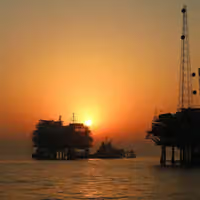
An Iranian tanker in the Persian Gulf - File photo
Iran’s commercial ties with East Asia have withered under the sustained pressure of US-led sanctions, pushing once-robust relations with countries like Japan and South Korea into near dormancy, according to a former senior Iranian diplomat.
Economic ties with Japan have collapsed despite the absence of political disputes, said Ali Majedi, Iran’s former ambassador to Germany, Japan, and Brazil.
“Europe still does some business with us,” Majedi said, but “But East Asia, outside of China, doesn’t work with us at all anymore.”
The former official said sanctions had affected trade not just with the West, but with Asian economies such as Japan, South Korea, and India, where commercial relations have reached a minimum.
“When I was in Tokyo in 2004, Japan was importing 750,000 barrels of oil per day and trade between us exceeded $10 billion,” Majedi added. “Now, even for items not under sanctions, trade is practically nonexistent.”
While China remains Iran’s last major oil customer in the region, Majedi said other East Asian nations have largely fallen in line with US restrictions. He added that smaller countries in the region still depend on American security guarantees and avoid Iranian trade out of fear of secondary sanctions.
Findings by Iran International show that while Iran’s oil sales to China dropped sharply last month, the decline in export revenues began months earlier, coinciding with US sanctions on dozens of tankers carrying Iranian crude.
The Biden administration imposed sanctions on dozens of tankers carrying Iranian oil after Iran’s missile attack on Israel in early October last year. While this initially led to a relative decline in Iranian oil offloading at Chinese ports, Beijing fearing potential US sanctions under Donald Trump's administration, prohibited sanctioned oil tankers from entering Shandong port.
Iran’s only oil customers are small, independent Chinese refineries, known as "teapots," most of which are based in Shandong, where 90% of Iranian oil cargoes is discharged.
Data from Kpler shows that Iran’s oil deliveries to China fell below 850,000 barrels per day in January, compared to over 1.8 million barrels per day in October last year.