• العربية
  • فارسی
Brand
  • Iran Insight
  • Politics
  • Economy
  • Analysis
  • Special Report
  • Opinion
  • Podcast
  • Iran Insight
  • Politics
  • Economy
  • Analysis
  • Special Report
  • Opinion
  • Podcast
  • Theme
  • Language
    • العربية
    • فارسی
  • Iran Insight
  • Politics
  • Economy
  • Analysis
  • Special Report
  • Opinion
  • Podcast
All rights reserved for Volant Media UK Limited
volant media logo

Ban on Iran Air hampers medicine imports, state carrier says

Mar 24, 2025, 08:10 GMT+0Updated: 20:08 GMT+0

Iran Air, the country's flag carrier, has reported significant losses and a severe impact on drug imports following the European Union and UK's flight ban, with the airline's CEO calling for international legal action to restore services.
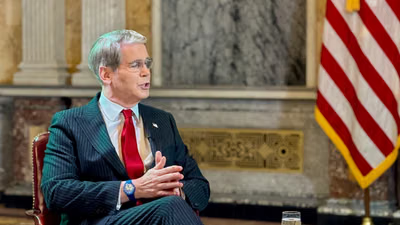
Hossain Khanlari, CEO of Iran Air (Homa), told ILNA news agency that the suspension of European flights has not only harmed the airline's revenue but also severely affected the supply of essential medicines to Iran amid an already dire health crisis.

EU sanctions have stopped all direct Iran Air flights to Europe. The flight bans impact passenger travel and trade, as Iran Air was the sole Iranian carrier serving Europe.

"Iran Air was a major carrier of pharmaceuticals from Europe, with two-thirds of the 12-ton cargo on each flight being medicine, primarily from Germany," Khanlari said.

The flight ban has disrupted this critical supply chain, creating hardships for patients in Iran. "We are pursuing legal avenues through international bodies to resume these flights, especially to address the current drug shortage," Khanlari stated.

Iran's healthcare system is under severe strain, grappling with critical medicine shortages and rapidly escalating costs with a huge flood of professionals fleeing the country for better opportunities abroad.

Government debt to pharmacies has crippled supply chains, while the plunging value of the Iranian rial has inflated the price of both imported and domestically produced drugs. A black market for essential medications has emerged, and some pharmaceutical companies have ceased production due to financial unviability.

The government's attempts to control drug prices and subsidize costs are failing to counteract the economic pressures, and rising healthcare expenses are driving more families into poverty.

In addition to the drug supply issue, Khanlari highlighted the ban's impact on Iranian citizens living in Europe, students, and academics who relied on Iran Air for travel.

"Many Iranians visited their families in Europe using our flights, and Iranians residing in Europe traveled back home with Iran Air. These individuals are now facing increased travel costs," he said.

To mitigate the financial losses from the European flight cancellations, Iran Air has increased its regional flights and added routes to East and South Asia. "While these new routes are profitable, they cannot fully compensate for the revenue lost from European flights," Khanlari explained.

Despite the new routes, Iran Air remains committed to resuming its European services. "We are eager to restart our European flights to serve our citizens," Khanlari said. "However, in the absence of European routes, we must focus on expanding our operations in Asia."

The European sanctions against Iran’s civil aviation industry announced in September are particularly significant, as Iran Air used to operate an average of 24 weekly flights each way to at least nine European cities, including Paris, London, Frankfurt, and Rome, according to information obtained by Aviacionline via Cirium.

In August, the United States sanctioned Iran Air after accusing Tehran of supplying Russia with short-range ballistic missiles. The US Treasury accused Iran Air of having transported goods "on behalf of Iran’s Islamic Revolutionary Guard Corps (IRGC) and Ministry of Defense and Armed Forces Logistics (MODAFL)."

Iran has been deeply involved in Russia’s war effort in Ukraine since mid-2022, providing drones, spare parts and training.

Most Viewed

Iran negotiators ordered to return after internal rift over Islamabad talks
1
EXCLUSIVE

Iran negotiators ordered to return after internal rift over Islamabad talks

2
ANALYSIS

US blockade enters murky phase as tankers spoof signals and buyers hesitate

3
ANALYSIS

Why the $100 billion Hormuz toll revenue is a myth

4

US tightens financial squeeze on Iran, warns banks over oil money flows

5
ANALYSIS

US blockade targets Iran oil boom amid regional disruption

Banner
Banner

Spotlight

  • Hardliners push Hormuz ‘red line’ as US blockade tests Iran’s leverage
    INSIGHT

    Hardliners push Hormuz ‘red line’ as US blockade tests Iran’s leverage

  • Ideology may be fading in Iran, but not in Kashmir's ‘Mini Iran'
    INSIGHT

    Ideology may be fading in Iran, but not in Kashmir's ‘Mini Iran'

  • War damage amounts to $3,000 per Iranian, with blockade set to add to losses
    INSIGHT

    War damage amounts to $3,000 per Iranian, with blockade set to add to losses

  • Why the $100 billion Hormuz toll revenue is a myth
    ANALYSIS

    Why the $100 billion Hormuz toll revenue is a myth

  • US blockade targets Iran oil boom amid regional disruption
    ANALYSIS

    US blockade targets Iran oil boom amid regional disruption

  • Iran's digital economy battered by prolonged blackout
    INSIGHT

    Iran's digital economy battered by prolonged blackout

•
•
•

More Stories

Israel arrests citizen over Iranian spy plot targeting nuclear, military facilities

Mar 23, 2025, 16:29 GMT+0

As cases of Israelis being hired by Iranian operatives continue to soar, Israel Police says it has arrested a 65-year-old accused of carrying out surveillance and photography missions for Iran at infrastructure and security sites in Israel.

Named as Eduard Yusupov, the statement from Israeli Police said: “Based on the findings of the investigation, it can be said that Yusupov was operated by Iranian intelligence elements.”

He is said to have agreed to carry out the missions starting last October, for a fee of tens of thousands of dollars paid in crypto currency after being approached by a person who identified himself as an Azerbaijani citizen living in Dubai.

“[Yusupov] had carried out numerous missions for him, including surveillance and photography missions related to infrastructure and security sites in Israel, including IDF bases, the Haifa Port, the Haifa refineries, and the Nuclear Research Center,” the statement added.

It shows a recurring pattern in the actions of Iranian intelligence, using agents of Azeri origin who recruit via social media networks, targeting in this case and others, Israeli citizens of Caucasian origin.

Israeli intelligence analyst Ronen Solomon, said it shows the breadth of languages Iranian operatives are working with to target weaker elements of Israeli society who often come from lower economic brackets or less integrated groups.

He wrote on X: “Both in Israel and when traveling abroad, don't think that Iranian intelligence only speaks Persian. They may sit next to you in a hotel or casino and chat in your language as well.”

Last month, 73-year-old Israeli, Moti Maman, received a 12-year sentence for spying for Iran and plotting to assassinate Israeli leaders including the country’s PM and defense chief, in what the prosecution called a “deterrence” punishment as the number of Iran-backed plots foiled shot up by 400% alongside Israel’s war against Hamas in Gaza and conflict with Iran’s allies in the region.

“During the year, 13 serious espionage affairs by Israelis were exposed and thwarted for the Iranian intelligence agencies, and serious indictments were filed against 27 Israelis,” a statement said.

US seeks full dismantling of Iran's nuclear program, Trump's advisor says

Mar 23, 2025, 15:07 GMT+0

The Trump administration is seeking full dismantlement of Iranian nuclear program in a way that the entire world can see, White House National Security Advisor Michael Waltz told CBS News on Sunday.

“It is time for Iran to walk away completely from its desire to have a nuclear weapon. And they will not, and cannot be allowed to have a nuclear weapons program, that’s enrichment, weaponization, and its strategic missile program,” Waltz said.

“The President has all options on the table. But we want to be clear, this isn't some kind of, you know, kind of tit for tat that we had under the Obama administration, or Biden. This is the full program. Give it up, or there will be consequences,” he added.

His comments came in contrast to the much more conciliatory tone of Trump’s Middle East envoy, Steve Witkoff, who spoke of the US president's intention to resolve Iran's nuclear dispute diplomatically.

Earlier this month, Trump wrote a letter to Iran’s Supreme Leader Ali Khamenei in an attempt to explore a new nuclear agreement and prevent military escalation, Witkoff told Fox News on Sunday.

"We don't need to solve everything militarily," Witkoff said.

He emphasized that Iran cannot have a nuclear bomb, saying, “It cannot happen and it will not happen.”

"Our signal to Iran is let's sit down and see if we can, through dialogue, through diplomacy, get to the right place. If we can, we are prepared to do that. And if we can't, the alternative is not a great alternative."

On Friday, Witkoff told the Tucker Carlson show, “We should talk. We should clear up the misconceptions. We should create a verification program so that nobody worries about weaponization of your nuclear material."

He also said Trump believes the issue “has a real possibility of being solved diplomatically” and “acknowledged that he's open to an opportunity to clean it all up with Iran.”

His remarks raised questions about the Trump's administration's approach toward Iran, as Trump's Secretary of State, Marco Rubio, and National Security Advisor, Michael Waltz, have taken a much tougher stance, insisting over the past few weeks that Iran's nuclear program must be dismantled and that Iran will face military action unless it complies with US demands.

Trump envoy says Iran cannot get nuclear bomb, urges diplomacy

Mar 23, 2025, 13:29 GMT+0

US President Donald Trump reached out to Iran’s Supreme Leader Ali Khamenei in an attempt to explore a new nuclear agreement and prevent military escalation, his special envoy said on Sunday.

"We don't need to solve everything militarily," Steve Witkoff told Fox News.

"Our signal to Iran is let's sit down and see if we can, through dialogue, through diplomacy, get to the right place. If we can, we are prepared to do that. And if we can't, the alternative is not a great alternative."

Witkoff emphasized that Iran cannot have a nuclear bomb, saying, “It cannot happen and it will not happen.”

On Friday, Witkoff said Iran used indirect channels to respond after the US president sent a letter to Supreme Leader Ali Khamenei earlier this month.

“I’m not at liberty to talk about the specifics,” Witkoff said in an interview released Friday on The Tucker Carlson Show, saying only it was through "back channels through multiple countries".

Last week, an Emirati official brought a letter from Trump proposing nuclear talks with Tehran, which Supreme Leader Ali Khamenei rejected, saying such a proposal was deception from Washington amid crippling sanctions on Iran.

Iran's foreign ministry said Tehran will respond privately to Trump's letter and will not make public its contents.

Witkoff's remarks come as a senior Iranian nuclear official on Sunday said that Iran will not yield to Western pressure regarding its nuclear program, warning that such pressure could have adverse effects on cooperation.

Behrouz Kamalvandi, spokesman for the Atomic Energy Organization of Iran (AEOI), emphasized Iran's determination to advance its nuclear industry and counter what he described as unjust accusations from Western powers.

In an interview on Sunday, Iran's Foreign Minister Abbas Araghchi said talks with the US are currently impossible unless significant changes occur as Washington awaits Tehran's response to its invitation for talks on a new nuclear deal.


IRGC Navy increases combat readiness as US beefs up Mideast presence

Mar 23, 2025, 12:51 GMT+0

Iran’s Islamic Revolutionary Guard Corps (IRGC) Navy commander said combat readiness is the top priority for the coming year, citing a direct order from the Supreme Leader.

"Combat readiness and combat capability are our priority, because it is the order of the Supreme Leader," said Alireza Tangsiri in an interview with ILNA news agency on Sunday.

Tangsiri also elaborated on the Navy's plans to incorporate artificial intelligence into its weaponry, saying, "We must definitely be equipped with artificial intelligence, and this is a necessity for our work, which is happening."

He added, "The flag of this work, thank God, is in the hands of the Supreme Leader, and the knowledge of this work is in the hands of the Supreme Leader, and God willing, the dear young people will continue this work."

His announcement comes as the United States prepares to significantly increase its naval presence in the Middle East, a move directly tied to escalating tensions with the Iran-backed Houthi rebels in Yemen.

US Defense Secretary Pete Hegseth has ordered two aircraft carrier strike groups to the region next month, a rare deployment intended to bolster US strikes against the Houthis, whose primary benefactor is Iran.

The buildup follows persistent Houthi attacks on commercial and military vessels in the Red Sea, which the group frames as a response to the Israeli war in Gaza.

These attacks, which began in November 2023, have included missile and drone strikes on over 100 vessels, resulting in the sinking of two ships and the deaths of four sailors.

The extended deployment of the USS Harry S. Truman and the expedited arrival of the USS Carl Vinson will provide US commanders with increased capacity for patrols and strikes.

Quds Force chief urges Iraqi militias to avoid response to US, Israel threats

Mar 23, 2025, 11:57 GMT+0

Esmail Qaani, commander of Iran’s Quds Force, told leaders of armed groups in Iraq not to take any action in response to threats from the United States and Israel during a recent trip to Baghdad.

According to Asharq Al-Awsat, Qaani’s message was also passed on to Yemen’s Houthis via intermediaries in Iraq.

Multiple meetings were held during Qaani’s visit, most of them in the Iraqi capital, according to reports received by Iran International.

According to Iraqi outlet Shafaq News, Qaani arrived in Baghdad last Wednesday for high-level talks with several key actors.

Among those in the talks were leaders of the Coordination Framework, a coalition of Iran-aligned Shia political parties; commanders of armed factions linked to Iran; members of the Popular Mobilization Forces (PMF), an umbrella group of mostly Shia paramilitaries integrated into Iraq’s security forces; and Iran’s ambassador to Iraq, the IRGC linked Mohammad Kazem Al-Sadegh.