Russian President Vladimir Putin and Iranian President Masoud Pezeshkian arrive for a ceremony to sign an agreement of comprehensive strategic partnership between the two countries, at the Kremlin in Moscow, Russia January 17, 2025.
As Moscow and Tehran seem determined to push ahead with plans for a gas pipeline linking their countries, critics within Iran argue against the project, warning that it could undercut Iran’s own gas exports.
Last week, Russian President Vladimir Putin announced that his country aims to export up to 55 billion cubic meters (bcm) of gas to Iran per year in the future.
Initial deliveries, expected to flow through an existing pipeline, are set to commence with volumes of up to 2 billion cubic meters per year.
The proposed pipeline by the two countries, is intended to deliver higher-volumes of Russian gas cross Azerbaijan to northwest Iran, with the potential of also using Turkmenistan as an alternative route to supply gas to northeast Iran.
Putin's announcement referred to a memorandum of understanding signed in June 2024 between Russia’s Gazprom and the National Iranian Gas Company (NIGC), outlining plans for energy cooperation between the two heavily sanctioned nations.
Following Russia's invasion of Ukraine in 2022, the United States and the European Union imposed extensive sanctions on Russia's natural gas sector, with critics arguing that any potential gas exports could involve Iran helping Russia circumvent these sanctions.
However, some vocal proponents of the deal inside Iran say that it could position the country as a regional energy transit hub, which would enhance its geopolitical leverage and influence in global energy markets.
The economic newspaper Jahan-e Sanat published an opposing viewpoint on the project in an article titled "The Bizarre Matter of Exporting Russian Gas," in which experts criticized the deal as one of the worst Tehran has made.
Several experts have also publicly questioned why a country with the world’s second-largest natural gas reserves would facilitate the export of a rival’s gas instead of maximizing its own production and export capacity, the newspaper said.
“Have Iran's political authorities conceded that Iran's gas will never be extracted from the seas and deserts … to decide to sell another country’s gas to India, or perhaps other countries? Does this deal and Iran's agreement … to sell the rival’s gas for a small profit make sense?,” the piece read.
The news outlet also accused Russia and its state-controlled energy giant, Gazprom, of repeatedly failing to fulfill investment commitments in Iran’s gas industry, using some projects instead as a means to permanently distance Iran from global gas export markets.
While Iran does possess significant natural gas reserves, years of Western sanctions, self-imposed isolation, and mismanagement have severely hindered its production capacity.
The lack of access to modern technology and foreign investments has led to a decline in output, which is falling by approximately 5% annually, leaving production insufficient to meet even domestic demand.
Yet, supporters of the gas pipeline have noted the project’s potential to generate a steady income for Iran, which they argue could bolster Tehran’s economy amidst sanctions.
Economic publication Tejarat News, however, highlighted Iran’s current dependence on Russian gas imports to address domestic winter shortages. The outlet described it as ironic that Iran, once viewed as a potential alternative gas supplier to Europe, is now forced to import gas from Russia to meet its own needs.
Challenges to implementation
The gas transit project faces several challenges including the need to build new pipelines or upgrade existing ones in Azerbaijan or Turkmenistan.
“There is currently a pipeline through the Republic of Azerbaijan which can very quickly carry the Russian gas to Iran, but the pipeline can transit just 2 bcm of gas per year. New pressure boosting stations and compressors are required to increase the pipeline's capacity. This can take a year or so. Even doing that can increase the transit capacity only to around 8 to 10 bcm per year,” Iran energy expert Dalga Khatinoglu told Iran International.
Other challenges the ambitious project may encounter include the need to build or upgrade north-south pipelines in Iran to transport Russian gas to India and other potential buyers in the south, as well as competition from other producers, such as Qatar, in South and Southeast Asian markets.
Western sanctions on both Iran and Russia present significant challenges to the implementation of their plan, as these restrictions limit access to international financing, advanced technology, and crucial partnerships for large-scale infrastructure projects.
Iranian officials and media remain sharply divided over Tehran's relationship with Washington, as President Donald Trump's inauguration speech focused almost entirely on US domestic politics.
Tehran's media landscape showcased the sharp divide, with various factions and their associated outlets voicing opinions on engaging in talks with the US. Optimistic reformists, such as those at Jamaran News and Ham Mihan newspaper, speculating that "Trump might visit Iran to mend ties broken since 1979," while hardliners like the ultraconservative Kayhan daily wrote, "Trump can only come to Tehran to face punishment for ordering the killing of IRGC top commander General Qassem Soleimani."
A few voices sought a middle ground between the extremes.
The pro-reform outlet Fararu questioned whether Trump can put an end to the deadlock between Tehran and Washington, outlining what it sees as three potential paths for Trump in his second term as US president: "diplomacy, war, or simply ignoring Iran."
The outlet also addressed the "maximum pressure” policy that Trump implemented during his first term (2017-2021), noting that "the policy did not achieve the results Trump expected."
Fararu predicted that "although Trump's America will continue to support Israel against Hamas and Hezbollah, yet it is unlikely that he would plunge America into a war with Iran."
The site also opined that "diplomacy can create a historic opportunity for resolving the chronic deadlock between Iran and the United States."
Meanwhile, an aide to Vice President Mohammad Javad Zarif, Sasan Karimi, argued, "Tehran should try to use Trump's Iran policy in a way that serves its own interests rather than allowing Israel to exploit the situation."
Karimi echoed the stance of President Masoud Pezeshkian and Foreign Minister Araghchi, saying, "Basically, we have no problem with furthering honorable negotiations." However, he overlooked Araghchi's earlier clarification that Iran is unwilling to discuss anything beyond the nuclear issue in negotiations with the West.
Karimi remarked, "Now Iran knows Trump has some experience with how Iran operates. The situation is more transparent now." He also quoted Zarif, who stated, "Iran cannot expect much from Europeans. They can blind you, but they cannot cure your eyes."
Karimi emphasized that "the Americans are the main party to any negotiations, while Europeans can only play a supporting role." In a subtle critique of Iran's inaction and lost opportunities, he added, "We should not continue as Cold War soldiers," likely alluding to the country's persistent confrontation with the US and reliance on Russia and China.
On Monday, the Javan daily, linked to the Islamic Revolutionary Guard Corps (IRGC), released a collage showcasing political figures known for their public support of direct talks with the US, including presidential aide Ali Abdolalizadeh, Vice President Zarif, former reformist government spokesman Ali Rabiei, and centrist politician Mohammad Hashemi.
The publication conveyed a message to these individuals, writing: "There is only one condition for direct negotiations with the Trump administration: Be prepared for execution if you do not reach an agreement within two months!"
The daily also accused the four politicians of "bribing the US," and, in a pointed reference to Zarif, declared, "Pezeshkian's vice president in particular should picture the noose around their neck on the gallows."
The IRGC-affiliated publication further warned, "Even if you send the best messages to America and employ the most skilled negotiators, you must understand that the United States has no intention of lifting the sanctions it has imposed on Iran."
The administration of Iran's president Masoud Pezeshkian's has hinted at willingness to engage with US under Donald Trump and to open Iranian markets to US companies.
In a recent interview with NBC, President Pezeshkian stressed Tehran's readiness for dialogue with the US, while also stating that the Islamic Republic had no intentions of assassinating Donald Trump over the 2020 killing of the IRGC's Qasem Soleimani in Baghdad.
A senior aide to Pezeshkian, Ali Abdolalizadeh, claimed on Saturday that an agreement with the Trump administration could be reached within two or three months.
Ensaf News, a reformist outlet highly supportive of Pezeshkian, reported last week that the US and Israeli flags, which were painted on the ground for people to step on as they entered the presidential compound, were removed “several weeks ago.”
US and Israeli flags painted on the ground at the presidential office now removed according to Ensaf News
Khamenei repeats opposition to 'hostile' US
In his speech on December 30, Supreme Leader Ali Khamenei reiterated that the US remains “hostile” to Iran and urged the nation to remain “a thousand times more vigilant”.
Khamenei advised against surrendering to American demands but did not explicitly address the prospect of negotiations with the US or the European parties to the nuclear deal.
As the government’s overtures grow, ultra-hardliners continue to highlight Khamenei’s past objections to negotiation with the US in general and with the Trump administration in particular, while also reiterating threats of avenging him for Soleimani's killing.
Is the government acting against Khamenei’s wishes?
The Pezeshkian administration’s moves appear at odds with Khamenei’s repeated declarations that the Islamic Republic would not engage with the Trump administration and his vow to avenge Soleimani’s assassination.
Notably, Khamenei refused to respond to a 2019 message from Trump delivered by then-Japanese Prime Minister Shinzo Abe.
Many Iranian analysts and politicians, however, argue that the Pezeshkian government could not proceed with such overtures without the Supreme Leader’s tacit approval.
For instance, the reformist newspaper Ham-Mihan accused state-run media outlets, such as Kayhan and the state broadcaster (IRIB), of portraying negotiations with the Trump administration as a "thick red line" after the US elections in November 2024.
“But the circumstances and a review of the positions and reactions show that this red line has long been gone and Iran does not rule out negotiations with the future US administration,” Ham-Mihan wrote.
Similarly, Ensaf News interpreted Pezeshkian’s remarks in the NBC interview as evidence that he has already received the green light to proceed with his plans to engage with the new US administration.
Pezeshkian signals the possibility of economic cooperation with the West
During Pezeshkian's interview with NBC, he also referred to the signing of a strategic cooperation agreement with Russia, suggesting that this did not mean the exclusion of the West in Iran's relations.
“We are going to sign a strategic agreement with Russia, the same ways as we did with China, and the same ways as we requested to have [one] with Europe … This does not just apply to Russia, we are prepared to sit down and sign this [type] of agreement with all countries that want to have a close, reasonable, and mutual agreement,” he said.
Foreign Minister Abbas Araghchi has also emphasized that the nature of the agreement with Russia was “primarily economic” and Kazem Jalali, Iran's ambassador to Moscow, has said that Iran “is not interested in joining any [Eastern or Western] blocs.”
However, Iran has been supplying thousands of suicide drones and allegedly missiles to Russia that have been extensively used to target civilians and civilian installations in Ukraine since mid-2022.
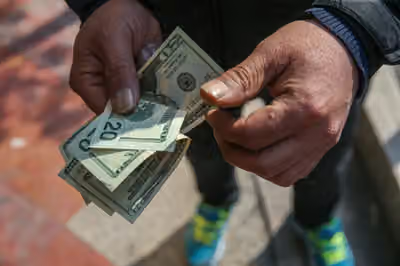
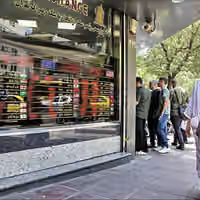
But in the past few months, Iran's deep economic crisis compounded by sanctions Trump imposed in his first term, has become more serious, with its national currency losing 30% of its value since August. More officials and commentators allowed to speak in public have been calling for negotiations with the US.
Pezeshkian’s aide, Abdolalizadeh, has argued that Iran should not have excluded the US from its economic dealings with the international community after the conclusion of the 2015 nuclear deal known as the JCPOA (Joint Comprehensive Plan of Action).
“After the JCPOA, we allowed all countries to cooperate with Iran, but we blocked the Americans, and this raised the question of why the US was not allowed to be in Iran for economic cooperation?” he said, adding that the Obama team did not make their complaint public, but Trump would not tolerate such exclusion. “He said he would rip the JCPOA and we said we would burn it. Both sides regret it now.”
He added that, if sanctions are lifted, Iran's oil and gas sectors could become attractive opportunities for American and multinational companies.
Former Iranian diplomat and Princeton professor Hossein Mousavian also suggested in a recent opinion piece for The Hill that direct talks with the US, even at the presidential level, are no longer off-limits.
Mousavian, often labeled a "loyal regime insider" by the Iranian diaspora in the West, proposed that a potential agreement could pave the way for significant economic cooperation, with projects valued in the hundreds of billions of dollars across industries such as petrochemicals, aviation, and clean energy.
Navigating between East and West
Pundits in Iran say the Pezeshkian administration’s overtures to the new US administration, along with its efforts to avoid appearing overly eager to align with Moscow or Beijing, should be viewed through the lens of a ‘positive balancing’ foreign policy.
This approach contrasts with the traditional “Neither East nor West” slogan inscribed at the entrance of the foreign ministry building in central Tehran.
“This strategy neither accepts isolationism nor unquestioning submission to the demands of others,” political analyst Reza Raisi said in an article published by the reformist Ham-Mihan newspaper.
On Monday, Iranian President Masoud Pezeshkian said the government was forced to burn mazut, a highly polluting fuel, to prevent interruptions to household gas supplies this year.
"We were not supposed to burn mazut at all, and we announced this. But then we got stuck. If we hadn't used it, we would have had to cut off gas supplies to households, because our consumption is many times higher than in other countries. We were forced to," Pezeshkian said in a speech broadcast on state TV.
"In order to stop these problems from happening next year, we've started to create plans," he added, without providing further details.
Iran, one of the largest oil producers in the world, has faced a severe gasoline shortage since last summer. That shortage has prompted refineries to bulk out the fuel's volume with other substances, like mazut.
In November 2024, the government issued a decree ordering an increase in household gas tariffs and authorizing provinces to use mazut in all power plants and industries.
Despite repeated promises since to phase out the use of the highly polluting fuel oil in power plants, several reports suggest the practice has not stopped.
Tehran has also implemented rolling power cuts for residential and commercial areas this winter due to a severe shortage of natural gas, the primary fuel source for the country's power plants. The government initially presented the rolling blackouts as a necessary measure to avoid using mazut or diesel.
According to a 2023 report by Radio Farda, official Oil Ministry reports showed that the country intensified its use of mazut in December 2022 to 38.5 million liters per day, a 22 percent increase, and 42 million liters per day in January 2023.
Mazut, the non-standard gasoline contains harmful additives and has significantly contributed to the air pollution crisis in the country.
In 2023, UN special rapporteur on human rights and the environment David Boyd called on Iran to halt the practice, declaring it a human rights violation.
"Iran is burning mazut, one of the dirtiest fuels, to generate electricity. This produces massive volumes of toxic air pollution, which poisons millions of people in Iran, violating their human rights, including the right to a healthy environment. Iran must stop burning mazut!," the post on X read.
The use of the low-grade fuel mazut by power plants in Iran has been linked to severe harm to public health and even fatalities, with Iranians frequently expressing frustration over the worsening air quality and pollution in many cities.
A 45% drop in rainfall since last year and a 29% decrease in water flowing into dams compared to the five-year average have pushed Iran deeper into a water crisis, adding pressure amid the current economic crisis and high inflation.
The situation is particularly critical in Tehran, where dam levels have fallen to just 17% of capacity, Firouz Ghasemzadeh, Iran's water sector spokesman, said on Sunday.
He added that cumulative rainfall since the beginning of the current water year (roughly starting in late September/early October) until late January is down 45% compared to the same period last year.
A 57-year rainfall record analysis places this year as the 53rd driest, meaning only four years in the past 57 have been drier.
Iran is currently grappling with one of its most severe droughts in over half a century. The situation has prompted criticism of the Iranian government's environmental management.
The volume of water entering Iranian dams since the start of the current water year until January 18th dropped by 5% compared to the same period last and 29% compared to the five-year average, Ghasemzadeh added.
Many regions of the country have been grappling with water shortages for more than a decade. Farmers have been periodically staging protests, demanding changes in government policies.
Outflow from dams has also decreased by 9% compared to the five-year average, since the beginning of the water year. As a result, current reservoir levels at 44% of total capacity, represent a slight improvement compared with last year.
Ghasemzadeh expressed particular concern about the state of dams in several provinces, including Tehran, where the five main dams are only 17% full—a 21% decrease compared to the five-year average. This shortage could have far-reaching effects on agriculture and food prices, especially with inflation averaging around 40% over the past five years.
The Zayandeh Rud dam in central Iran is at a critically low 13% capacity, a 28% drop compared to the five-year average. Significant reductions in reservoir volume and inflow are also reported in the provinces of Khorasan Razavi, Hormozgan, Zanjan, Markazi, and Golestan, underscoring the urgent need for water conservation.
The dam, which significantly restricts water flow to Iran's eastern provinces, threatens over two million residents in Razavi Khorasan Province who rely on the river for drinking water.
The current drought marks the fourth consecutive year of significant water scarcity in Iran, one of the most severe such periods in over half a century.
This has led to public criticism of the Iranian government's environmental policies. Even amidst government denials, the governor of Tehran recently admitted the country is "confronting a significant challenge in the water sector," acknowledging the dwindling rainfall and depleted dam reserves.
Additionally, the United Nations Water (UN-Water) has classified Iran as experiencing “extremely high-water stress” in its annual world water development report. The report highlights that Iran, along with other countries in the Asia-Pacific region, faces critical water scarcity issues.
The protest by a guest on a program aired by Iran’s state television has ignited widespread debate over the Islamic Republic's emphasis on the veneration of death and its aversion to expressions of joy.
At the conclusion of each episode of the program The Black Box, guests are presented with a black box containing a folded white shroud tied with a black ribbon, along with a mock death notice featuring their photo. In this program, intended to be a light-hearted one-on-one talk show, guests are then asked to share their feelings about confronting their own mortality.
The shroud symbolizes the government’s Shia ideology, representing a wish for the recipient to achieve the honor of martyrdom or simply depart from an unworthy earthly life and go to paradise.
Around fifty episodes of the program have been aired over the past ten months with guests chosen from among recognized political, artistic, athletic, and academic personalities.
Many Iranians only heard the controversial program’s name a few days ago because Iran's ideologically driven state television has lost most its audience to satellite TV channels. Many Iranians turn to these both for news and entertainment.
The program drew widespread attention after a guest shared a video on social media. In his post, Hadi Amel, a popular television wrestling reporter, criticized the state broadcaster for the insensitivity of the gift he was presented with at the end of the show.
Amel revealed that he had protested immediately in the studio, demanding that the footage of the incident not be aired. Despite his request, he noted in his post, a re-run of the episode was broadcast last week. "It was unethical. They broke my heart," he said.
Amel’s post and a video clip of the controversial scene quickly went viral on Persian social media with thousands commenting.
In the aired program, Amel is visibly shocked upon opening the black box and discovering the gift symbolizing his "future." "I don’t like this. I don’t like talking about death," he says, placing the death notice face down on the table.
The presenter appears equally uncomfortable, turning to the production team and asking, "Is this what you wanted?" He then calls the gesture "bad taste."
“You wouldn’t kill so many people, commit such injustices, carry out executions, or engage in so much corruption if you truly understood the meaning of a shroud, a death notice, or the day of death,” a viewer said in an audio message sent to Iran International TV, addressing the Islamic Republic authorities. “You are the ones who should be gifted shrouds, as you are nearing your final day,” he added.
Shortly after, an excerpt from another episode surfaced on social media, showing the shocked reaction of another guest, Maryam Razzaghi-Azar, a prominent professor of pediatric endocrinology. Upon receiving the gift, she protested, stating that she did not want her children to see the shroud and death notice. She then insisted that the presenter tear it to pieces.
The intense public backlash compelled Peyman Jebelli, the head of the state broadcasting organization (IRIB), to address the controversy. Speaking to reporters, he acknowledged the criticism, agreeing that the gift was in poor taste. Jebelli also claimed to have reprimanded the producers responsible for the decision.
Despite the public outcry, pro-establishment figures and social media users argued that the criticism was unfounded because only two of the nearly fifty guests of the program were offended by the gift while some others, including ultra-hardliner lawmaker Hamid Rasaei, had even welcomed it.
Speaking to Iran International TV, prominent Washington-based Iranian sociologist Hossein Ghazian explained that the program’s controversy stems from its production and broadcast by a state-owned media outlet. He suggested that if a similar concept had been produced by, for example, a Belgian television channel, it might have been seen as creative. However, Iranians reacted negatively because the program is perceived as a reflection of the state’s ideology, he noted.
Ghazian argued that, within this ideology, life is viewed as a fleeting phenomenon unworthy of significant focus, while death is regarded as eternal. “In political terms, this implies that people should not expect much improvement in their living conditions from the government,” he added.
The IRIB has completely degenerated,” psychologist Azadeh Jazini wrote in an X post to fellow citizens. “This toxic system, which opposes life and happiness, has now stooped to presenting gifts that induce mental collapse. Stay away from this media outlet, not just for your own mental well-being but also to protect the mental health of your children.