Tehran says 5,000 people working to expand Bushehr nuclear plant
Thousands of workers are currently involved in constructing the second and third units of the Bushehr nuclear power plant in southern Iran, the country's atomic energy chief announced on Monday.
"Currently, 5,000 people are involved in the construction of the two new units," Mohammad Eslami said during a visit to the site, adding, "Their efforts are ensuring the project progresses with good discipline and speed."
Eslami claimed that lessons learned from work on the second unit have helped accelerate progress on the third.
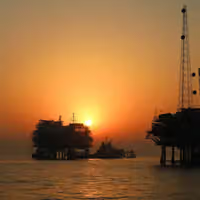
Located in Bushehr province, Iran's first commercial nuclear energy facility sits along the Persian Gulf.
The official also asserted that the project had recently achieved a record by pouring an enormous amount of concrete in one day, specifically 22,000 cubic meters. "Next year, we aim to ramp up our daily concrete pouring to 65,000 cubic meters to keep the project's momentum going," Eslami added.
Eslami was previously sanctioned by the United Nations in 2008 while he was the head of Iran's Defense Industries Training and Research Institute, for his involvement in "Iran's proliferation of sensitive nuclear activities or for the development of nuclear weapon delivery systems."
In February last year, Ahmad Mohammadizadeh, the governor of Bushehr,disclosed that the Islamic Revolutionary Guard Corps (IRGC) was undertaking a new expansion of the Bushehr nuclear power plant. This revelation followed a day after Rafael Grossi, the head of the UN's nuclear watchdog, commented that Iran was "not entirely transparent" regarding its nuclear activities.
Speaking about the the work to expand the nuclear plant, Eslami pointed to the use of domestically manufactured equipment and detailed the technical challenges of stabilizing the reactors' foundations. "We have completed 34,000 rod injections to reinforce the foundation beneath the reactor buildings," he said.
In addition to the reactors, Eslami said work is ongoing on supporting infrastructure, including power transmission systems and water intake facilities.