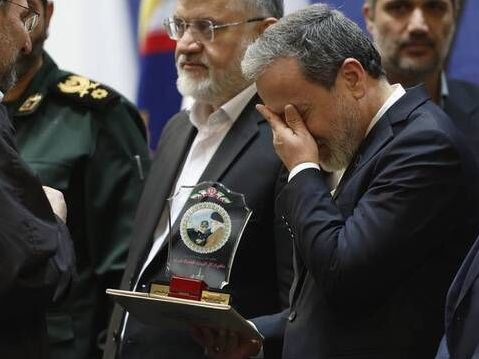
Iran's FM cries after receiving Soleimani's ring as award
Photos released by Iran's state media show Foreign Minister Abbas Araghchi crying after receiving a ring belonging to former IRGC Quds Force commander Qassem Soleimani as an award for his service.
Soleimani was killed in a drone strike ordered by Donald Trump on January 7, 2020.
In a video of the event released by state media, Araghchi is seen crying after receiving the award from the mother of Mohammad-Hossein Haddadian, a member of the IRGC's Basij paramilitary who was killed in early 2018.
Tehran has no plan to acquire a nuclear bomb since Iran's Supreme Leader Ali Khamenei has forbidden it on religious grounds, Iran's president said on Tuesday.
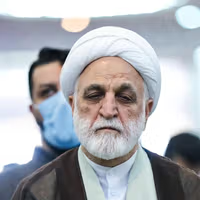
"The Islamic Republic has absolutely no intention of utilizing its nuclear capabilities for military purposes based on its ideological beliefs and a fatwa by Supreme Leader Ali Khamenei," Masoud Pezeshkian said in a meeting with Britain's new ambassador to Tehran.
For two decades, the Supreme Leader's so-called nuclear fatwa has been repeatedly cited by senior officials as proof of Iran's peaceful intentions. But even supporters of that view say the decree could be amended.
"According to the Leader’s opinion, going in this direction is now forbidden, because he is a religious authority; (but) maybe he will change his opinion tomorrow," Shahid Beheshti University President Mahmood-Reza Aghamiri said recently in an interview.
The nuclear engineer went on to say that if Khamenei’s opinion changed, Iran would have the capacity to build a nuclear weapon.
Tehran ready for return to JCPOA
Pezeshkian's comments came one day after French President Emmanuel Macron warned Tehran's nuclear program is nearing the point of no return.
Iran says its uranium enrichment program is for peaceful purposes but has accelerated activity since US President-elect Donald Trump withdrew from the 2015 nuclear deal - officially known as the Joint Comprehensive Plan of Action (JCPOA) - during his first term and reimposed sanctions on Tehran.
"The Islamic Republic is fully prepared for all parties to return to the 2015 agreement and fulfill their mutual commitments," Pezeshkian added on Tuesday.
Last month, European powers France, Germany, and Britain warned that Iran’s actions had further eroded the agreement, noting that Tehran’s stockpile of highly enriched uranium has no credible civilian justification.
In December, the head of the UN nuclear watchdog reported that Iran was dramatically advancing enrichment close to the 90% purity needed only for weapons-grade material.
The three European nations, co-signatories of the 2015 accord, had brokered the deal under which Iran agreed to limit enrichment in exchange for the lifting sanctions.
US President-elect Donald Trump on Tuesday said he is not "stupid" to answer a question on the possibility of a US attack on Iran's nuclear facilities.
"It's a military strategy and I'm not answering a question on our military strategy. Only a stupid person would answer," Trump told reporters in Florida.
Axios reported on Monday that Trump left Israeli Minister Ron Dermer with the impression that he was likely to support an Israeli military strike on Iran’s nuclear facilities—or even order a US strike—after a November meeting.
In a January 2 report, Axios said that White House national security adviser Jake Sullivan had presented President Joe Biden with potential military options for striking Iran's nuclear facilities if Tehran advances toward a nuclear weapon before January 20.
Biden and his national security team reviewed scenarios during a meeting around a month ago but the president has not authorized any strike, the sources said.
The United States has long sought to prevent Iran from acquiring nuclear weapons, a concern that has driven years of diplomacy and sanctions.
Tehran says that its nuclear program is for civilian use only and has steadily expanded it since Donald Trump unilaterally withdrew the US from the 2015 nuclear deal, formally known as the Joint Comprehensive Plan of Action (JCPOA).
The sign of the Central Bank of the Islamic Republic of Iran is seen in Tehran, Iran January 25, 2023.
Iran has made strides in recovering portions of its blocked financial assets, foreign minister Abbas Araghchi announced, while emphasizing that billions remain inaccessible due to international sanctions.
“Some of it has been released through efforts, while some still remains. This issue is on our agenda, and we continuously pursue it,” Araghchi said on Monday, speaking at the Supreme Council for Foreign Economic Relations.
Iran's frozen assets in international accounts are estimated to be valued between $100 billion and $120 billion. Nearly $2 billion of these assets are held in the United States. According to the Congressional Research Service, in addition to funds in foreign bank accounts, Iran's frozen assets include real estate and other property.
The value of Iran's real estate in the US, along with accumulated rent, is estimated at $50 million. Beyond the assets frozen in the US, portions of Iran's assets are also frozen globally under United Nations sanctions. Despite these obstacles, Araghchi highlighted Iran’s ability to adapt.
“Managing the economy of foreign relations under sanctions and external pressures is a unique skill in which we have become proficient over the past years,” he added.
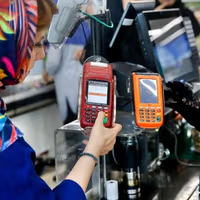
The Biden administration has eased some restrictions, notably through a September 2023 waiver enabling the transfer of $6 billion from South Korea to Qatar as part of a prisoner exchange. While advocates of such moves argue they facilitate diplomacy, many contend they enable Iran to support proxy groups in the Middle East.
Since President Joe Biden’s term began, relaxed enforcement of oil sanctions has also allowed Iran to generate an estimated $32 billion to $35 billion in additional revenue, according to the Foundation for Defense of Democracies.
Congressional Republicans have voiced concerns that these funds could fuel Iran’s nuclear ambitions or military activities, while the administration defends its policies as part of broader engagement efforts.
In a contrasting move, the US Treasury imposed sanctions in June 2024 on nearly 50 entities linked to Iran’s shadow banking network, which funneled billions to Tehran’s military and proxy forces. These groups, according to US officials, have destabilized the region and supplied drones to Russia for use in Ukraine.
Iran says it has postponed its plan to send human to space because of technical and financial challenges.
"Iran planned to send humans into space using bio-capsules as part of its space program by the year 1404 (starting in mid-March), but the plan has been delayed due to technological challenges and issues in securing funding for the project," said Iran's Space Organization chief Hassan Salarieh.
Western countries have long accused Iran of exploiting its space program to test technologies that can be repurposed for military use, specifically long-range ballistic missiles capable of carrying nuclear warheads. Despite numerous UN resolutions calling for a halt to these activities, Tehran has pressed ahead, raising alarms across the globe.
Women in Iran are being killed at alarming rates, with rights groups reporting an average of one woman killed every other day in 2024.
Many of these killings are carried out by male family members, often citing reasons such as so-called family honor, objections to divorce requests or resistance to abusive forced marriages, according to US-based Center for Human Rights in Iran (CHRI).
CHRI in a statement on Monday warned against the rising toll and attributed this systemic violence to the government’s refusal to enact protective laws or hold perpetrators accountable.
“Women in Iran are being shot, stabbed and burned to death by husbands and fathers in shocking numbers, but the government does not take even the most basic measures to try to prevent these crimes, and the Iranian judicial system lets these cases go with little or sometimes even no punishment,” said Hadi Ghaemi, CHRI’s executive director.
CHRI highlighted data from rights groups documenting the alarming rate of violence against women and girls in Iran. According to the Human Rights Activists News Agency (HRANA), 114 publicly reported femicides occurred in 2024, while Stop Femicide in Iran (SFI) reported 93 femicides in the first half of the year, equating to one killing every other day during that period.
A report by Tehran-based Etemad Daily also revealed that femicide rates in Iran in 2024 had increased by 60% compared to the previous two years.
CHRI emphasized that these figures likely represent only a fraction of the true toll, as many cases remain unreported or are misclassified as suicides or accidents.
Separately, Norway-based rights group Hengaw reported that at least 182 women were killed by family members due to domestic violence in 2024, further underscoring the extent of the crisis.
Ghaemi urged the international community to take action: “The international community must recognize the growing emergency in Iran—women and girls are being killed with impunity, and many more will be killed without the international community demanding that the Iranian authorities take concrete steps to address this violence.”
Last month, the UN Special Rapporteur on the human rights situation in Iran issued a call for input for its report on the country to the Human Rights Council.
The Special Rapporteur said the report will focus on gender-related killings and the systemic failures that enable them, including state complicity through inadequate laws and a lack of accountability for perpetrators.