Iran will act firmly against those spreading fear and despair, chief justice says
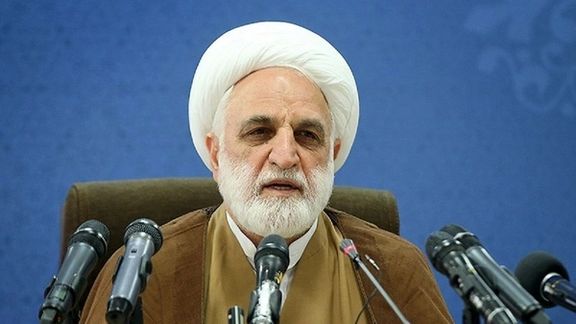
Iran's judiciary chief has issued a stern warning against those engaging in financial corruption, spreading fear, and undermining public morale, vowing firm action.
Iran's judiciary chief has issued a stern warning against those engaging in financial corruption, spreading fear, and undermining public morale, vowing firm action.
"Those who commit financial corruption, spread fear among the people, create despair and hopelessness, or undermine the public's psychological security will face firm and lawful action," Gholamhossein Mohseni Ejei said on Monday, emphasizing the need to maintain stability.






Iran's Ministry of Culture and Islamic Guidance said on Monday that Italian journalist Cecilia Sala was arrested in Tehran for violating Iranian laws, without detailing any specific charges.
"Cecilia Sala, an Italian citizen, traveled to Iran on December 13, 2024, with a journalist visa and was arrested on December 19, 2024, on charges of violating the laws of the Islamic Republic of Iran. Her case is currently under investigation," a statement by the ministry said.
It added: "The arrest was carried out in accordance with relevant regulations, and the Italian Embassy in Tehran has been informed. Consular access has been provided to Sala during this period, and she has been in telephone contact with her family."
While emphasizing the country's openness to international journalists, the ministry did not specify the exact charges against Sala.
On Sunday, Washington urged Iran to release Sala, a case likely related to Italy's arrest of an Iranian businessman on terrorism charges at the behest of the United States.
Sala’s detention in Tehran may be linked to the arrest of a Swiss-Iranian businessman at Malpensa Airport three days earlier on a US warrant for allegedly violating sanctions on electronic exports, La Repubblica said citing his lawyer.
Italian Foreign Minister Antonio Tajani said on Saturday that Sala is in good health and is being held alone in a cell in Evin Prison. Tajani called for media discretion over the case and confirmed that Sala has spoken to her parents twice by phone. Italian Ambassador to Tehran Paola Amadei has also visited her in prison.
Iranian workers face a deepening struggle as the minimum wage, which once covered half of basic living expenses, now meets just one-quarter of the costs, labor activists now warn.
“With the increase in exchange rates and the instability of basic commodity prices, many workers are facing very challenging economic conditions, particularly tenant workers, whose wages can only cover three days of living expenses,” said Ayat Assdi, the workers’ representative in the Supreme Labor Council.
In March, Iran’s Supreme Labor Council increased the minimum monthly wage by 35%, setting it at 111,070,000 rials (approximately $185 at that time) including benefits. However, as the rial has dropped to around 810,000 per US dollar, this amount is now worth just $137.
Meanwhile, the estimated cost of living in Tehran exceeds 400 million rials (over $500), with smaller cities averaging over 250 million rials ($300).
The crisis is exacerbated by inflation, which is nearing 50%, with widespread shortages in essentials such as fuel and electricity.
Winter power outages and natural gas deficits have further compounded the difficulties for ordinary citizens. The steep devaluation of the rial has also increased the cost of imported goods.
Efforts to adjust wages to reflect these conditions have been stymied. Asadi noted that attempts to convene the Supreme Labor Council to determine wages for the next year have been blocked by government intervention. Many workers, unable to make ends meet, have turned to informal jobs to survive.
Economic pressures in Iran have ignited a wave of strikes, with business owners and employees in Tehran's historic bazaar staging a rare protest on Sunday against runaway inflation and soaring foreign currency rates.
The strike, beginning with shoe sellers in the 15th Khordad area, quickly spread to other sectors, highlighting the mounting frustration among merchants and workers grappling with declining purchasing power and unstable markets.
Videos shared online captured merchants chanting slogans like “Don’t be afraid, close up,” and “Brave merchants, support, support,” reflecting a spirit of solidarity amidst economic despair.
Iran’s economic struggles reflect a combination of internal and external pressures. In addition to domestic turmoil, international sanctions targeting the country’s financial and energy sectors have hampered trade and access to foreign reserves.
Iran’s central bank governor has accused the US-based website Bonbast of fueling the devaluation of the rial by setting unofficial exchange rates used by Iranian exchange offices.
“The Bonbast channel, which determines the dollar exchange rate for all Iranian exchange offices starting at 9 AM, is registered in the US, and all its servers are also located there,” Mohammad Reza Farzin said.
Bonbast is widely known for publishing the free-market exchange rate of the rial against foreign currencies.
Iran has multiple official exchange rates but the free market rate reflects the true value of transactions. The rial has depreciated by over 25% since September, driven by regional conflicts and Iran’s setbacks in Syria and Lebanon.
Prominent Iranian human rights lawyer Nasrin Sotoudeh criticized the Iranian authorities for using foreign nationals as bargaining chips following the arrest of Italian journalist Cecilia Sala.
"For the regime, every foreign citizen is a bargaining chip for their demands," Sotoudeh said in an interview with Italian daily newspaper Corriere della Sera.
She described Sala's arrest as "disgraceful" and demanded her immediate release, stressing, "Journalism is neither a crime nor a bargaining chip."
The case has been likened to that of Swedish EU diplomat who was exchanged in return for a jailed Iranian official imprisoned on charges of war crimes in June.
Last year, five US-Iranians were also exchanged for the release of $5bn in frozen Iranian funds.
Sotoudeh called on the international community to pressure Iran to respect human rights and release all unjustly imprisoned journalists, the exact numbers of which are not known, but around 100 have been arrested in Iran this year alone.
In 2021, Sotoudeh was recognized as one of Time's 100 Most Influential People in the World. Despite her contributions to human rights advocacy, Sotoudeh was imprisoned in Tehran's Evin Prison, where Sala is now being held, and was released on a medical furlough in July 2021.
Recalling the time she spent in the notorious jail, which has held a string of high-profile international detainees such as British-Iranian Nazanin Zaghari-Ratcliffe, she said: "I remember the gray walls, the very small space in the room, and the cold. Political prisoners like us were given just one blanket without a pillow or mattress. I couldn’t call home, and when they allowed me this luxury, there was always a guard next to me listening to my conversations."
Her husband Reza Khandan was recently detained in Tehran for his activism and his support of Sotoudeh's campaign against Iran’s mandatory hijab laws.
An Iranian MP has criticized the Energy Minister Ali Akbar Mehrabian’s handling of the ongoing energy crisis as national blackouts continue to affect the country in the harshest winter months.
“The energy crisis in the power sector stems from poor management and misguided policies by the energy ministry. During Ali Akbari’s tenure, instead of addressing infrastructural issues, we have witnessed mismanagement in power plants and blackouts, which has worsened the situation and deepened the energy crisis in the country,” Ali Haddadi, a member of the parliamentary committee on industries and mines, said in an interview with Student News Network (SNN).
“Unfortunately, instead of taking responsibility and being accountable, officials blame others for the problems. This irresponsible approach has caused significant delays in many power plant projects and insufficient investment in the energy sector,” Haddadi added.
He warned that as long as mismanagement continues, the energy crisis will remain unresolved, adding that the public has the right to demand transparency and accountability from the energy ministry.
Half of Iran’s industrial parks have ceased operations due to power outages, according to the employers' representative in the Supreme Labor Council, as the electricity cuts further hamper the economy.
There has also been a widespread closures of schools, universities, and government offices in the country as the government struggles to curb energy consumption amid a worsening winter crisis.