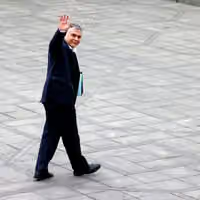
Russia's Vladimir Putin meeting with Islamic Republic President Masoud Pezeshkian during the BRICS summit in October.
Iran’s government-controlled media have criticized Moscow—frequently hailed by officials as Iran’s 'strategic ally'—for not issuing an immediate and unequivocal condemnation of Israel’s October 26 air strikes on Iran.
Relying on an actor like Russia cannot advance the Islamic Republic’s national interests or ensure its national security, stated a commentary in the reformist Shargh Daily on Monday.
“Although Cairo and Beijing half-heartedly condemned Israel's attack yesterday, there is still no news of Moscow's condemnation,” the newspaper remarked.
For years, the Islamic Republic led by Ali Khamenei, has touted its doctrine of relying on Russia and China to limit the power and influence of the United States.
Many regional and Islamic countries including Turkey, Saudi Arabia, Qatar, Jordan, and the United Arab Emirates condemned the attack within hours in “strongest terms”, but the Russian Foreign Ministry Spokeswoman Maria Zakharova’s statement Saturday only expressed “deep concern regarding the ongoing explosive escalation” and fell short of condemning the strikes.
“We urge all the stakeholders to exercise restraint, stop violence, and prevent the situation from sliding towards a grave disaster. It is high time that efforts to provoke Iran to respond cease,” Zakharova said.
“Russia’s position on this matter was only slightly different from that of European countries. While asking for restraint, they said Israel had a right to this attack … The difference between these countries and Russia is that they currently have strained relations with Iran due to the accusations they raise about Tehran's involvement in the Ukraine war, and Russia presents itself as Iran's strategic partner,” the moderate-conservative Fararu news website wrote Sunday about Zakharova’s statement.
Israel's three-hour long series of air strikes in the early hours of Saturday targeted Iran's Russian-supplied air defense system and a several military and weapons sites. The operation took place with impunity as Iran's air defenses seemed to have failed to exact any toll on dozens of Israeli warplanes, some of which are said to have reached the capital Tehran.
At the UN Security Council’s emergency meeting Monday, Russia's ambassador, Vasily Nebenzya, praised Iran for showing “unprecedented restraint” and said the Israeli raid had not only violated international law but also would destabilize the already highly tense situation in West Asia.
Nebenzya also alleged that the Israeli strikes had been “coordinated with the US” and urged Israel to “refrain from the practice of provocative military actions in the Middle East but avoided the term “condemn” which bears diplomatic significance.
“As key members of BRICS of which Iran is also a member, Russia and China were expected to officially condemn the attack on our country given the propaganda about Tehran’s strategic relations with Moscow and Beijing,” an article entitled “Where Are Russia and China?” in another reformist newspaper, Ham-Mihan, wrote Tuesday.
Like Moscow's tepid response, Beijing also took three days to officially react to the strikes in a cautious tone.
“The Russians could have taken a stronger position … In matters one side of which Iran and the other side is another Middle Eastern country, whether Arab countries or the Israeli regime, Russians always tend to side with the other country,” Mahmoud Shouri, a Russia expert, told Ham-Mihan website in Tehran.
“Maybe their perception is that their relations with Iran will not be damaged whatever happens but their relations with the other side can be affected,” he added.