• العربية
  • فارسی
Brand
  • Iran Insight
  • Politics
  • Economy
  • Analysis
  • Special Report
  • Opinion
  • Podcast
  • Iran Insight
  • Politics
  • Economy
  • Analysis
  • Special Report
  • Opinion
  • Podcast
  • Theme
  • Language
    • العربية
    • فارسی
  • Iran Insight
  • Politics
  • Economy
  • Analysis
  • Special Report
  • Opinion
  • Podcast
All rights reserved for Volant Media UK Limited
volant media logo

Israeli PM: We’re fighting Iran, not the Lebanese people
Oct 13, 2024, 14:33 GMT+1Updated: 15:39 GMT+0
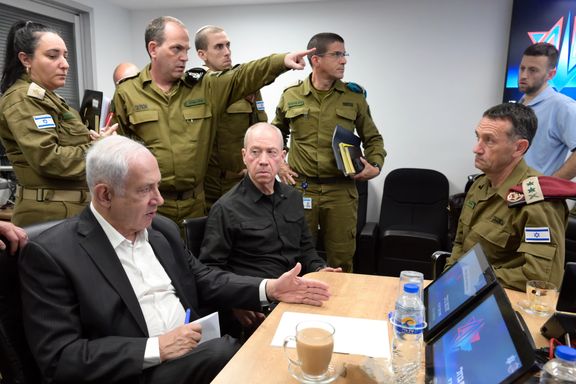
PM Netanyahu seen with Israeli military officers.

Amid the escalating conflict in Lebanon, Israeli Prime Minister Benjamin Netanyahu emphasized in a speech on Sunday that Israel's battle is not with the Lebanese people, but with Iran.

“These days we mark the anniversary of the difficult war that was imposed on us, the war of revival against the axis of evil of Iran,” Netanyahu said on Sunday, just days after the one-year anniversary of the October 7, 2023, attack, when Iran-backed Hamas invaded Israel.

“We are not fighting the Lebanese people. We are fighting the terrorist branch of Iran, Hezbollah, which has taken over Lebanon. All of which is aimed at providing a human shield to Hezbollah terrorists.”

On October 8, 2023, Hezbollah joined the fight with Hamas, forcing Israel to face conflict on its southern and northern fronts.

In Gaza, the Israeli offensive has killed nearly 42,000 people, according to Gaza Health Ministry figures. The Israeli attacks on Lebanon from October 2023 to early September 2024 have also killed over 2,000 people, including at least 137 civilians, figures released by the Lebanese Ministry of Health and the United Nations showed.

Israel has also vowed to retaliate against Iran for a large barrage of ballistic missiles launched by Tehran against its territory earlier this month.

Attack on UNIFIL forces

In his Sunday remarks, Netanyahu also issued a warning to the UN to move the peacekeeping forces from southern Lebanon “out of harm’s way”.

Five peacekeepers have been injured in fighting since Operation Arrow of the North began last month. Israel started with a series of deadly air strikes, targeting Hezbollah’s top ranks, including killing the group's leader, Hassan Nasrallah.

Forty countries contributing to the UN peacekeeping mission in Lebanon on Saturday condemned the Israeli attacks on the mission and called for an investigation of the incidents.

In their statement, the 40 countries said they "strongly condemn recent attacks on UNIFIL peacekeepers" and that "such actions must stop immediately and should be adequately investigated."

The Israeli offensive has expanded this month into what it calls a ‘limited ground operation’, but combined, has now seen 1.4 million Lebanese displaced and hundreds more killed.

During the address in Hebrew, Netanyahu turned to English to address UN Secretary General, Antony Guterres. “Mr. Secretary General get the UNIFIL forces out of harm’s way, it should be done right now, immediately,” he warned.

In Hebrew, he expressed regret for the injuries suffered by the UNIFIL soldiers. "We do everything in our power to prevent this injury, but the simple and necessary way to prevent this is to simply get them out of the danger zone,” he said, warning their presence is also a danger to Israeli soldiers.

Israeli forces asked UNIFIL to withdraw from some of its positions, but "there was a unanimous decision to stay" in the area, AFP reported Saturday citing UNIFIL spokesperson Andrea Tenenti.

UNIFIL, set up in 2006, was designed to keep Hezbollah and other armed groups behind designated lines, and to see the disarmament of all such groups in the area. Neither has since been achieved.

Hezbollah was Iran’s largest and most powerful proxy until a few weeks ago. While a Hezbollah operative earns $1,500 a month, the Lebanese Armed Forces, the only armed power able to challenge Hezbollah, are paid just $300 a month. Limited by resources in the ailing economy, their troops often do not even have funds for gasoline to fuel their patrol trucks.

On Sunday, Israel announced it had captured a Hezbollah militiaman in one of the group’s tunnels, along with huge stashes of armaments, the first such announcement since fighting began. He was taken to custody in Israel while scores more projectiles continued to be fired into Israeli territory.


Most Viewed

Iran negotiators ordered to return after internal rift over Islamabad talks
1
EXCLUSIVE

Iran negotiators ordered to return after internal rift over Islamabad talks

2
ANALYSIS

US blockade enters murky phase as tankers spoof signals and buyers hesitate

3
ANALYSIS

Why the $100 billion Hormuz toll revenue is a myth

4

US tightens financial squeeze on Iran, warns banks over oil money flows

5
ANALYSIS

US blockade targets Iran oil boom amid regional disruption

Banner
Banner

Spotlight

  • Hardliners push Hormuz ‘red line’ as US blockade tests Iran’s leverage
    INSIGHT

    Hardliners push Hormuz ‘red line’ as US blockade tests Iran’s leverage

  • Ideology may be fading in Iran, but not in Kashmir's ‘Mini Iran'
    INSIGHT

    Ideology may be fading in Iran, but not in Kashmir's ‘Mini Iran'

  • War damage amounts to $3,000 per Iranian, with blockade set to add to losses
    INSIGHT

    War damage amounts to $3,000 per Iranian, with blockade set to add to losses

  • Why the $100 billion Hormuz toll revenue is a myth
    ANALYSIS

    Why the $100 billion Hormuz toll revenue is a myth

  • US blockade targets Iran oil boom amid regional disruption
    ANALYSIS

    US blockade targets Iran oil boom amid regional disruption

  • Iran's digital economy battered by prolonged blackout
    INSIGHT

    Iran's digital economy battered by prolonged blackout

•
•
•

More Stories

Iranian military and energy to be target of Israeli retaliation - report

Oct 13, 2024, 13:28 GMT+1

NBC reported that US officials believe Israel has focused its potential retaliation for Iran's recent ballistic missile barrage on military and energy infrastructure targets.

However, the US and Israeli officials speaking to NBC News told the network that the retaliation could come during the weekend's Yom Kippur holiday, which has now passed, showing the lack of clarity as to the exact timing of the response.

Following a stream of attacks, starting with the alleged Israeli killing of Hamas political leader Ismail Haniyeh in Tehran in July, and most recently, an airstrike that killed long-time Hezbollah leader Hassan Nasrallah, Iran launched its biggest barrage to date on the Jewish state this month.

On October 1, Iran launched 181 ballistic missiles at Israel, with several striking military and civilian infrastructure. The attack prompted Israel, Iran's longstanding adversary, to vow a strong retaliation.

NBC reported that there is no indication Israel will target nuclear facilities or carry out assassinations in its response. However, US officials emphasized that Israel has not yet made a final decision on the timing or nature of its retaliation, as the country is currently observing a series of religious holidays.

The US is now working to defuse a rapidly escalating situation, as Iran's proxies across the region continue to attack Israel from multiple fronts following the October 7 invasion by Iran-backed Hamas last year. However, a US official, speaking to Iran International on condition of anonymity, firmly stated that there are "absolutely no" back-channel talks between the US and Iran to ease tensions.

Since the missile barrage, while the US has affirmed Israel’s right to respond, President Joe Biden has made it clear he will not support a strike on Iran’s nuclear sites, despite the looming threat as Iran inches closer to developing a nuclear weapon—now only "weeks, not months" away, according to the UN's nuclear chief.

Last week, Israeli Defense Minister Yoav Gallant said: ”The Iranian attack was aggressive but inaccurate. In contrast, our attack will be deadly, pinpoint accurate, and most importantly, surprising - they will not know what happened or how it happened. They will just see the results.”

The US official based in the region said that the Biden administration remains firm in its objection to nuclear targets being off limits. This was reiterated in a call last week between Biden and Israeli Prime Minister Benjamin Netanyahu, who has long warned of Iran’s nuclear threat to the world.

"The fact is that the President and PM spoke spoke through issues and the President made it clear about what should not be done," he said, referring to the warning to avoid nuclear targets. "We've had more impact [influence on Bibi] than people give us credit for. It was a good conversation. Biden made clear what he doesn't support."

However, the official, who was also on the conference call between the two leaders, also said Israel, as a sovereign nation, has the right to decide independently of the US.

“We don't approve targets. We don't want responsibility for targets,” he said. “It’s not about approval. It's two sovereign countries [Israel and the US] but we make clear what would be problematic. For example, we said to ease up in Beirut [due to the impact on civilians] but that doesn't mean they aren't any legitimate targets,” as Israel continues to dismantle Iran’s largest proxy, Hezbollah, in Lebanon.

With oil a critical resource for heavily sanctioned Iran, it is also believed that Israel is weighing that as an option, but Biden has made clear that too would not be his choice of target. "If I were in their shoes, I'd be thinking about other alternatives than striking oil fields," Biden told reporters earlier this month.

In April, Iran launched its first direct attack on Israel, a barrage of 350 projectiles, following an alleged Israeli airstrike on the Iranian consulate in Damascus. The strike killed a senior Quds Force commander and multiple senior IRGC figures.

However, since October 7, proxies in Gaza, Lebanon, Syria, Iraq and Yemen have launched a multi-front offensive against Israel in support of Iran-backed Hamas in Gaza.

One year ago, Hamas killed 1,100 mostly civilians and captured 251 more in a shock offensive that took the world by storm, revealing a much more sophisticated militia funded and trained by Iran, than had been understood.

Today, 101 hostages remain in Gaza and according to Hamas, around 42,000 Palestinians have died. Israel claims at least 16,000 are Hamas operatives.

“Not only at home, but the world does not understand what a horrific, brutal terror organization Hamas and Iran's proxies are,” the US official said. “They are not freedom fighters.”

French labor unions blame authorities' negligence for deadly Iran mine explosion

Oct 13, 2024, 12:44 GMT+1

The French Trade Union Collective, a coalition of five major labor unions in France, issued a statement blaming the negligence of authorities for last month’s deadly coal mine explosion in Iran, which killed at least 52 workers.

"According to international labor conventions, the government and private employers are obligated to protect the safety and lives of workers in the workplace," the statement read.

"The deaths of these workers were entirely preventable," the unions added, blaming the disaster on negligence.

The explosion at the Tabas coal mine, which occurred on September 21, was caused by a methane gas leak deep within the mine, according to Iranian state television. Rescue efforts were severely hampered by the high levels of methane gas, with many miners trapped in Block B, where conditions were particularly hazardous.

In their statement, the unions emphasized that miners had alerted management to the presence of methane gas in the tunnels before the explosion, yet they were still forced to continue working.

The French trade unions underscored the severity of the issue by citing official statistics from 2023, which reported that 2,115 people were killed in workplace accidents in Iran, with an additional 27,000 injured.

"The frequency of these deadly mining accidents clearly shows that miners face a systemic problem and a lack of political will to address it," the statement read.

Ali Nesaee Zohan, public prosecutor and head of the South Khorasan Revolutionary Court, announced last week that the case investigator had confirmed a lack of safety measures at the mine, attributing the negligence to the mine's management.

Hassan Hashemi, a representative of Birjand in Iran’s Islamic Consultative Assembly, also criticized the managers of the Tabas Ma'danjoo mine for failing to implement an online monitoring system and a gas venting shaft, which he said directly contributed to the explosion.

Despite the findings, no official action has been taken to summon or question the owners of the private coal mining company Ma'danjoo.

The unions involved in the statement include the Confédération française démocratique du travail (CFDT), Confédération générale du travail (CGT), Fédération syndicale unitaire (FSU), Union syndicale Solidaires, and Union nationale des syndicats autonomes (UNSA).

Iran’s FM denies ballistic missile transfers to Russia

Oct 13, 2024, 10:51 GMT+1

Iranian Foreign Minister Abbas Araghchi has denied that Tehran supplied ballistic missiles to Russia, pushing back against accusations as the European Union prepares to impose sanctions.

During a meeting with the European Union's foreign policy chief Josep Borrell, Iran's Foreign Minister confirmed the delivery of short-range rockets to Russia, but said Iran has not provided ballistic missiles to Russia.

In a statement posted on social media platform X, Araghchi wrote, “We have not provided ballistic missiles to Russia, and if Europe needs an excuse to cave in to Israel’s blackmail, it should find another story.”

It is not the first time that Iran has deflected attention by blaming Iran's archenemy Israel, which was targeted with a barrage of 181 ballistic missiles earlier this month.

Araghchi added, “Iran-Russia military cooperation is not new and dates back to before the Ukraine crisis. Some European countries have provided the Israeli regime with advanced weapons while participating in military operations against Iran.”

The remarks came in response to an earlier report from The Wall Street Journal, in which EU reporter Laurence Norman said that Araghchi had acknowledged, during a meeting with EU foreign policy chief Josep Borrell in New York, that Iran sent short-range missiles with a range of 250 kilometers to Russia.

Norman wrote, “Senior EU official says Araghchi acknowledged in NY that Iran had sent missiles to Russia of less than 250km range. He claimed they were not 'ballistic' missiles.”

Despite Araghchi’s denial, the European Union is pressing ahead with sanctions targeting Iranian individuals and entities connected to the missile transfers. Citing a senior EU official, Reuters reported that the sanctions are likely to be introduced as early as Monday. The sanctions are part of the EU’s first wave of punitive measures linked to Iran’s alleged missile transfers and could also impact sectors beyond military ties.

Iran's ballistic Fath-360 on display, said to be the missile supplied to Russia (undated)
100%
Iran's ballistic Fath-360 on display, said to be the missile supplied to Russia

Iran has been widely criticized for its deepening military support for Russia in Ukraine, particularly its provision of drones used to target civilian infrastructure. It has also led to global sanctions on Iran.

The two nations appear to be drawing closer politically and militarily. Reflecting the ideological alignment, on Friday, Iranian President Masoud Pezeshkian and Russian President Vladimir Putin met in Turkmenistan, where Putin remarked that the countries’ “assessments of events taking place in the world are often very close.”

Last month, EU foreign policy chief Josep Borrell issued a warning to Tehran, stating that the bloc would “respond swiftly and in coordination with international partners” if Iran continued supplying weapons to Russia.

Iranian president faces protests at Tehran University, avoids key issues

Oct 13, 2024, 07:00 GMT+1

During his speech at the University of Tehran on Saturday, President Masoud Pezeshkian was repeatedly interrupted by protesters. Despite earlier promises, he avoided addressing the dismissal of students and professors involved in protests.

As Iranian media reported, one student interrupted Pezeshkian at the beginning of his speech, protesting the lack of opportunity for students to voice their opinions. “A student doesn’t disrupt the event—let me finish my speech, and we’ll see what happens next,” Pezeshkian responded, offering to leave if the protests continued. He then asked the students to appoint a representative to speak on their behalf.

The president stepped down from the podium to listen to a student protester from the Basij, a hardline paramilitary organization. The student called for Pezeshkian to participate in a December 7 revolutionary ceremony in the university. However, moments after Pezeshkian resumed his speech, the session was disrupted again, this time by a university employee, escalating the tension.

“You, who can’t maintain order, mean we still haven’t reached the understanding to follow the rules,” Pezeshkian said to the employee, criticizing his behavior. He added, “If university staff have something to say, hold a meeting for them, and we’ll talk together.”

Two years ago, during the Woman, Life, Freedom protests, Iranian universities became hubs of unrest, with students openly protesting against the government, including Supreme Leader Ali Khamenei. Pezeshkian’s speech, which was broadcast live on state television, was a reminder of the divide between the government and the student body.

Iran's President Masoud Pezeshkian (center, taking notes) and Science Minister Hossein Simayi Sarraf (sitting to his right) during a ceremony on October 12, 2024.
100%
Iran's President Masoud Pezeshkian (center, taking notes) and Science Minister Hossein Simayi Sarraf (sitting to his right) during a ceremony on October 12, 2024.

Despite the mounting frustration, Pezeshkian continued his speech, stressing, "Why should we fight? Whether left or right, religious or non-religious, bring a valid argument, and we’ll accept it.”

Notably absent from Pezeshkian’s speech was any mention of the ongoing crackdown on academic freedom. In recent weeks, the government has expelled more students for participating in protests, intensifying the scrutiny on Iran’s higher education system. While Pezeshkian previously criticized such dismissals, his silence on the matter at the University of Tehran was significant.

In an indirect response to earlier calls for reinstating expelled students during Pezeshkian campaign, Mostafa Rostami, the Supreme Leader’s representative in universities, made clear that such efforts would not be tolerated. Following his remarks, two more students were officially banned from continuing their education, reinforcing the control of security bodies over universities.

The financial challenges facing Iran’s higher education sector also loomed large. Iran’s Science Minister, Hossein Simayi Sarraf, underscored the situation during the same event, stating, “The total budget for our universities and educational centers is less than the budget for a single top university in the world.” Sarraf emphasized that the education budget has halved in foreign currency terms since 2011, warning of an academic exodus as students and professors seek better opportunities abroad.

Pezeshkian, however, focused on the need for Iranian universities to generate their own income, sidestepping Sarraf’s concerns. "Abroad, universities either receive government funding or generate their own income. If we want to solve our problems, university professors must help us address societal issues,” Pezeshkian said, suggesting that Iranian universities adopt similar financial strategies.

Ali Shirazi, an Iranian affairs expert, told Iran International that Pezeshkian’s remarks revealed a divide between him and the science minister. “When the science minister talks about the budget shortage, Pezeshkian counters by saying universities, like those abroad, must generate their own income,” Shirazi explained. “He doesn’t acknowledge the vast differences between the situation in Iran and universities in other countries.”

Iran’s university crisis is compounded by controversial policies, such as admitting members of Iraq’s Popular Mobilization Forces (PMF) into Iranian universities without entrance exams. Student activists have objected, vowing to resist the militarization of academic institutions.

Iran was aware of Hamas's plan to launch October 7 attack - NYT

Oct 12, 2024, 17:55 GMT+1

Iran had been informed about Hamas's plan to launch the October 7 attack on Israel at least since July 2023 and even welcomed it, secret documents seen by The New York Times reveal, contradicting previous claims by Iranian authorities that Tehran was not aware of the plan.

Iranian officials have repeatedly made the claim that they were not involved in the terror attack, but the government immediately on October 7 praised the invasion and ordered street celebration, with large banners erected within hours.

Documents seized by the Israeli military and verified by The New York Times show senior Hamas leader Khalil al-Hayya discussed the plan with IRGC commander Mohammed Said Izadi in July 2023.

Izadi said that Hezbollah and Iran welcomed the plan in principle, but that they needed time “to prepare the environment," the report said.

The documents, however, do not say how detailed a plan was presented by Hamas to its allies.

Back in November, Iranian officials claimed they had no warning of the October 7 invasion of Israel by its proxy Hamas, according to a report by Reuters. Three sources said at the time that “Iran's supreme leader delivered a clear message to the head of Hamas when they met in Tehran in early November … You gave us no warning of your Oct. 7 attack on Israel, and we will not enter the war on your behalf.”

Iran’s Mission to the United Nations denied the claims made in the secret documents verified by The Times. “All the planning, decision-making and directing were solely executed by Hamas’s military wing based in Gaza, any claim attempting to link it to Iran or Hezbollah — either partially or wholly — is devoid of credence and comes from fabricated documents,” the Iranian statement said.

In the attack on southern Israel, 1,200 people, mostly civilians, were massacred by Hamas fighters and a further 240 were taken hostage, in the deadliest single day for Jews since the Holocaust.

The attack prompted Israel to bombard and invade Gaza, killing tens of thousands of Palestinian civilians and militants. The Gaza war also engaged Hezbollah in a one-year exchange of fire with Israel, which culminated in the Israeli killing of Hezbollah leader Hassan Nasrallah and almost all other top commanders of the group.

The New York Times said the newly obtained documents "represent a breakthrough in understanding Hamas" and "show extensive efforts to deceive Israel about its intentions as the group laid the groundwork for a bold assault and a regional conflagration that Hamas leader Yahya Sinwar hoped would cause Israel to 'collapse'."

According to the secret documents, "Hamas initially planned to carry out the attack, which it code-named “the big project,” in the fall of 2022. But the group delayed executing the plan as it tried to persuade Iran and Hezbollah to participate."