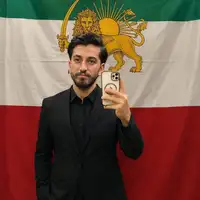
Masoud Pezshkian during a campaign event in Tehran on June 23, 2024
Masoud Pezeshkian, Iran’s pro-reform candidate, is notably non-combative and refrains from personal attacks on other candidates both in and outside of debates. When confronted with attacks, he remains silent.
Regarding agendas and issues, the 70-year-old doctor, commits only to implementing existing policies and laws, steering clear of any controversies.
Former president Hassan Rouhani claims that two candidates, Alireza Zakani and Amir Hossein Qazizadeh, were qualified by the Guardian Council specifically to attack the pro-reform candidate during the debates. This raises the question: does Pezeshkian, as the sole advocate of some reforms, have a chance to win? If he does win, what changes can he deliver in domestic and foreign policies?
Pezeshkian’s chances of winning
Four realities on the ground tell us that we should not consider him a loser at this moment. The first one is that other candidates believe he could win. When Pezeshkian said Zakani is going to withdraw and support another candidate in the third debate, Zakani replied "I will not let you become the president." This means that he believes in the possibility of his victory.
The second notable fact is the anticipated increase in voter participation compared to the 2021 presidential and March 2024 parliamentary elections. With the entry of the Reform Front, which has about 10-15% of the voting base, even if only half of them participate, overall turnout will rise. Not only the Reform Front supports Pezeshkian but historically, in the Islamic Republic, any increase in voter turnout has benefited pro-reform candidates. Still, overall turnout can be less than 50%, a bit higher than in the past two elections.
The third reality is reflected in the poll results from online and security institutions. Although these polls and their conducting institutions are not entirely trustworthy and tend to be biased against reformers, they cannot completely distort the public's opinion. Despite this bias, Pezeshkian consistently ranks first or second in these polls.
The fourth fact is the significant turnout at some of Pezeshkian's rallies in major cities. For instance, his election rally in a sports arena in Shiraz was packed, with several thousand people unable to get inside. A segment of the electorate, albeit small, believes that his presidency could bring about change.
Can a Pezeshkian presidency bring change?
Although Pezeshkian’s opponents and rivals label his potential administration as Hassan Rouhani’s third term, he is likely to be a weaker and less effective executive for three reasons.
First, his personality and background differ significantly from Rouhani's. Hassan Rouhani was one of the founders of the Islamic Republic and was the first to call Khomeini "Imam," elevating him to the status of a Shia saint. Rouhani served in top political and security positions for three decades before becoming president. In contrast, Pezeshkian has only served as the Minister of Health and a lawmaker.
The second reason is Rouhani's substantial electoral support, with over 18 million and 23 million votes in two elections, both with more than 70% voter turnout. This strong mandate allowed him to have some influence on foreign policy. In contrast, Pezeshkian is unlikely to secure such a large number of votes and lacks the ability to turn popular support into a strong mandate.
The third reason is the expanded power of the IRGC and the totalitarian faction during the Raisi administration. Today, all power channels are controlled by military and security ‘mafia’ type groups. Pezeshkian cannot marginalize them and would have to include them in his cabinet. Their influence in the Khatami and Rouhani cabinets was significantly less than the current political reality. Due to Ali Khamenei’s support for these hardliners, Pezeshkian cannot challenge them.
For these reasons, a Pezeshkian administration would not only fail to replicate Hassan Rouhani's but would likely be much weaker and more disastrous. While Rouhani at least demonstratively drafted a charter for citizens' rights, which was quickly forgotten, or criticized the IRGC, Pezeshkian would be unable to even address these issues. Additionally, Rouhani never pledged to follow Ali Khamenei’s policies unquestioningly or to be “melted in him,” a promise Pezeshkian cannot avoid making.
The opinions expressed by the author are not necessarily the views of Iran International.
Iran says Canada is violating the human rights of Iranian expatriates by not allowing them to cast absentee votes in the upcoming presidential elections slated for June 28.
Kazem Gharibabadi, the Secretary of Iran's High Council for Human Rights, said Sunday that it is a “violation of human rights” to leave many Iranians without possibility to cast their ballots in Canada.
"After Canada severed diplomatic relations with Iran, we no longer have any political representation in Canada, and a vast number of Iranians there are deprived of consular services. How are Iranians supposed to participate in the presidential elections there? Is Canada's action against human rights or not?" he said.
The decision has sparked outrage among critics who view it as legitimizing the Islamic Republic’s "authoritarian rule".
The Presidential Election Headquarters of the Islamic Republic of Iran in the United States and Canada, which is run by Iran's Interests Section in Washington DC, recently said in a statement that "consultations are underway regarding the establishment of polling stations and the feasibility of absentee and postal voting" to facilitate voting "for fellow Iranian compatriots residing in the United States and Canada."
Since 2012, Canada and Iran have not maintained formal diplomatic relations. In the absence of direct diplomatic presence, Italy serves as the protecting power for Canada in Iran, while Switzerland fulfills this role for Iran in Canada.
Canada cut off diplomatic relations with Iran and shut down its embassy in Tehran due to several concerns including Iran's support for the Assad regime amid the Syrian civil war, failure to adhere to UN resolutions on its nuclear activities, ongoing threats against Israel, and concerns for the safety of Canadian diplomats, especially after attacks on the British embassy in Iran.
Furthermore, Canada designated the Iranian government as a state sponsor of terrorism under the Justice for Victims of Terrorism Act and the Canadian Department of Foreign Affairs and International Trade discouraged all travel to Iran by Canadian citizens.
Further straining bilateral relationships with Tehran, Canada on Wednesday designated Iran's Revolutionary Guards Corps (IRGC) as a terrorist organization. The move, supported by the families of the victims of Ukraine International Airlines Flight PS752—which was shot down by the IRGC in January 2020—marks a significant escalation in Canada's stance against Iran.
In response, Gharibabadi called the move by Canada "hostile" and defended the IRGC as a key element of Iran's national security apparatus responsible for countering terrorism in the region.
The official designation of the IRGC as a terrorist organization aligns Canada with other nations taking a firm stance against Iran's aggressive activities.
The Iranian Chess Federation has announced a suspension of all activities, including competitions and training in the lead-up to the Presidential elections in a bid to ensure people come to the polls.
"While encouraging all the great chess community of the country to participate enthusiastically and widely in the elections, by the order of the Ministry of Sports, any sports activities, including holding competitions, training courses, and classes, etc. are prohibited from June 27-30, 2024," said the statement from the Ministry of Sport.
If the elections extend to a second stage, the suspension will also apply from July 4 to July 7, 2024, it added.
The federation did not provide further explanation for its decision or specify how training classes or chess tournaments could impede the presidential elections.
It comes as record low turnout is expected for the snap election on June 28. The elections were called after President Ebrahim Raisi died in a freak helicopter crash last month along with his delegation.
Latest polls predict at least two thirds of Iran will abstain from the sham vote which offers six candidates, hand chosen by the country's supreme leader.
As Iran approaches its snap presidential elections, families of slain protestors and activists are urging the public to boycott the event.
Goljahan Ashrafpour, the mother of Akbar Mohammadi, a student activist who died in prison, called the elections "a charade", speaking from her hospital bed.
Atash Shakrami, the aunt of 16-year-old Nika Shakrami, a protestor killed during Iran’s 2022 nationwide uprising, spoke out on Instagram.
"The hands of every government agent are stained with the blood of the nation's children," she stated, underscoring the pain and anger felt by many families who have lost loved ones under the regime oppression.
Writing on Instagram, Foad Choobin, the uncle of 17-year-old Artin Rahmani, killed during the protests in November 2022, reminded the public of the tragic events that took his nephew's life.
"We will not forget that in November 2022, agents of the Islamic Republic shot at us and killed Artin...we will not participate in this election circus…we will not vote for any of the 6 candidates who whitewash Khamenei’s crimes," he wrote.
In recent days many activists, student unions, and prominent opposition figures of the Islamic Republic have called for the boycott of the elections.
Like the March parliamentary elections, turnout is expected to be at record lows. At least two thirds of Iranians revealed they do not plan to vote, according to latest figures.
As the Islamic Republic faces its greatest battle for legitimacy since its founding, a new survey shows at least 65 percent of the country will boycott the upcoming presidential elections.
According to the survey conducted by the Netherlands-based Gamaan Institute, only 22% of respondents confirmed they would definitely vote, while 12% remain undecided.
Titled "Iranians’ Attitudes Toward the 2024 Elections," the survey was conducted online over three days from June 17 to 19, 2024, with a sample of 77,216. However, in the past three days the election campaign might have somewhat impacted voters' mood in favor of participation.
Figure 1, GAMAAN June 2024 Survey
Additionally, approximately 34% of the population reported being unaware of the date of the snap election on June 28 in the wake of the sudden death of former President Ebrahim Raisi. He died last month in a helicopter crash along with several officials.
Figure 2, GAMAAN June 2024 Survey
The results of the survey highlight deep-seated dissatisfaction with the current political system, with roughly 68% of respondents citing "opposition to the overall system of the Islamic Republic" as their primary reason for not voting. Other notable reasons included "the limited power of the president" (18%) and the "disqualification of my preferred candidate" (8%).
Iran International cannot independently verify the accuracy of the survey since polling with traditional methods is not possible within Iran.
However, in February this year, Gamaan’s survey revealed that three-quarters of Iranians will boycott the upcoming parliamentary elections, with 75% seeking the overthrow of the government. The prediction of that survey came out to be largely true, with the government claiming a 40% turnout.
Figure 5, GAMAAN June 2024 Survey
The survey also touched on public perceptions surrounding the helicopter crash which killed Raisi, with 51% of respondents attributing it to "power struggles within the regime," while 13% believing it was due to natural factors, and 6% suspecting sabotage by foreign countries.
Figure 7, GAMAAN June 2024 Survey
The findings reflect the general mood in the country amid economic and social turmoil. Iran has been suffering from more than 40% annual inflation for the past four years, and unprecedented government violence against those who have dared to protest since 2019.
In recent days, political and civil figures, women activists, and civil organizations, have called for boycotting the elections. More than 500 teachers, union activists, and prominent cultural figures in Iran publicly announced their decision to abstain from voting in the upcoming presidential elections through a joint statement.
Similarly, political prisoner Mahboubeh Rezaei slammed the elections explaining that “the Islamic Republic has no legitimacy" after almost two years of the Woman, Life, Freedom uprising has left the government in crisis.
Dozens of citizens also said in messages to Iran International that they would not participate in the elections.
With the world's largest diaspora of Iranians abroad, there will be over 30 stations in the US which last year labeled Iran the world's number one state sponsor of terror.
Ballot boxes will be set up at the Iranian Interests Section of the Pakistani embassy in Washington and in New York among others.
Many Iranians are still deliberating whether to boycott the "neither fair nor free" elections or to vote. The only candidate with the potential to sway some of these voters appears to be the pro-reform Masoud Pezeshkian.
Pezeshkian’s chance of being elected as the Islamic Republic’s next president largely depends on a high voter turnout. However, predicting public sentiment for the June 28 election is challenging due to the lack of reliable and independent surveys. So far, there is little evidence on social media or from reports inside Iran to suggest a shift in the public’s generally indifferent attitude toward the elections.
Three government agencies – the intelligence and interior ministries and the state broadcaster (IRIB) – conducted separate surveys in all previous elections. Results were not publicly announced but were often leaked to the media which referred to them only as “poll by a reliable state agency”.
In these elections, however, poll results are being tightly guarded, likely to prevent evidence of a possible low turnout from reaching the public. Authorities have also warned about unofficial online polls, labeling them as “falsified,” and have arrested at least twenty people for conducting such polls.
At this stage, former nuclear negotiator Saeed Jalili and newly re-elected speaker of the parliament, Mohammad-Bagher Ghalibaf, both of whom are hardliners, appear to be the strongest contenders with Pezeshkian closely following them in most unofficial, online polls.
Pezeshkian supporters in Sanandaj
Pundits say Pezeshkian has a chance of winning against his rivals if both hardliners remain in the race and around 60 percent of eligible voters go to the polls. Jalili and Ghalibaf have both insisted that neither will withdraw in favor of the other.
The chances that the three other candidates -- hardliners Alireza Zakani and Amir-Hossein Ghazizadeh, and conservative Mostafa Pourmohammadi – make a significant difference in the outcome of the elections is too small unless they withdraw in someone else’s favor, pundits say.
Pezeshkian, an independent politician with views close to reformists, is being supported by the Reforms Front and some moderate conservatives, including former Foreign Minister Mohammad-Javad Zarif. In the three highly controlled debates aired by the state television so far, Pezeshkian has presented a rather conservative image.
Zarif announced his support for Pezeshkian on June 17 and accompanied him to the second televised debate of the candidates where he delivered a fiery speech. Zarif’s support could increase Pezeshkian’s popularity among some of the voters but also has the potential to damage his position among other groups of the Iranian society.
Since then, he has actively promoted Pezeshkian on social media, Club House discussions and campaign meetings. Zarif also traveled to Kashan in central Iran on Friday where ultra-hardliners tried to disrupt his speech.
Pezeshkian supporters in Shiraz
In the past few days Pezeshkian’s popularity appears to have increased on social media. Google Trends also suggests he has been looked up more than the other candidates by more people since the first televised debate.
On Saturday, Pezeshkian received a rather warm welcome in Sanandaj, the capital of Iran's Kordestan Province, and then in Shiraz, the capital of Fars Province. Thousands also gathered for his speech in Ahvaz, the capital of the oil-rich but poverty-stricken province of Khuzestan, in the evening of the same day.
In Shiraz, thousands of supporters filled the stadium where he spoke, reiterating his promises to fight for social freedoms and try to solve the problem of crippling sanctions and corruption.
These, some Iranian social media users say, are only empty promises because they believe it is Supreme Leader Ali Khamenei who has the final say in all matters of importance and there are other centers of power, including a hardline dominated parliament and the Revolutionary Guards (IRGC), that can sabotage Pezeshkian’s efforts as they did when Hassan Rouhani was president.
Pezeshkian supporters in Ahvaz waiting for his arrival outside a packed hall
Those in favor of boycotting elections also argue that voting for Pezeshkian, whether he merits being chosen president or not, is tantamount to acknowledging the legitimacy of the Islamic Republic and its elections that they believe are “engineered”.
Others say he is not so different from the other candidates and politicians because throughout his campaign he has insisted in his speeches and election debates that if elected, he will not introduce any new economic plans and only carry out the existing ones that have been “approved” by Khamenei.
Critics also say Pezeshkian, 70, is out of touch with the younger generation who were the driving force of the anti-government protests of 2022-23.
Pezeshkian appears to be betting on the votes of ethnic groups and the Sunni minority who are mainly Kurdish, Turkmen and Baluchi speakers.
He has advocated the teaching of Turki, the Turkic dialect spoken in Iran's East and West Azarbaijan provinces, as well as other ethnic languages such as Kurdish in schools and says he will champion the rights of all ethnic groups and the Sunni minority.
Pezeshkian was born to a Kurdish mother and Azari father in the Kurdish city of Mahabad and is fluent in Turki and Kurdish languages. Some of Pezeshkian’s campaign posters have been printed in these two languages and he delivered part of his speech in Sanandaj Saturday in Kurdish.