• العربية
  • فارسی
Brand
  • Iran Insight
  • Politics
  • Economy
  • Analysis
  • Special Report
  • Opinion
  • Podcast
  • Iran Insight
  • Politics
  • Economy
  • Analysis
  • Special Report
  • Opinion
  • Podcast
  • Theme
  • Language
    • العربية
    • فارسی
  • Iran Insight
  • Politics
  • Economy
  • Analysis
  • Special Report
  • Opinion
  • Podcast
All rights reserved for Volant Media UK Limited
volant media logo

Zarif’s Name Pops up Amid Iran’s Presidential Race

Mardo Soghom
Mardo Soghom

Iran International

Jun 9, 2024, 21:53 GMT+1Updated: 16:37 GMT+0
Mohammad Javad Zarif, Iran's former foreign minister

A short video interview with a 'moderate' candidate in Iran’s upcoming presidential election has stirred interest because a reporter asked the candidate if he would appoint Javad Zarif as foreign minister if elected president.
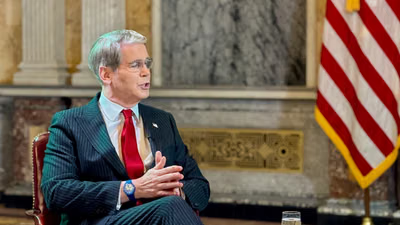
Massoud Pezeshkian, a lawmaker running as the sole ‘reformist’ candidate replied that he would welcome people “who have experience, knowledge and are effective,” without directly affirming or rejecting Zarif’s possible appointment.

Pezeshkian is being promoted by some on social media as an alternative to five other candidates who are clearly on the conservative side of the political spectrum. Whether the highly manipulated election will give Pezeshkian a fair chance, or whether millions of disillusioned voters would rally around him are entirely different questions.

In the last three elections, in 2020, 2021 and March 2024, a substantial segment of voters stayed away from the ballot box. Turnout was substantially below 50%, although amid government control over information it is hard to exactly know how many people voted. In the March parliamentary elections, officials announced that around 40% of eligible voters participated, but many regard this as an exaggerated tally by those who are in control.

Zarif has not commented on his willingness to re-enter the government. However, he was one of over 150 'reformist' figures who signed a letter last week, urging the regime to moderate its behavior and encouraging people to vote. 'Reformists' as their label denotes, are committed to the essence of the Islamic Republic as a political system but cautiously criticize some of its practices.

For example, in the letter, signed by many prominent 'reformists' homage is paid to Iran's missile and drome attack on Israel, harshly condemning the United States for its support for the Jewish state. However, the signatories criticize the regime for its internal policies favoring hardliners and creating a rift with the people.

The make-up of six candidates, out of 80 aspirants, approved by the unelected Guardian Council, which is controlled by Supreme Leader Ali Khamenei, is not much different from the 2021 election. The list is dominated by conservatives and hardliners loyal to Khamenei, with one ‘reformist’ included who has to face difficult odds if 10 million more voters do not turn up to push him ahead of others.

But voters have tested what many call “the regime’s game.” In order to increase turnout and boost the Islamic Republic’s waning legitimacy, sometimes a reformist is included to attract voters. Even if that candidate wins, an array of conservative state institutions, media and pressure groups launch obstructive campaigns to make the elected official ineffective.

This is what happened to President Mohammad Khatami (1997-2005), who faced crisis after crisis during his tenure, mostly manufactured by hardliners. The same awaited ‘centrist’ Hassan Rouhani (2013-2021), who was harassed and subjected to incessant attacks, while having little control over key economic and diplomatic decisions.

These two presidents were elected by large turnouts encouraged by ‘reformist’ groups and parties. However, voters realized that no meaningful change could take place, even if a ‘reformist’ is president or ‘moderates’ dominate the parliament.

The question now is whether Pezeshkian, a physician seemingly untainted by corruption scandals, can motivate "the gray strata" to come out and vote. If he secures a decisive victory, he might consider appointing Javad Zarif. However, it's important to note that Khamenei has the final say on most ministerial appointments. If he agrees with Zarif’s appointment, it could mean an inclination to use his diplomatic experience to find a way out of back-breaking sanctions that have paralyzed the economy.

Most Viewed

Ukraine moves to aid US in Iran war after striking Tehran-Moscow supply link
1

Ukraine moves to aid US in Iran war after striking Tehran-Moscow supply link

2
PODCAST

Is Iran using the US war to accelerate executions and silence dissent?

3

Potential US targets in Iran extend beyond Pickaxe Mountain - WSJ

4

Thousands pack Tehran mall as Gen Z rallies around a YouTube star

5
ANALYSIS

Iran is living through America’s 2022 inflation shock almost every month

Banner
Banner
Banner

Spotlight

  • US strikes pause. What comes next for Iran?
    PODCAST

    US strikes pause. What comes next for Iran?

  • Iran is living through America’s 2022 inflation shock almost every month
    ANALYSIS

    Iran is living through America’s 2022 inflation shock almost every month

  • Tehran braces for possible new phase of war
    INSIGHT

    Tehran braces for possible new phase of war

  • Cafés close, tolerance ends: Iran’s post-war shift on compulsory hijab
    INSIGHT

    Cafés close, tolerance ends: Iran’s post-war shift on compulsory hijab

  • Iran bears biggest economic cost of Hormuz closure
    ANALYSIS

    Iran bears biggest economic cost of Hormuz closure

  • Russia’s gasoline imports add pressure to Iran’s strained fuel market
    ANALYSIS

    Russia’s gasoline imports add pressure to Iran’s strained fuel market