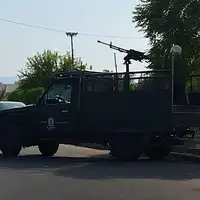
Iran Deploys Drones to Help Enforce Women’s Hijab

Iranian authorities have implemented drone surveillance on Kish Island in the south to enforce the country’s mandatory hijab laws, as shown in a video released by Iranian media.

Iranian authorities have implemented drone surveillance on Kish Island in the south to enforce the country’s mandatory hijab laws, as shown in a video released by Iranian media.
The footage shows law enforcement agents confront and stop women in public areas, escalating the enforcement of compulsory hijab.
The news of the surveillance has sparked significant backlash on social media, with many users condemning the government's tactics.
Critics have drawn parallels between the use of Iranian drones for military purposes in Ukraine and against Israel – and, their current domestic use against women now for the enforcement of dress codes.
The enforcement of the hijab is part of a broader initiative dubbed the Noor plan, at the directive of the Supreme Leader, which Iranian police claim responds to "national and public demand" for stricter adherence to hijab.
The physical presence of the "morality police” has intensified, particularly in Tehran’s central districts, following a period of reduction after the death of Mahsa Jina Amini in 2022. Amini's death in “morality police” custody, which resulted from severe head injuries, ignited the most substantial protests against the regime since the establishment of the Islamic Republic in 1979.
The resurgence of strict enforcement occurs as the controversial "Hijab and Chastity Culture" bill lingers in legislative proceedings.
Although awaiting final approval, authorities have already started to implement its strict regulations. Women are increasingly threatened with severe punishments, including arrest and travel bans, for non-compliance with the mandatory hijab.
The bill initially passed the Iranian parliament in September 2023 but was sent back for further review by the Guardian Council, the ultimate legislative authority in Iran, signaling ongoing contention and enforcement challenges within the country.


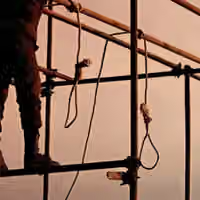
Amnesty International is warning of the imminent execution of Kurdish Sunni prisoner Kamran Sheikheh, the last survivor of seven men arbitrarily condemned to death, highlighting the continued escalation in the country's execution spree.
“Earlier today, Kamran Sheikheh, the last remaining survivor of this group, was transferred to solitary confinement, raising concerns he is at imminent risk of execution,” the human rights organization wrote Thursday on X.
Sheikheh was detained in December 2009 alongside Anwar Khezri, Ghasem Abasteh, Ayoub Karimi, Farhad Salimi, Davoud Abdollahi, and Khosrow Besharat.
The Kurdish men faced allegations over reportedly trumped-up charges, including "moharebeh," "corruption on earth," "supporting Salafi groups," and the killing of an imam named Abdolrahim Tina in 2008. The charge of “moharebe” (waging war against God) and “corruption on earth” both carry the death penalty in Iran.
In 2017, the men were sentenced to death, but the Supreme Court overturned the verdict and referred the case to Branch 15 of the Revolutionary Court in Tehran. Despite this, Branch 15 reissued the death sentences in June 2018, and the Supreme Court confirmed these sentences in February 2020.
Besharat was executed this week, two weeks after Khezri, Abdollahi and Salimi were killed in January, and Abasteh and Karimi were executed last November.
In published letters, Besharat and the other defendants repeatedly asserted their innocence, denying the charges against them.
An Amnesty International report last month, titled "Don't Let Them Kill Us" showed that there were an unprecedented number of executions in Iran in 2023, noting that at least 853 were killed – with a large number of minorities, including Kurds, among them.

Turkey has signed an agreement with Azerbaijan to import and transit Turkmen natural gas, excluding Iran from Turkmen gas east-west land transit routes to the Mediterranean and Europe.
Turkish and Azerbaijani energy ministers signed a comprehensive deal in Istanbul on May 15 on capacity expansion for several natural gas pipelines as well as Turkmen gas transit.
Turkey's energy and natural resources minister Alparslan Bayraktar said that the deal would allow for additional gas volumes from Azerbaijan and Turkmenistan to Turkey and Europe by 2030, although the exact volumes are yet to be announced.
Ankara and Ashgabat had already signed a gas purchase deal in March 2024.
Bayraktar also said that the Igdir-Nakhchivan gas pipeline would be operational soon.

Ilham Shaban the head of Baku-based Caspian Oil Research Center told Iran International that Turkmenistan can deliver a restricted amount of gas (2-3 bcm/y) to Azerbaijan by constructing a short subsea pipeline, connecting Turkmen offshore gas fields to Azerbaijan’s Azeri-Chirag-Guneshi block, or a significant amount of gas by constructing the 300-km Trans Caspian pipeline.
During last two decades Azerbaijan has been supplying gas to its Nakhchivan territory, a region geographically separated from the mainland, by swapping gas with Iran that has a border with the small Azerbaijani region. After launching the Igdir-Nakhchivan pipeline Baku can deliver its own gas to the landlocked exclave of the Republic of Azerbaijan through Turkey.
Currently two gas pipelines connect Azerbaijan and Turkey through Georgia: Southern Gas Corridor and Baku-Tbilisi-Erzurum.
Azerbaijan exported 24 billion cubic meters of gas in 2023, of which 2.5 bcm went to Georgia, 9.5 bcm to Turkey and 12 bcm to Europe via the Southern Gas Corridor.
EU and Baku sealed a memorandum of understanding in July 2022 to double Azerbaijani gas intake by 2027.

Iran is excluded from transit routes
Although Iran does not have any dedicated and direct pipeline to connect Turkmenistan to Azerbaijan or Turkey via its territory, it has a vast pipeline network for gas swap operations. Iran had already swapped about 4 bcm of Turkmen gas to Azerbaijan during December 2021 to January 2024, but Baku and Ashgabat recently stopped the deal. Iran was getting 15% of gas volume as swap fee; three times more than gas transit fees through Georgia or Turkey. Tehran was receiving gas from Turkmenistan that it used in its northern and northeastern regions, while delivering the agreed amount of gas from its northwestern regions.
Alongside Russia and Azerbaijan, Iran is also a natural gas supplier to Turkey, but in the past three years, deliveries have been interrupted frequently in winters due to Iran’s own severe domestic shortages. Iran is unable to boost its output due to lack of investments and Western technology, restricted by sanctions.
As a result, Turkey halved Iranian gas intake to 5.2 bcm in 2023.
The 25-year gas deal between Turkey and Iran will expire in 2026.
Last year, Turkmenistan exported 40 bcm of gas also to China and more limited volumes to Central Asian states, but with deep discounts.
According to Iran International’s calculations based on Chinese and Azerbaijani customs statistics, China imported Turkmen gas at $240/1000 cubic meters, or less than a half of Azerbaijani gas prices in European markets.

As Iranian authorities violently clamp down on women refusing to wear the hijab, the minister of culture appeared to justify the mandate by citing carvings in ancient Persepolis showing women in "appropriate clothing."
Mohammad Mehdi Esmaili said Thursday that "Iranian identity and the post-Islamic era do not conflict," as Iranian women wore "appropriate clothing" at that time, based on petroglyphs from the 2,500-year-old Persepolis.
Founded by King Darius I, Persepolis was the ceremonial capital of the Achaemenid Empire. It is a UNESCO World Heritage Site and existed 1,100 years before the founding of Islam.
The Islamic Republic’s first Supreme Leader, Ayatollah Ruhollah Khomeini, made the hijab mandatory for women as one of his priorities after the Islamic Revolution in 1979.
In recent years, the Iranian populace has, according to the most recent polling, undergone "secularization and liberalization faster than any society in the Islamic world, despite having lived under the rule of Islamists for decades."
The culture minister’s comments this week come as Iranian women continue to defy the Islamist compulsory veiling laws in the country, which Amnesty International has called a war on Iranian women and girls.
“The pre-Islamic era is not a threat to us but an opportunity…our reading of it should be based on the teachings of Supreme Leader Ali Khamenei and founder of the Islamic Republic Ruhollah Khomeini,” Esmaili stated.
Dubbed the “Noor Plan” Khamenei issued a directive weeks ago to re-intensify the physical crackdown on women refusing to wear the hijab. Since then, videos have circulated on social media, showing the “morality police” using violence to detain women seen in public without the hijab.
While there has long been opposition to the mandated veil in Iran, authorities have increasingly struggled to enforce the regime’s Islamic dress code after the killing of Mahsa Amini in September 2022, and the ensuing nationwide protests. Many women in cities now defy mandatory veiling.

Senator Jim Risch, Ranking Member of the Senate Foreign Relations Committee, suggested Thursday that his committee might issue a subpoena to get details about what led to the downfall of former Iran envoy, Robert Malley.
Malley was appointed by President Joe Biden in early 2021 as the administration announced its plans to begin talks with Iran to revive the 2015 JCPOA nuclear deal. For many years, he had been an advocate of engagement –and not isolation– of the Islamic Republic.
After 18 months of multi-lateral talks with Iran in Vienna it became finally apparent that Tehran was not inclined to accept Western proposals, and the talks broke down.
In April 2023, Malley was noticed to be absent. Iran International was first to report two months later that Malley had been placed on compulsory leave and had his security clearance suspended.
For more than a year now, members of US Congress have been trying to figure out “what he did, when he did it, and how much damage he has cost US national security,” in the words of Risch, who grilled the Deputy Secretary of State, Rich Verma, during a committee hearing on Thursday.
“The Rob Malley saga has been wildly out of control,” Senator Risch said. “Your department has failed to respond for months… We can’t help but conclude there’s an orchestrated effort to obscure the facts from Congress… and we probably won’t get answers until we agree to issue a subpoena.”
Last week, two influential congressmen suggested that Malley had lost his security clearance because he had transferred classified documents to his personal email and cell phone, and the documents were then stolen by a hostile “cyber actor.”
“Can you confirm that a malign cyber actor actually gained access to Mr. Malley’s personal email,” Senator Risch asked Verma –to which Verma replied, “I’m not in a position to speak to the status of the investigation or anything related to it.”
The Malley ‘saga’, as Risch put it Thursday, is set against the backdrop of growing concerns over Iran’s “influence” operations in the US. In fact, Rob Malley’s case seems to be a significant factor in such concerns.
Only a day before the SFRC hearing, US Director of National Intelligence Avril Haines predicted that the Iranian regime would intensify its cyber and influence activities in the run up to the 2024 elections in November.
“Iran is becoming increasingly aggressive in their efforts,” Haines told the US Senate Select Committee on Intelligence on Wednesday. “[They] seek to stoke discord and undermine confidence in our democratic institutions, as we have seen them do in prior election cycles.”
President Biden has been widely attacked for not being assertive enough in dealing with Iran and its anti-US activities. Biden critics say his ‘soft’ approach and his fear of a regional war has only emboldened the Islamic Republic to pursue its ambitions more aggressively, increasing the risk of the large-scale war that he’s fearing.
More pertinent, the critics say Biden's Iran policy may have been influenced by individuals, including Rob Malley, who seem to take too much note of Iran’s positions due to their political views or longstanding and extensive relationship with individuals linked to Iranian officials.
“We deserve to know whether Mr Malley’s crimes impacted US-Iran policy, influenced nuclear discussions, or swayed the President’s decisions to unfreeze cash for wrongfully detained Americans. Or importantly, misinformed us as we tried to formulate foreign policy,” Senator Risch said in the hearing Thursday.

Iran's interior minister has raised an outcry not only for approving the violent arrest of a woman for hijab violation but also claiming that catching the woman in a blanket, was “according to protocols”.
Ahmad Vahidi made the statement in response to a reporter’s question after a cabinet meeting this week, who asked him about the viral video of the arrest of the woman on a street in central Tehran Monday.
The video shows two black-veiled women dragging, a woman with uncovered hair, shoving her and pushing her to the ground before taking her away in an unmarked van accompanied by a police car.
The woman’s top came off during the scuffle after which one of the enforcers fetched a blanket from the van to throw it over her and push her into the vehicle.
Vahidi claimed that the woman had “disrobed” herself so she had to be covered up with the blanket.
The use of blankets to cover women at the time of their arrest has been reported in a few other instances in the past few weeks.
Video showing the incident that the interior minister commented on
“I have a daughter and cried so much after seeing the video. I cried even more when the minister confirmed that catching girls using blankets in the manner that we saw is protocol. Please don’t give birth to girls. Having a daughter here is the greatest calamity. Being a woman in Iran is the hardest of things, particularly now that we know they have a ‘blanket protocol’ for hunting us,” a woman posting as Sousan on X wrote.
Even some moderate regime supporters have condemned the violence on social media.
“What does the law say about [using] blankets [in this manner]? Who would dare do such things if General [Qasem] Soleimani were alive. He would say girls with unsatisfactory hijab were his daughters too. There’s a difference between gold and copper!”, an X user tweeted.
Another video showing a male hijab enforcer throwing a blanket over a woman resisting arrest in Tehran
In recent years, many Iranian women have protested mandatory hijab, leading to arrests and imprisonment. Authorities have also impounded thousands of cars and closed businesses for failing to enforce hijab rules.
Many Iranians, including some women who wear the hijab themselves, believe that wearing or not wearing the hijab is a personal decision. Eighty four percent of the over 12,000 respondents to an online poll by the reformist Shargh daily in October said they were opposed to mandatory dress code and headscarves.
This very recent video shows police violently arresting a woman for hijab
Hardliners, particularly the small but very influential Paydari Party which is positioned at the extreme end of the fundamentalist camp in the Islamic Republic, have been looking for ways to strengthen the enforcement of hijab. Their ‘morality police’ tactic of arresting women for “improper hijab” backfired with the death of Mahsa Amini in September 2022, triggering nationwide Woman, Life, Freedom protests that lasted for months and shook Iran's ruling establishment to its core. More than 550 civilians were killed by security forces and around 22,000 arrested.
Consequently, the morality police largely disappeared from the streets as authorities feared further backlash from the populace.
In March 2023, hardliners attempted to end women's increasing defiance of compulsory hijab and reclaim lost ground through various instructions to government bodies, but their efforts failed as the number of women who refuse to abide by the current rules only kept increasing.
On April 13, the infamous morality patrols returned to the streets. Since then, extensive violence including sexual harassment has been reported by the few relatively independent newspapers and websites that are aligned with reformists and moderate conservative as well as social media citizen reports.