• العربية
  • فارسی
Brand
  • Iran Insight
  • Politics
  • Economy
  • Analysis
  • Special Report
  • Opinion
  • Podcast
  • Live TV
  • Iran Insight
  • Politics
  • Economy
  • Analysis
  • Special Report
  • Opinion
  • Podcast
  • Live TV
  • Theme
  • Language
    • العربية
    • فارسی
  • Iran Insight
  • Politics
  • Economy
  • Analysis
  • Special Report
  • Opinion
  • Podcast
  • Live TV
All rights reserved for Volant Media UK Limited
volant media logo

Persian Plateau Is The Hub For Early Human Migration Out Of Africa, Study Reveals

Mar 25, 2024, 22:03 GMT+0
A person stands in Pebdeh Cave, in the southern Zagros Mountains, Iran, in this undated photo obtained by Reuters on March 25, 2024. Pebdeh Cave was occupied by hunter-gatherers as early as 42,000 years ago, inferred to be Homo Sapiens.

A new study has unveiled the Persian Plateau as a pivotal geographic location serving as a hub for Homo sapiens during the early stages of their migration out of Africa some 70,000 ago.
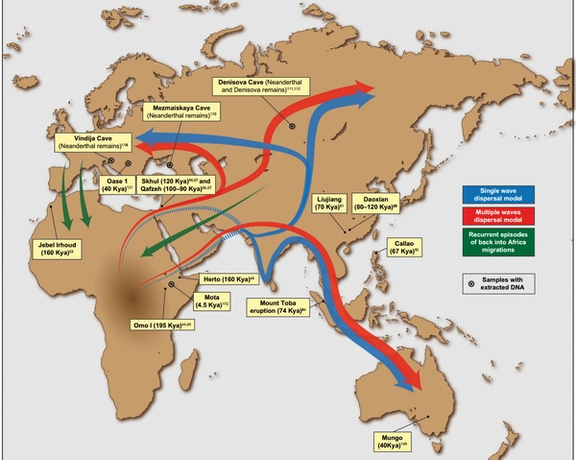
After years of debate, the new study said the human species, who emerged in Africa more than 300,000 years ago and migrated out of the continent 60,000 to 70,000 years ago, have lingered for thousands of years in a geographic hub that spanned Iran, southeast Iraq and northeast Saudi Arabia. These bands of hunter-gatherers then went on to settle all of Asia and Europe starting roughly 45,000 years ago.

Their findings were based on genomic datasets drawn from ancient DNA and modern gene pools, combined with palaeoecological evidence that showed that this region would have represented an ideal habitat, because of its capacity to support a larger population compared to surrounding areas in West Asia.

100%
Putative migration waves out of Africa and location of some of the most relevant ancient human remains and archeological sites.

"Our results provide the first full picture of the whereabouts of the ancestors of all present-day non-Africans in the early phases on the colonization of Eurasia," said molecular anthropologist Luca Pagani of the University of Padova in Italy, senior author of the study published in the journal Nature Communications, opens new tab.

Anthropologist and study co-author Michael Petraglia, director of the Australian Research Centre for Human Evolution at Griffith University, said the study "is a story about us and our history - our goal was to unravel some of the mystery about our evolution and our worldwide dispersal." "The combination of genetic and paleoecological models allowed us to predict the location where early human populations first resided as soon as they exited Africa," Petraglia added.

Most Viewed

Iran oil workers protest pay conditions at offshore platforms, Assaluyeh
1

Iran oil workers protest pay conditions at offshore platforms, Assaluyeh

2
PODCAST

Iran, where eggs are a better bet than cash

3

US carried out covert four-month Hormuz mine-clearing mission - FT

4
ANALYSIS

Starlink next door could loosen Iran’s grip on internet

5

Iran doubles gasoline price amid fears of renewed unrest

Banner
Banner
Banner

Spotlight

  • Iran deploys security forces as gasoline price rise takes effect
    VOICES FROM IRAN

    Iran deploys security forces as gasoline price rise takes effect

  • Iranian protester undergoes months of secret treatment to save wounded leg
    EXCLUSIVE

    Iranian protester undergoes months of secret treatment to save wounded leg

  • Iran’s new war strategy seeks to turn blockade into broader economic confrontation
    ANALYSIS

    Iran’s new war strategy seeks to turn blockade into broader economic confrontation

  • Europe’s third-way ambitions on Iran give way to alignment with Washington
    ANALYSIS

    Europe’s third-way ambitions on Iran give way to alignment with Washington

  • The gamble behind US attacks on Iran’s oil tankers
    ANALYSIS

    The gamble behind US attacks on Iran’s oil tankers

  • Starlink next door could loosen Iran’s grip on internet
    ANALYSIS

    Starlink next door could loosen Iran’s grip on internet