Iran's former president Hassan Rouhani has accused hardliners in power of preferring low-turnout parliamentary elections in March to keep control of the legislature.
“The ruling minority will establish itself better if we don't participate in the elections and minimal elections are held … There is a minority that does not want the majority to go to the ballot box,” Rouhani said in a speech at a meeting with a group of clerics and seminarians on Wednesday.
Rouhani’s website published the text of his speech on Saturday, shortly after Supreme Leader Ali Khamenei in a speech to a large group of hand-picked people from Kerman and Khuzestan provinces stressed the importance of voting in the upcoming elections.
In addition to electing a new parliament, the March 1 vote will also select the eighty-eight clerics of the Assembly of Experts that must choose Khamenei’s successor.
Blaming the opposition for discouraging people from voting, Khamenei insisted that the solution to the country’s problems is voting to form a “strong parliament” and that elections could prevent “dictatorship, chaos, insecurity, and turbulence (anti-government protests)”.
Rouhani registered to run in the elections of the Assembly of Experts at the last moment. He has been a member of the council for three consecutive terms since 1999. The last time that he was elected to the council was during his second presidential term in 2016 when he ran on a slate headed by the moderate former President Akbar Hashemi-Rafsanjani.
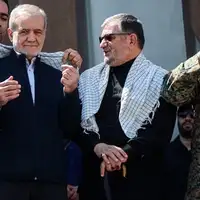
Presidents Ebrahim Raisi (left), Supreme Leader Ali Khamenei (2nd left), former president Hassan Rouhani and former parliament speaker Ali Larijani
President Ebrahim Raisi joined the council eight later than Rouhani, in 2007.
Agahi-ye No, a reformist bi-monthly, has claimed that several influential figures including the reformist former vice president, Esh’aq Jahangiri, former moderate conservative speaker of the parliament Ali Larijani, and moderate conservative former speaker Ali-Akbar Nateq-Nouri advised Rouhani to run again.
Last week, the Secretary General of the pro-Rouhani Moderation and Development Party, Mohammad-Bagher Nobakht, who also served as the Rouhani administration’s spokesman, said Rouhani is trying to put together a list of sixteen candidates for the Council seats from Tehran but has no intention of doing the same for the parliamentary elections.
Rouhani's website featured a headline that emphasized a sentence from his speech: "Sometimes not voting in elections is a kind of vote." This statement has been perceived by some of his opponents as an encouragement to abstain from voting.
In an editorial on Sunday, the ultra-hardliner Bultan News attacked Rouhani for “proposal not to participate in the elections, on the same day that the Leader of the Revolution stresses participation.”
However, in his speech the former president argued that by not voting, people may be indirectly expressing their opinion about candidates who are not considered competent. In the absence of suitable candidates, it is hard to encourage people to go the ballot boxes, he stated.
“We should try to encourage people to participate and take [appropriate] measures so that those who come to the polls can vote for at least a few people instead of casting blank ballots,” he said referring to the unprecedented blank and void votes that made up at least 10 percent of the vote in the 2021 presidential elections.
Convinced that hardliners committed to Khamenei’s policies will cruise to victory with the help of the Guardian Council, which has barred most other insiders, many Iranians are showing very little interest in the upcoming elections.
A poll recently conducted by the semi-official Iranian Students Polling Agency (ISPA), found 27.9 percent of those polled saying they would definitely vote against 36 percent who said they would not under any circumstances. 21.9 percent said they had made no decision yet.