Iran's Police Sends ‘Hijab Warning’ Text Messages To Men

Maryam Sinaiee
Iran International

Some men have said on social media that they received the police hijab warning text messages meant for women driving without a veil, for no reason.
Iran International
Some men have said on social media that they received the police hijab warning text messages meant for women driving without a veil, for no reason.
“I received a hijab warning text message! I swear by God that I was alone in the car!” former reformist vice-president Mohammad-Ali Abtahi tweeted Tuesday.
Abtahi who is a cleric jokingly said the police surveillance cameras had warned him for not donning his turban, but he didn’t know what to do because people try to toss his turban when he wears it.
“I got a text message warning me to abide by hijab rules. I think the surveillance cameras are unable to distinguish between men and women. The Chinese [surveillance equipment and software] are apparently the reason for that. They are too modern!” a male tweeter user said Tuesday with the hashtag NoToCompulsoryHijab and an image of the text message he had received.
“Dear citizen, respecting the hijab law and abidance by it is necessary as any other law,” a text message sent en masse to cell phone holders by the police in the past few days reads.
Khabar Online said official statistics indicate that there are over 141m sim cards in active use in the country. Iranian media say sending the said text messages has entailed a cost around 2 trillion rials ($40,000) to the police.
In the past few weeks, hardliner government officials, lawmakers, and clerics have also demanded that businesses refuse serving hijab-less women.
Opposition to compulsory hijab has grown hugely in the past few years. Apparently in a bid to lessen the direct engagement of the police against women and to avoid escalating the situation to protests as in September last year, authorities have been trying to shift the responsibility of enforcing hijab rules to businesses.
Punishment of businesses, including cash fines and closure, for hijab infringements by their customers has a long history in the Islamic Republic but this level of strict warnings and threats which puts great pressure on the retail and hospitality sectors at a time of economic hardship is unprecedented.
Some legal and Sharia experts say measures making businesses responsible for enforcement of hijab rules are not justified, even according to Sharia.
Mohsen Borhani, an Islamic law expert and lawyer, argued in a tweet that nowhere in Sharia one can find reasons to justify the ban on selling commodities to hijab-less women or to shut down a shop if a hijab-less woman is spotted there. “You neither abide by the law, nor the Sharia. It’s flustering!” he tweeted Tuesday.
Some Iranian politicians including former President Hassan Rouhani have repeatedly suggested holding referendums on “important issues”, which may include hijab in the current circumstances, to give the power of decision to the people. Supreme Leader Ali Khamenei, however, has ruled out the possibility of referendums despite the Islamic Republic’s own constitution.
“[Who says] the country’s various issues can be put to referendum? Where in the world do they do that? [Who says] all the people participating in a referendum have the faculty of analyzing that matter? What kind of demand is that?” he said Tuesday at a meeting with some students.
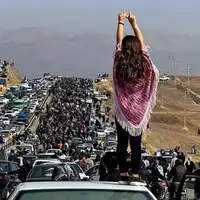
Defying hijab rules has turned into a form of civil disobedience. Many women have been sharing their photos taken in public places without hijab to prove that they have not given up despite the threats and harsher measures adopted recently.
The ultra-hardline Kayhan newspaper whose chief editor, Hossein Shariatmadari, is appointed by Khamenei claimed Monday that these images were “forged”.