A Top Iranian Conservative Admits Unrest In Iran Is Serious

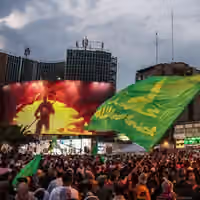
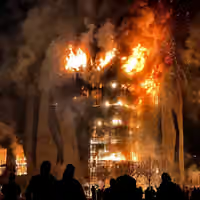
Recent protests in Iran were more widespread than in the past, an influential conservative has admitted, expressing surprise at the sharp international reaction.
Recent protests in Iran were more widespread than in the past, an influential conservative has admitted, expressing surprise at the sharp international reaction.
Mohammad-Reza Bahonar, who is a leading figure among hardliners, in a television program contradicted what the Islamic Republic has tried to portray as limited protests since September.
Bahonar, who is also a member of the regime’s Discernment Council, said that the protests were “more widespread and deeper than demonstrations in the past five years, but he still used the word “riots” to characterize the popular movement.
The clerical regime has refused to recognize that the unrest triggered by the death in custody of a young woman in September was a genuine popular expression of dissatisfaction at the multiple crises Iran faces.
However, he admitted that “certain grievances and inefficiency in the economy, politics and even culture and diplomacy exist in the country.” On a few occasions in the past one year, Bahonar who was a deputy speaker of parliament, has asked for reforming governance in the Islamic Republic, even directly appealing to Supreme Leader Ali Khamenei in February 2022 to support “structural changes.”
Bahonar has a proven track record in organizing and mobilizing conservative groups. He did that following the landslide victory of Iran's reformists in the 1997 presidential election and the 2000 parliamentary elections and consolidated the conservative groups. Nonetheless, he had remained conspicuously silent on major political issues until Iran’s economic situation deteriorated and President Ebrahim Raisi’s first few months in office came as a shocking disappointment to many conservatives.
In his latest statement, he repeated his previous position that "We need a second Republic," meaning that a Constitutional Assembly should be formed to determine new boundaries for the government's authority and the people's rights.
On the face of it, this is not much different from what Mir-Hossein Mousavi, the reformist opposition figure under house arrest, said Saturday. In scathing criticism of the regime, Mousavi put forth three conditions: A free and untainted referendum about the necessity to change or write a new constitution. Second, in case of a positive vote by the people, to form a constitutional assembly composed of the “real representatives of the nation” through a free and fair election. Third, a second referendum to approve the draft constitution to establish a regime based on rule of law, in conformity with human rights and the will of the people.
Although Bahonar repeated the official line that “enemies” played a major role in instigating the protests, he called for wider political participation. He argued that conservatives' political rivals should not be barred from elections as it was the case in the parliamentary and presidential elections in 2020 and 2021. He also criticized the political system for weakening the country's political parties.
This runs counter to Khamenei’s policy of consolidating rule under hardliners, with a substantial number of parliament members representing the Revolutionary Guard at the expense of hundreds of other loyalists who were prevented from running in the elections.
Bahonar criticized the one-sided vote in 2020 and argued that it resulted in a low elections turnout and convinced foreign powers that the Islamic Republic has lost its legitimacy.
Referring to recent protests and noting that they have not come to an end, Bahonar said that after the protests recede, “we should not forget about the people's grievances and protests, although we tend to forget about their complaints as soon as the situation calms down."