Sunni Leader In Iran Slams Government Policies Amid New Restrictions

Iran’s most prominent Sunni leader Mawlana Abdolhamid has criticized the government for not allowing criticism, while officials are planning more hijab enforcement.
Iran’s most prominent Sunni leader Mawlana Abdolhamid has criticized the government for not allowing criticism, while officials are planning more hijab enforcement.
In his Friday Prayer sermon in Zahedan, Abdolhamid called for freedom of speech and suggested that the Islamic Republic government should begin to include qualified secular individuals in its institutions.
The Sunni leader has become an outspoken critic of the Islamic Republic since nationwide protests broke out last September, and specially after security forces killed more than 80 civilians in the city on September 30.
Criticizing brutality in Iranian prisons, Abdolhamid said that inmates should not feel that they have been imprisoned by the enemy. "All Muslims and followers of other faiths should be treated fairly and equally in prisons. Wardens should not insult or attack the inmates," Abdolhamid stressed.
The call for fair treatment of inmates was made while photos of a political prisoner, Farhad Meysami has gone viral on social media and even found their way to more controlled traditional media. Meysami who has been in jail for five nearly years for doing nothing other than opposing the death sentence, supporting women who removed their scarves in public in 2018, and calling for the release of other political prisoners, is seen in these pictures with his ribs and bones alarmingly visible under his skin with almost no fat and flesh.
Abdolhamid also called for press freedom in Iran and said that journalists should be free to speak about the realities and highlight weaknesses. Meanwhile, he warned government officials that "there is no value in ruling over people who do not want you." In another part of his sermon, Abdolhamid called on the government to release Sunni leaders Mawlana Abdolmajid, Mawlana Gorgij and the Mamustas (Sunni clerics in Kurdistan) from jail. He said these men of God wish well for the society. So, they should not be intimidated or threatened.
The Sunni leader’s critical comments came one day after Shiite cleric Mousa Ghazanfarabadi, the head of the Iranian parliament's Judiciary Committee called for harsher treatment of those who undermine the compulsory hijab rule.
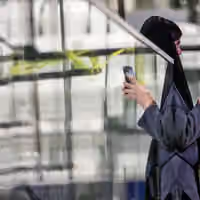
Ghazanfarabadi suggested that those women who undermine compulsory hijab should first receive a text message on their phone and then they should be fined in case they continue to ignore the hijab, and they will be deprived of all social services until they pay the fine.
He also suggested that bad-hijab women should be identified using face detection technology in the streets. Once they are identified, their ID cards will be confiscated, and they will be deprived of social services including using the banking system. He said the parliament is adamant to implement this plan once it is finalized and becomes a law.
However, he insisted that the new system of dealing with bad-hijab women does not include any physical confrontation.
The protests began when Mahsa Amini, a 22-year-old woman was fatally wounded in the custody of the ‘hijab police’ in September. During widespread street protests officials were careful not to speak about enforcing the veiling rule, but now they feel they have crushed the movement.
All this is happening against a backdrop of general dissatisfaction about the deteriorating economic situation. In one of the latest cases of unhappiness about the government's performance, Deputy Commander of the Iranian Army, Habibollah Sayyari said that the budget allocated to the army for the coming year is not enough to confront the many threats Iran is facing in the region.