IRGC Commander Repeats Threat To Avenge Soleimani’s Death
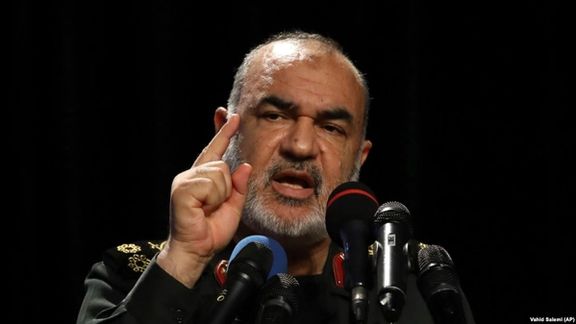
Iran’s hardliner commander of Revolutionary Guard has once again threatened the West to take revenge for the killing of former IRGC General Qassem Soleimani.

Iran’s hardliner commander of Revolutionary Guard has once again threatened the West to take revenge for the killing of former IRGC General Qassem Soleimani.
Major General Hossein Salami said Sunday during an event to commemorate Soleimani’s death that “sooner or later we will avenge his assassination.”
He claimed that no one can create problems for the Islamic Republic establishment, and addressing the West he said, “stop your miscalculations.”
Soleimani was in charge of supporting and organizing militant proxy forces, including the Lebanese Hezbollah and Iraq Shiite militia groups that were repeatedly attacking US forces in Iraq and eslewhere.
On Saturday, Iran’s Revolutionary Guard said retaliatory military attacks against US targets for the killing of Qassem Soleimani in 2020 are still viable options.
IRGC spokesman Ramazan Sharif was quoted by Iranian media as saying that “moves such as [the attack on] Ain al-Assad base [in Iraq] are still being considered and “will become operational in due time.”
Five days after Soleimani was killed by a US air strike on January 3, 2020, Iran fired ballistic missiles at the Iraqi base hosting US troops. No Americans were killed but reports at the time spoke of dozens of servicemen receiving concussion because of the strong explosions.
At the time, President Donald trump who ordered the killing said that Soleimani presented an imminent danger to US personnel and interests in the region.
Since then, the Islamic Republic has continued threatening revenge for Soleimani, and these threats were repeated during the third anniversary of his killing this week.
The United Kingdom has slammed Iran's execution of two protesters Saturday and urged the regime to "immediately end the violence against its own people".
The country’s Foreign Minister James Cleverly in a tweet said, "The execution of Mohammad Mahdi Karami and Seyed Mohammad Hosseini by the Iranian regime is abhorrent."
"The UK is strongly opposed to the death penalty in all circumstances," he added.
Iran hanged the two men for allegedly killing a member of the security forces during nationwide protests that were triggered following the death of 22-year-old Kurdish woman Mahsa Amini in police custody in September.
The convictions were not based on a criminal charge related to the murder per se, but they were charged with ‘moharebeh’, meaning “war against God”, a vague religious concept. The Islamic Republic applies the charge to people who might get into a confrontation with security forces during protests.
Despite widespread international attempts to stop the executions, the regime decided to implement the verdict reached in November. Officials say death sentences for three others in the same case have been canceled.
So far, the government has executed four protesters and nearly a dozen others have received the death penalty, some for much less charges than murder, while at least 100 protesters face charges that could end in death sentences for them, an Iranian human rights group based in Oslo has reported.
Dozens of prisoners are either on hunger strike or suffer from life-threatening illnesses that are not treated by prison authorities and some are deprived of life-saving medications.

New figures show that due to extensive internet and social network restrictions, 20 percent of people in Iran have lost their online jobs in the past four months.
According to Jobvision website, the restriction imposed on Iranians’ access to social networks following nationwide protests has resulted in a series of undesirable consequences such as cutbacks, increased uncertainty about the future, reduced salaries, and the suspension of development plans.
The website published a chart showing that 46 percent of organizations have suspended or postponed more than half of their recruitment programs due to the recent internet restrictions.
45% of companies or businesses that depend on the Internet have decided to reduce their payments or had to pay wages by delay.
The statistical findings of Jobvision show one out of every five people have lost their jobs, and 16% of those working in this area expect to be fired soon.
Restrictions on Instagram has had a deep impact on the lives of people who used to make a living on this popular social network.
The government often shuts of slows down access to the Internet and social media platforms, while President Ebrahim Raisi promised in his election campaign that he would not block Instagram because "it is the place of business for many Iranians".
Since the beginning of nationwide protests almost four months ago, the government has cracked down on protests violently, and officials have repeatedly blamed cyberspace and foreign media for provoking the protesters.

Prime Minister Justin Trudeau has reaffirmed Canada's commitment to pursue justice for the “senseless” deaths of those onboard an airliner downed by Iran in 2020.
Trudeau made the comments in a meeting with family members of victims of Ukraine International Airlines Flight PS752 that was shot down by Iran’s Revolutionary Guard on January 8, 2020.
Mélanie Joly, Minister of Foreign Affairs, Omar Alghabra, Minister of Transport and Ralph Goodale, High Commissioner in the United Kingdom were also present in the meeting which was held on the anniversary of the tragic event.
A statement published by Global Affairs Friday said, “Canada honors the victims of Flight PS752 and all air disasters and continues to stand in solidarity with their families and loved ones.”
“Canada and its partners in the Coordination Group—Sweden, Ukraine and the United Kingdom—continue to work together to hold Iran accountable for the downing of Flight PS752 and ensure full reparations are made for the deaths of 176 innocent people,” reads the statement.
On December 28, 2022, the Coordination Group of countries affected by the tragic incident announced an important step in the pursuit of accountability in accordance with international law. Members of the group Britain, Canada, Sweden, and Ukraine urged Iran to agree to arbitration as Tehran has stonewalled over an independent investigation and proper compensation.

The airliner was shot down by two air-defense missiles fired by the IRGC as it took off from Tehran’s Imam Khomeini International Airport. Hours earlier, the IRGC had fired more than a dozen missiles at Iraqi bases hosting US troops in retaliation for the killing of the IRGC Quds Force Commander Ghasem Soleimani who was targeted by a US drone strike just five days earlier.
All 176 passengers and crew, including 63 Canadians and 10 from Sweden, as well as 82 Iranian citizens on the plane died in the disaster.
Iranian activist groups have called for large rallies both in Iran and abroad on Sunday, January 8 to mark the third anniversary of the incident, coupled with ongoing antigovernment protests.
The execution of two more protesters in Iran on Saturday may add to the intensity of the gatherings on Sunday.
The Canadian Broadcasting Corporation reported January 6 that Ottawa is weighing the options regarding claims that Iran’s envoy to International Civil Aviation Organization (ICAO), Farhad Parvaresh might have had involvements with Iran’s Revolutionary Guard.
Parvaresh is currently based in Canada and some are demanding that the federal government impose restrictions on his movements.
Parvaresh was the head of government airline, Iran Air during the years when the company’s aircraft were used to transport weapons to Syria, a task organized and controlled by IRGC’s extraterritorial Quds (Qods) Force.
In a confidential audio recording obtained by Iran International in April 2021, former foreign minister Javad Zarif told an Iranian journalist that Iran Air was extensively used to ferry weapons to Damascus. The authenticity of the long audio recording was not disputed. Zarif’s reference was to early and mid-2010s, when Parvaresh headed Iran Air.

Iran's Revolutionary Guard spokesman Ramazan Sharif says Supreme Leader Ali Khamenei sought to support Palestinian militias against Israel through Quds Force.
He said that Ali Khamenei had asked former commander of Qods (Quds) force Ghasem Soleimani to empower the resistant front, a term the Islamic Republic uses for its proxy groups across the region.
Sharif said in remarks this week that a wave of anti-Israeli sentiments in the third and fourth generation of Palestinians, not only in the Gaza Strip but also in the West Bank, was achieved "thanks to Soleimani," without elaborating on how.
However, many documented reports and statements by Iranian officials in the past show that Tehran is the main financial and military backer of Hezbollah and has also provided substantial support to Palestinian militant groups and the Houthis in Yemen.
He added that the Supreme Leader had also assigned Soleimani to supporting the Lebanese Hezbollah, which led to the “victories” of the group.
On January 3, 2020, the US military, on the order of former President Donald Trump, killed Soleimani in a drone strike near Baghdad International Airport, saying that he had been "actively developing plans to attack American diplomats and service members in Iraq and throughout the region."
In a tweet on the occasion of the third anniversary of the targeted killing of Soleimani by the US, the Iranian Foreign Ministry renewed the regime’s pledges to avenge his death, saying the US killing of the former IRGC's Quds Force commander in 2020 failed in bringing Washington its desired outcome.

Iran's Supreme Leader Ali Khamenei has appointed an infamous military figure as the country's new police chief to step up crackdown on protests.
On Saturday, Khamenei appointed Ahmadreza Radan, an IRGC officer who was transferred to police forces many years ago, as the country's new Commander-in-chief of Law Enforcement Force replacing Hossein Ashtari.
Sources had earlier told Iran International that Khamenei had "harshly scolded" Ashtari over his "incompetence" in quelling anti-regime protests.
Radan served as a deputy police chief from 2008 to 2014 and played a key role in the crackdown on protesters after the disputed 2009 presidential elections and in the formation of “morality police”.
Radan was heading the Center for Strategic Studies of the Law Enforcement Force.
He has been designated by the United States as a person who is, "among other things, responsible for or complicit in, or responsible for ordering, controlling, or otherwise directing, the commission of serious human rights abuses against citizens of Iran or their family members."
In 2007, Ahmad-Reza Radan launched a "Public Security Plan". The police arrested dozens of alleged criminals for what it called “increasing public security”. The people were sometimes beaten on camera in front of city inhabitants.
In his Saturday decree, Khamenei urged Radan to ensure that people are satisfied with the police's performance in providing security, a rhetoric indicating security for the regime amid protests.