Foreign Tours Bound For Iran's Popular Tourist Destinations Canceled
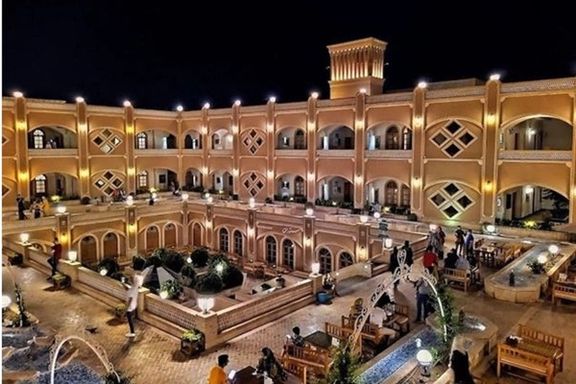
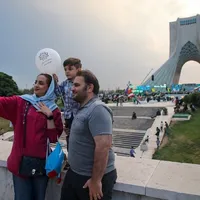
A hotel in the central city of Yazd
Fearing arrest by Iranian authorities, the majority of foreign tours booked for the New Year and January in the very popular historic cities of Yazd and Kerman have been canceled and the rest may follow suit.
According to Donya-ye Eghtesad daily, the heads of hoteliers’ associations of Yazd and Kerman provinces -- both of which are among Iran's most popular tourist destinations -- are facing a significant drop in foreign and domestic tourism, and a significant part of bookings have recently been canceled.
“Only a few tours have not been canceled but they may also make a last-minute decision not come just as two of the booked tours did not arrive recently even though they had not canceled,” the head of Hoteliers’ Association of the historic city of Yazd, Amir Nasereddin Tabatabaei, said earlier this week. He estimated the number of booking cancelations at around 80 percent.
Mohammadreza Bahrami, Head of the Kerman Hoteliers Association, has also said that his province has lost 90% of its foreign travelers in recent months.
Some countries have advised their nationals not to travel to Iran or asked them to leave the county immediately since nationwide anti-government protests began in Iran three months ago. Iran’s apprehension of several foreign nationals and dual nationals on unknown charges has made the situation more complicated and more damaging to the tourist industry.
In early November the chairman of the board of Iran's Tour Guides Association, Mohsen Haji-Saeed said the regime tourists seen in the wrong places and at the wrong time were seen as spies and that some foreign nationals had been detained only for taking photographs of the protests ““out of curiosity”.
On September 30, Iran’s Intelligence Ministry announced the detention of nine foreign citizens from Germany, Poland, Italy, France, the Netherlands and Sweden. The ministry alleged those arrested had been "on the stage or behind the scenes" of the recent protests.
James Cleverly, the British foreign secretary, has again said that the United Kingdom has sanctioned Iran’s Revolutionary Guard Corps “in its entirety.”
The British foreign office tweeted Tuesday a clip of Cleverly listing British sanctions against Iran where he mentions judges, morality police, individuals and companies allegedly involved in supply military drones to Moscow, as well as “the IRGC in its entirety.”
Cleverly December 13 said in parliament, according to the official record: “We already sanction the IRGC in its entirety.” But questioned immediately before this on the government’s intentions by John Spellar, a parliament member, Cleverly suggested that any IRGC designation remained in its future plans: “The UK is committed to holding Iran to account, including with more than 300 sanctions—including the sanctioning of the Islamic Revolutionary Guard Corps in its entirety.”
The UK announced December 9 the sanctioning of ten Iranian officialsconnected to Iran’s judicial and prison systems. “There is growing frustration that the Islamic Revolutionary Guards Corps (IRGC) the branch of the Iranian army accused of peddling terror abroad, has escaped sanctions that would see it proscribed,” claimed the right-wing Daily Telegraph newspaper the following day. Neither was the IRGC mentioned when the UK December 13 sanctioned Iranians purportedly involved in transferring drones to Russia.
The United States government in 2019 included the IRGC in its list of ‘foreign terrorist organizations,’ a move announced by Secretary of State Mike Pompeoas the US “continuing to build its maximum pressure campaign against the Iranian regime.” The Trump administration had the previous year launched ‘maximum pressure’ sanctions as it withdrew from the 2015 Iran nuclear agreement, the JCPOA (Joint Comprehensive Plan of Action).
This remains the only example of Washington including part of a sovereign state’s armed forces as a ‘foreign terrorist organization,’ a category otherwise comprised of non-state groups. The US 2019 press release on the listing referred to the IRGC “in its entirety,” the same phrase used by Cleverly.
Critics of JCPOA have long argued for designating the IRGC, with Canada following the US in October. During talks aimed at restoring the 2015 agreement, which have foundered since late summer leaving Iran’s nuclear program expanding and ‘maximum pressure’ in place, there have been intermittent reports of Iran seeking to have the designation lifted.
‘Moving talks forward’
Peter Stano, the European Union foreign affairs spokesman, Monday defended the “diplomacy” and “engagement” seen in EU foreign affairs chief Josep Borrell meeting with Iran’s foreign minister Hossein Amir-Abdollahian in Jordan December 20. Given the EU role coordinating multilateral nuclear talks in Vienna April 2021-March 2022 and subsequent bilateral Iran-US meetings, Stano said the meeting had been part of moving “talks about the revival of the JCPOA forward.”
In Tehran, Javad Karimi-Qudousi, a conservative member of the parliament’s national security commission, told the reformist newspaper Etemad that progress had been made on two issues stymying the talks – an enquiry by the International Atomic Energy Agency into Iran’s pre-2003 nuclear work and the status of foreign investment should the US again leave the agreement.
There has been ongoing speculation in Israel that failure to renew the JCPOAwill lead to an Israeli attack. With Benjamin Netanyahu, a virulent JCPOA opponent due to form a new government including the Religious Zionism Party, Lieutenant-General Aviv Kohavi, the Israeli chief of staff, said Tuesday the “level of preparedness for an operation in Iran has dramatically improved.”
While he would “say no more than that,” Kohavi promised the armed forces would be “ready for the day when an order is given to act against the [Iranian] nuclear program.” Kohavi, who was Israeli Operations Director during the December 2008-January 2009 Gaza conflict when 1,400 Palestinians and 13 Israelis died, claimed Israel carried out at least one operation “against Iran” weekly somewhere across the Middle East.
President Ebrahim Raisi submitting the administration’s draft of the national budget bill for the Iranian calendar year 1401, which started on March 21, 2022
While the Islamic Republic’s currency rial is in a freefall, President Ebrahim Raisi’s government has not finalized the country's budget for the next Iranian year starting March 21.
The delay by the government, which should have submitted the budget bill by December 6 according to the regulations, is reminiscent of the administration of Mahmoud Ahmadinejad who postponed the budget bill until a few months into the year. This means that government departments and organizations were disoriented for a couple of months before they understood how they had to plan their spending.
According to parliament rules, if the administration misses the December 6 deadline, it must attach an addendum to the budget bill that will earmark the spendings for quarterly portions of the year. This means demanding extra work from an administration that has already failed to perform its ordinary procedural duty.
Quarterly allocations means parliament will approve only three-month budgets, which will tremendously complicate operations not just for government departments but all the businesses owned or controlled by the state, which constitute up to 80 percent of the economy.
Many economic experts are of the opinion that the delay by the administration means economic chaos for at least the first few months of the next Iranian year. Meanwhile, many lawmakers believe that the administration is deferring the decision until the very last minute so that the MPs do not have enough time to fiddle with the figures and are forced to pass the bill as is.
Another reason that may be behind the delay in submitting the budget bill is timing for the country’s Seventh Five-year National Development Plan (2022-2026). Since 1989, the Islamic Republic has been devising five-year development plans for the country. A lot of organizations and institutions are involved in designing and actualizing these plans, which mostly remain on paper, because of they are full of general statements without planning for the needed monetary resources.
For example, “The country should see a rise in the speed of scientific and technological progress and commercialization of their products, while the educational and research systems need to be updated and upgraded over the target period,” reads part of the Seventh Five-year National Development Plan.
In September, the Supreme Leader outlined the general policies of the seventh development plan and Raisi tasked the Planning and Budget Organization (PBO) to officially start its compilation.
According to the general policies, the 7th development plan’s main goal and priority is economic progress with an average rate of eight percent during the five-year period, with an emphasis on boosting productivity, capital, technology and management. Reforming the structure of the government budget was also among the major policies stressed in the Seventh National Development Plan. The economic policies also call for transformation in the tax system with a view to making levies the primary source of the government’s current budget.
Amid ongoing antigovernment protests, the Islamic Republic’s currency rial has been losing value so much that regime insiders have started passing the buck. Iran’s currency dropped to a new historic low on Tuesday, breaking the 421,000 rial resistance point against the US dollar.
Alicia Kearns, chair of the House of Commons Foreign Affairs Committee
A top British lawmaker has advised all Britons and citizens of western countries to leave Iran immediately as the Islamic Republic detained seven people with links with the United Kingdom.
Alicia Kearns, chair of the House of Commons Foreign Affairs Committee, said Monday that the Iranian regime had shown it would “happily” arrest people as it seeks to blame foreign countries for escalating anti-government protests.
In a statement on Monday, the Revolutionary Guards (IRGC) said that it had arrested seven people with “direct links” to Britain in the central Kerman province including some dual nationals. The IRGC also alleged that the network, which called itself ‘Zagros’, acted under the direct guidance of elements in Britain to organize and carry out “subversive conspiracies” during the ongoing protests.
Iranian state media claim that the seven people who were apprehended were arrested while trying to escape the country.
“If I was a British foreign national in Iran, I would absolutely be leaving, because there is evidence that they will use them in any game of chess they can and they will face brutal repression. I would encourage anyone who is Western to try to leave Iran as safely as they can,” added Kearns.
Iran’s foreign ministry has alleged the arrests of citizens linked to Britain proved that London has played a “destructive role” in recent protests in Iran.
The British foreign ministry said it was seeking further information from Iranian officials on reports that British-Iranian dual nationals had been detained.
Following Supreme Leader Ali Khamenei’s lead, Iranian officials claim that the ongoing antigovernment protests across Iran – ignited by death in custody of 22-year-old Mahsa Amini -- are instigated by foreign enemies.
President Ebrahim Raisi addressing the parliament in August
Although the need for changes in President Ebrahim Raisi's cabinet has been long discussed by the media, debate on an urgent reshuffling has intensified.
Although the demand of anti-regime protesters is not about a government reshuffling, regime insiders are debating the matter amid a fast-deteriorating economic situation. The unprecedented steep fall in the value of Iran’s currency puts pressure on political elites to appear responsive to public anger.
Proreform Ensaf News website wrote December 24 about "The increasing possibility of changes in the cabinet." It said "moves among conservative political groups, as well as debates among conservative politicians and lobbyists to put forth their preferred choices indicate that a change in the cabinet is imminent."
A few changes Raisi has already made in his cabinet have remained unnoticed probably because those who left had not done anything significant and those who joined were not much different in calibre.
IRGC-linked Housing Minister Rostam Ghasemi died less than a month ago and was replaced by ultraconservative Mehrdad Bazrpash. Vice President for parliamentary Affairs Mohammad Hosseini was silently removed from his post for an unknown reason. Populist Labor Minister Hojjat Abdolmaleki was replaced by Solat Mortazavi a politician with long experience and no eye-catching achievement at the Interior Ministry.
Oil minister Javad Owji with his senior team seen on March 9, 2022
One of the outgoing ministers is said to be Javad Owji who had a minor heart attack at the cabinet meeting two weeks ago, apparently due to pressures caused by a chronic shortage of natural gas. Ensaf News wrote: "Ironically, those who lobbied to get the oil minister’s post during his illness were his close aides!" The candidates named so far for the post include Hossein Shiva the head of the Iranian Oil Tankers Company and Alireza Zeighami, a former senior official at the ministry.
According to Ensaf News, there are talks in the corridors of the government about possible changes at top level in the Oil Ministry and the Ministry of Education. Politicians in Tehran say that individuals close to the IRGC and the ultraconservative Paydari party are in fierce competition over winning the posts. The lucrative nature of the oil ministry post is clear to everyone. The candidate for the post of education is Yousef Nouri from the Teachers' Fund, an organization known for a major financial corruption case.
Meanwhile, as parliament’s term comes to an end in early 2024, some lawmakers are also trying to get closer to Raisi in a bid to win a post in the cabinet.
Mohsen Rezaei, Raisi's vice president for economic affairs, is a former IRGC officer who says he received a PhD in economics
According to most Iranian news outlets including the moderate news website Rouyda24, Raisi's economic team is likely to be where most of the changes will take place. Economist Kamran Naderi told the website that changing the members of his economic team is Raisi's only way out of the problems created by the current team.
Economy Minister Ehsan Khandouzi is said to be under pressure to leave the cabinet, reportedly for giving many posts to individuals from Khorasan Province, presumably those linked to hardliner Friday prayer leader Ahmad Alamolhoda. According to recently leaked top-secret documents, even Raisi himself, who is Alamolhoda's son-in-law is not happy about the cleric's interventions in the affairs of the government.
Naderi attributed the continuing fall of the rialto the inefficiency of the government's team, including self-proclaimed economic genius Mohsen Rezaei who is the vice president for economic affairs.
Meanwhile, former IRGC officer and presidential candidate Saeed Mohammad, who recently left his post as the head of wealthy Kish Free Trade Zone and was once one of Raisi's closest allies, has started harshly criticizing Raisi's economic team. Mohammad's new stances reveals that dissatisfaction of with Raisi's economic team has reached his closest inner circle.
Iran's current foreign minister Amir-Abdollahian with his famous predecessor Javad Zarif in August 2021
Amid its most serious internal crisis in 40 years, the Islamic Republic is now facing daily criticism of its foreign policy, even in its government-controlled media.
Multiple pundits and politicians are questioning a one-sided foreign policy in favor of China and Russia and calling for balance and a resumption of the suspended nuclear talks with the West. They have also unleashed tough criticism against foreign minister Hossein Amir-Abdollahian, saying that he is not capable of steering the country’s foreign relations.
The attacks began after he attended a regional summit in Jordan, where he met the European Union foreign policy chief Josep Borrell, expressing Tehran’s readiness to resume nuclear talks. No tangible results emerged from the trip.
Expediency Council member Mohammad Sadr, has harshly criticized Iran's dependency on Russia and China in an interview with the centrist Entekhab News, charging that the two countries are not Iran's strategic allies, but they solely follow their own interests. He further criticized the foreign minister and the President Ebrahim Raisi for failing to give a proper response to China putting its signature on a statement with the Gulf Cooperation Council states that questioned Iran's ownership of three Persian Gulf islands.
Mohammad Sadr, member of Islamic Republic's Expediency Council
In the reality of the Islamic Republic, everyone knows that these decisions are made in the office of Supreme Leader Ali Khamenei, not at the foreign ministry or by the president.
Sadr also criticized Iran's policy regarding relations with Saudi Arabia, adding that Riyadh is waiting for US Republicans to win the presidency, before revealing its real intentions toward Iran. Sadr called for a realistic foreign policy that would prioritize the country's national interests. Iran, he said, should maintain relations with all countries except Israel, and seek to revive the 2015 nuclear deal, or JCPOA.
Academic and expert on foreign policy Mehdi Motaharnia
An expert on international relations Mehdi Motaharnia told Fararu website in Tehran that if Iran continues its current foreign policy of aligning with China and Russia and considering itself an enemy of the United States and Europe, it will have no third option soon vis-à-vis the EU-US-Israeli alliance and the new alliance between Arab countries and Israel. He warned that China and Russia have also let Tehran down.
Fararu observed that the biggest political upheaval of the country in the past 43 years has paralyzed the government and asked Motaharnia if there was a third way out for Iran.
Motaharnia responded that Iran's tilt towards the Russia and China has left nothing of its initial non-alignment policy. As a result, whatever is against the West finds legitimacy. This inevitably brings about an identity crisis for the political system.
He added that Tehran not only needs to redefine its relations with the West, but it also needs to reform its internal governance. Motaharnia said that this will determine international community's approach to Iran in coming months.
Meanwhile, as some of Iran's hardliners such as the editor of Kayhan newspaper have harshly attacked Amir Abdollahian's attempts to resume talks with the West, former diplomat Fereidouin Majles has said in an interview with moderate Roiuyda24website that the approach of some of Raisi's supporters will lead to Iran's further isolation. Majlesi said ironically that while everybody wants to determine the fate of the JCPOA in his own way, let us shut down the Foreign Ministry and let the Tehran Municipality to regulate Iran's relations with the rest of the world. Majlesi charged that the Foreign Ministry's critics have no concern about Iran's interests.