No Final Decision On Mahsa Amini’s Cause Of Death: Attorney General

Iran’s Attorney General says no final decision has been made regarding a complaint by the family of Mahsa Amini whose violent death in police custody led to protests.

Iran’s Attorney General says no final decision has been made regarding a complaint by the family of Mahsa Amini whose violent death in police custody led to protests.
Mohammad Jafar Montazeri said Sunday, “The Legal Medicine Organization announced its comprehensive and expert opinion in this case, but Amini's family filed a complaint against the medical council of the country.”
He added that the complaint has been referred to the medical board for expertise, and the experts of the medical board have not yet announced their final opinion.
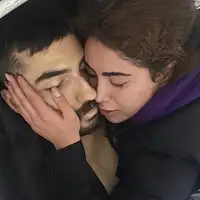
The 22-year-old Iranian woman Mahsa Amini, also known as Jina Amini, died in a hospital in Tehran September 16, suffering from severe head trauma after being arrested by Iran’s ‘morality police’ apparently for improper hijab.
Police claimed that she had a heart attack at a police station, collapsed, and fell into a coma before being transferred to a hospital. However, eyewitnesses, including women who were detained with Amini, reported that she was severely beaten and that she died because of police brutality, which was denied by authorities.
Mahsa's father, has repeatedly emphasized that “he saw himself that there were traces of blood on his daughter's body, in the back of her neck and ears, and many parts of her body, including her legs, were bruised.”
Family lawyers December 9 issued a statement warning that government insistence on their narrative will damage the transparency of the proceedings.


Islamic Republic’s prosecutor-general says Iranian women unveiling in public is an act “planned and promoted by enemies,” and described it as a “crime.”
In a press conference on Sunday, Mohammad Jafar Montazeri said one of the “enemies’ plots” in the past few months was breaking the norms and redlines of the Islamic regime. He went on to threaten that people who unveil will be strictly confronted.
Emphasizing that observing hijab – or Islamic dress code – is legally mandatory, he said, "When the law mandates the observance of hijab for women in public places within the borders of the Islamic Republic, we cannot say that [the issue] is personal."
The law’s Montazeri referred to are what more than 50 percent of the people in Iran oppose, but they have no peaceful way of trying to change them, because the regime considers any such attempt a violation of the fundamental precepts of the clerical rule.
The attorney-general added that he believes the way to deal with those who remove the compulsory hijab "needs planning" and "cultural work” before resorting to legal action.

He repeated the regime’s propaganda line that describes the current wave of antigovernment protests sparked by death in custody of 22-year-old Mahsa Amini as a ploy by the West. The United States, United Kingdom, Israel and Saudi Arabia are called “enemies” in the discourse of the clerical regime.
Mahsa Amini was arrested by a patrol van enforcing hijab on streets and suffered a head trauma during her arrest and died in hospital a few days later, triggering the boldest challenge the regime has faced in its over 40 years of existence.
Montazeri also claimed that the final results of the investigation regarding the case of Mahsa Amini's death have not yet been given to her family.
His remarks came as he had earlier pretended it had abolished the the so-called ‘morality police,’. However, his Sunday remarks showed that the whole volte face was only a sham to control the nationwide unrest.
Many activists, such as US-based Masih Alinejad, debunked Montazeri’s claim as a sheer publicity stunt or even misinformation spread by a dictatorial regime that is about to fall.
Following the propaganda stunt about disbanding the ‘morality police’, foreign and Iranian media are full of interpretations of how the regime plans to both enforce the dress code regulations and at the same time appease protesters.
Western governments, including the UK, the US, and Canada, added the hijab law enforcement unit to their list of sanctioned entities. Despite the regime killing about 500 protesters and hanging two, Iran’s police chief threatened the people earlier in December with more "decisive" response in the coming days.
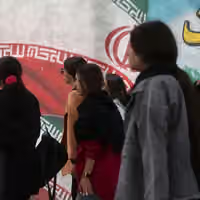
Many women in Iran are now appearing in public without the mandatory veil and regular police are not interfering in a sign that authorities are either unwilling to risk further confrontation with the public or find it impossible to deal with so many women undermining the rule all at the same time. Police forces have also become over-stretched during protests and many have resigned or have applied for early retirement.

Iran’s exiled Prince Reza Pahlavi has called on people to take part in the ceremonies marking the fortieth day after the killing of some protesters by security forces.
In a tweet on Sunday, Pahlavi called on Iranians to participate in the ceremonies to commemorate Kian Pirfalak, Aylar Haqqi, Hamidreza Rouhi, and Sepehr Maqsoudi, victims of state brutality.
According to Iranian tradition the 40th day after the death of a loved one is an important occasion for mourning. The ceremonies for people killed by security forces quickly turn into new protests.
Kian Pirfalak, a nine-year-old boy, was killed in the city of Izeh a town of 100,000 residents in the oil-rich Khuzestan province on November 16.
Security forces opened fire on the family car carrying Kian, his parents, and three-year-old brother for no apparent reason. Kian’s father was also seriously wounded in the shooting. Authorities claimed the family car was attacked by “terrorists”.
Aylar Haqqi, 23, a medical student had reportedly taken refuge in a building during demonstrations, where regime agents found her and pushed her from the top of the building. A rebar pierced through her abdomen and out from her back. However, the regime announced she had died after falling into a construction dig.
Hamidreza Rouhi, 19, a civil engineering student, was killed by security forces in the evening of November 17 in Tehran.
Sepehr Maqsoudi, 14, was killed by regime agents on November 16 during the attack on Izeh market, but the state media presented him as a victim of a “terrorist incident” and kidnapped his body.

Amid ongoing antigovernment protests, the Islamic Republic’s currency rial has been on freefall, losing value so much that regime’s insiders have started passing the buck.
Iran’s currency dropped to a new historic low on Sunday, breaking the 410,000 rial resistance point against the US dollar, prompting some parliament members to blame the presidential administration of Ebrahim Riaisi for the economic blow.
Parliament’s Sunday session was held behind closed doors when lawmakers, particularly members of the economic committee, briefed the parliament about the falling rial as well as the high rate of inflation. The explanations by the head of the Central Bank of Iran (CBI), Ali Salehabadi, and Ehsan Khandouzi, the minister of economic and financial affairs, were also delivered before the reporters were allowed to enter.
Mehdi Toghiani, the spokesman of the economic committee, said that one of the main reasons behind the rial’s unprecedented fall is the government’s insistence on ineffective policies, and especially the "mandatory determination of the exchange rate" and "increasing the money supply."
The parliament stacked with hardliners rarely criticizes the like-minded government, but as the crisis has rattled the public amid antigovernment protests, lawmakers tried to deflect blame from the legislature. Economists have long been warning of an impending meltdown, as the regime has failed to resolve its nuclear dispute with the United States, which maintains crippling sanctions on Iran.

Another lawmaker, Rouhollah Izadkhah slammed the 50-percent devaluation of the rial during the current administration, noting that the high demand for foreign currencies should not lead to higher prices for essential goods.
“The national currency of war-torn Syria is eight times higher than Iran’s because it has managed the unofficial (free) market,” he argued.
“The currency market is very turbulent and chaotic, and there is no clear prospect in the horizon, and it is not clear when the exchange rate will be recovered,” said another MP, Kamal Hosseinpour.
"What kind of sustainable economy the minister is talking about," he quipped, criticizing the ministry’s actions – or lack of action – in the currency market. “You cannot blame the enemy for all the problems of the country. What is the plan of the economic team of the government?” he said, urging President Ebrahim Raisi to intervene and introduce measures to control the prices.
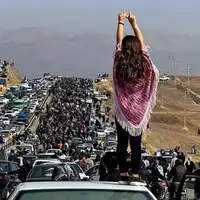
Iran has been rocked by nationwide antigovernment protests since mid-September after a 22-year-old woman, Mahsa (Zhina) Amini, was killed in police custody. She was arrested for violating the country’s forced hijab rules. But since then, protests have turned against the ruling regime, with many Iranians demanding a secular and democratic form of government.
Opponents of the Islamic Republic have also urged people to withdraw their deposits from government banks to put further pressure on the government, which has been printing more money in recent years. The money supply has grown at an unprecedented pace since September.

The Islamic Republic's government has appointed IRGC Brigadier General Mohammad Karami as the new governor-general of the restive Sistan-Baluchestan province.
Karami served as the commander of IRGC Ground Forces in southeastern Iran where the province is located during the recent crackdown on protesters.
The appointment comes as more than 100 people have been killed by IRGC-led security forces in the largely Sunni province since protests began in September.
Karami replaced Hossein Modarres Khiabani, who was first proposed as minister of Industry, Mines and Trade in the government of Ebrahim Raisi, but after a negative vote in the parliament, he was appointed governor of Sistan-Baluchestan in September 2021.
Raisi’s hardliner government has appointed several IRGC generals as provincial governors.
Sistan-Baluchestan has been one of the main centers of protests against the Iranian regime in recent months, and after the September 30 "Bloody Friday" in Zahedan when forces shot and killed more than 80 protesters, demonstrations have been held every Friday in the city. Zahedan is the provincial capital.
The Bloody Friday in Zahedan, the provincial capital of Sistan and Baluchestan took place September 30, when security forces killed at least 93 people, and injured hundreds more.
Zahedan is one of the few Sunni-majority cities in predominantly Shiite Iran.
The outspoken Sunni Imam of Zahedan, Mowlavi Abdolhamid, said Thursday that the Islamic Republic authorities are the main culprits behind the massacre in his city.

Punitive measures to hold the Islamic Republic accountable for its deadly crackdown on dissent continue with Western sanctions and international investigations.
In an interview released on Saturday, Canada’s envoy to the United Nations Bob Rae told Iran International’s correspondent that organizations focused on accountability have started to gather and verify information about the current wave of antigovernment protests.
He praised efforts by the United Nations “to get to the root of the injustices that are happening to make sure that the investigations are in place; that we are gathering the information and the evidence that will lead to accountability.”
The Canadian diplomat underlined that there should be consequences for the criminal acts, “and many things that are happening in Iran are criminal,” he said, noting that there are “abuses of human rights and abuses of international law.”

He urged the people of Iran to be patient to see the results of mechanisms deployed to hold the regime accountable, saying there is no tribunal yet because the Islamic Republic is not a party to the International Criminal Court. However, he said that “there will be a reckoning; there will be an accountability process for the regime in Iran.”
"We're not going to invade Iran, but we won't ignore what's happening either. The regime isn't stable or predictable because the ground underneath the feet of the regime is shifting all the time... Dictators think they can control everything, but they can't," he stated, adding that “Canada has always been a place of refuge.”
Earlier in the month, the Islamic Republic was voted out of the United Nations Commission on the Status of Women (CSW) for policies contrary to the rights of women and girls. Members of the UN Economic and Social Council (ECOSOC) adopted a US-drafted resolution to "remove with immediate effect the Islamic Republic of Iran from the Commission…for the remainder of its 2022-2026 term.” The CSW is the principal global intergovernmental body exclusively dedicated to the promotion of gender equality and the empowerment of women.
It was the second step against the Islamic Republic’s violations of human rights during the current wave of protests. The first step by the United Nations was creating a fact-finding mission by the Human Rights Council. The Geneva-based UN Human Rights Council voted on November 24 to launch an independent investigation into the regime’s deadly repression of protests that has killed around 500 civilians, including about 60 children.
The Islamic Republic might become more isolated in the Middle East, as policies of intervening in other countries affairs was condemned at the “Baghdad II” summit, held December 20 in Jordan aimed at resolving regional crises, particularly in Iraq. France and the European Union play a major role in the annual gathering. The first summit was held in Baghdad last year.

Etemad newspaper in Tehran cited Macron as talking about a regional project, supported by France, to limit Iran’s influence in the region. The daily quoted Macron as saying that he is convinced there is no solution to the problems of Lebanon, Iraq and Syria except through reducing Tehran's regional influence.
During the summit, Iraqi Prime Minister Mohammed Shia al-Sudani said, "We reject interference in its (Iraq) internal affairs, undermining its sovereignty, or attacking its lands.” At the same time, he added, "We do not accept any threat to be launched from Iraq against any of the neighboring countries or the region."
Since the beginning of the uprising in Iran in mid-September, Tehran has accused foreign countries, including regional rival Saudi Arabia – with which it has had no diplomatic relations since 2016 – of fomenting unrest as protests rage on.