Court Upholds Death Sentence For Another Iranian Protester

The Islamic Republic's Supreme Court says it has upheld the death sentence of Iranian protester Mohammad Qobadlou after rejecting his appeal.

The Islamic Republic's Supreme Court says it has upheld the death sentence of Iranian protester Mohammad Qobadlou after rejecting his appeal.
However, the country’s judiciary announced in a statement Saturday that it had accepted the appeal against the death sentence of another demonstrator, Saman Saidi Yasin.
Earlier, the Court had announced the appeals of both protesters have been accepted, but subsequently Mizan news agency affiliated with the judiciary said just the appeal of Saman Saidi Yasin was accepted and the ruling of Mohammad Qobadlou was confirmed.
Qobadlou is accused of killing a police officer and wounding five others during the protests.
Yasin, a Kurdish man who sings rap songs about inequality, oppression, and unemployment, was charged with attempting to kill security forces and singing anti-regime songs.
Nationwide protests against the Islamic Republic erupted in mid-September after the death in custody of 22-year-old Kurdish Iranian woman Mahsa Amini for wearing improper hijab.
Over 500 people have been killed by regime forces and over 18,000 were detained.
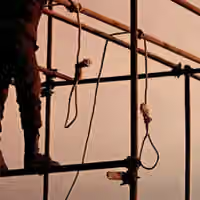
The clerical rulers hanged two protesters earlier this month: Mohsen Shekari, 23, was executed of blocking a street and injuring a member of the Basij militia force. Majid Reza Rahnavard, 23, accused of stabbing to death two Basij members, was publicly hanged in the religious city of Mashhad.
According to Amnesty International at least 26 people are in danger of receiving death penalty in what it called “sham trials designed to intimidate those participating in the popular uprising that has rocked Iran”.


According to an official at Tehran’s Sharif University of Technology following student protests, 33 punitive rulings have been issued for the students.
Hadi Nobahari, Director General of Sharif University Dean’s Office told Mehr News Agency Saturday that since the beginning of the student protests, about 300 complaints have been lodged with the university’s disciplinary committee, that “out of these cases, 33 preliminary rulings have been issued, but the appeal board rulings have not been issued yet.”
He said these students have received “written warnings or up to one or 2.5 years ofsuspensions from studying.”
During the nationwide protests in Iran following the death of 22-year-old, Mahsa Amini in police custody and tension at universities, special law enforcement units as well as plainclothes security forces surrounded Sharif University for hours on October 2.
They entered the multistorey parking lot of the university with dozens of motorcycles and targeted protesting students who were sheltering in the parking lot with shotguns and paintballs.
Hundreds of students have also been arrested and many still remain in jail.
So far, the exact number of suspended and expelled students have not been announced, but in addition to Sharif University, there have been similar cases of punishments at other universities.
In Bahonar University of Kerman in central Iran 12 students were expelled and 80 suspended. Similar reports have been published about the universities of medical sciences in Kerman, Shiraz in the south, and Tabriz in the northwest.

As every Friday for three months, protests started December 23 following the sermon of Zahedan’s Sunni cleric and spread throughout the provincial capital of Sistan-Baluchestan.
People also held rallies in several cities of the province on December 23 chanting slogans against the Islamic Republic’s ruler, referred to as “dictator” in the vernacular, as well as Basij paramilitary forces, who are the main force of repression in the region. Another slogan frequently used by the protesters is roughly translated as “Basijis, Sepahis (IRGC members), you are our ISIS” pointing out the similarities between the Islamic Republic regime and the takfiri terror group.
During his Friday prayer sermon, Abdolhamid addressed the rulers of the Islamic Republic urging them to "Return the soldiers to the barracks. Let them stay in the barracks and try to defend the homeland and refrain from hitting their own people.”
Condemning the regime’s crackdown on dissent, he recalled that the Islamic Republic came to power with the support of the people and not a military coup or armed insurrection. Only people's movement for freedom and justice would work, he noted, adding that "The revolution will last as long as the people want it. It survives as long as people support it. It is not possible to maintain the system by using weapons and soldiers, by force and prison.”
In another part of his sermons, he said saving the religion is superior to saving the Islamic government, noting that religion should not be sacrificed to save the regime.

Many have argued in the media and public forums that commitment to religion has weakened in Iran as people became more disillusioned with clerical rule over four decades.
Abdolhamid also criticized the death sentences issued for protesters and reports of rape and torture of detainees, wondering who has allowed such atrocities. "Islamic law – or sharia -- has rules. Judges and other officials should work within the framework of Islam. No one can beat the accused, force them to confess and execute them…No ruler has such authority and cannot act above God's law."
On Thursday, Abdolhamid had repeated his demands for the prosecution of those responsible for the massacre in his city, underlining that the killings in Zahedan was “a premeditated plot.” He also rejected statements by officials, including a delegation sent by Iran’s ruler Ali Khamenei in November, about protesters attacking a police station before security forces opened fire at them. He emphasized that security forces fired live ammunition at peaceful protesters in Zahedan, insisting that the attack was unprovoked.
Abdolhamid enjoys respect, especially among the 15 million Sunni population of the country. His popularity was dwindling over his support for hardliner President Ebrahim Raisi and recent meeting with representatives of Ali Khamenei, but he started to save face by his signature criticism of the regime and his criticism of systematic corruption in Iran.
An audio file recently leaked by the hacktivist group Black Reward revealed that the Islamic Republic planned to tarnish Abdolhamid’s reputation to curb his influence. In November, the outspoken Sunni Imam said women, ethnic and religious groups, and minorities have faced discrimination after the establishment of the Islamic Republic in 1979. He has also called for an internationally monitored referendum in Iran saying by killing and suppression the government cannot push back a nation.

Iranian activists are warning about a bloody crackdown on the restive southwestern city of Izeh where the IRGC has killed two armed regime opponents and arrested many.
Izeh, a town of around 100,000 in the east of the oil-rich southwestern Khuzestan Province, has been restive since November 15 when a ten-year-old child, Kian Pourfalak was shot dead by security forces while in the car with his family during an evening of protests. Six others were also killed in the protests in Izeh that night.
Authorities claim the Pourfalak family car was attacked by “terrorists” who they also blame for the killing of other victims that night. On Tuesday, the Revolutionary Guards and other security forces raided the hideout of four regime opponents who were apparently armed, with heavy weapons and tanks according to social media reports. The government ties to pin the deaths in November on the four people. Internet and even phone lines to Izeh have been cut off.

Official media say two of these opponents were killed and two others were arrested in the raid. Photos of the hideout from where the four men fought the security forces for several hours indicate a heavy clash and the use of RPG grenade launchers and DShk heavy machine guns by the security forces.
Like Kian and many other residents of Izeh, the four armed young men, whose political affiliations are not known, belong to the very closely-knit Bakhtiari tribe, a Luri speaking population known historically for their bravery in war. The four had reportedly attacked security forces in Izeh on November 15 and taken out at least two of the snipers of the security forces firing at protesters.

Kian Pourfalak’s mother, Zaynab Molaei-Rad who was also in the car insists that it was security forces who sprayed their car with bullets that night on their way home. Kian’s father who was also seriously wounded in the shooting is still in hospital and has not been told about Kian’s death.
Video showing the attack by security forces on the house of the four regime opponents
There are photos of two of the Bakhtiari men taken from their social media which show them in their tribal attire posing with a battered Kalashnikov assault rifle. “When this regime kills people, it calls them rioters but when people kill them they are called terrorists,” Hossein Saeedi, one of the two men who was killed in the raid Tuesday, wrote in an Instagram post in which he said the only way to defeat “the dictator” is armed uprising across Iran.

“Those you killed and those you are torturing in prisons are all my brothers and sisters. I will take revenge, several-fold, on your brothers and sisters. I don’t care if I’m called a terrorist or a murderer. Everyone of you will pay for your deeds,” Saeedi wrote in another Instagram post before being killed. “This head will bow to no regime,” he said.
On Thursday, a large crowd of protesters gathered at the grave of Artin Rahmani in a village of Izeh for a 40th-day remembrance ceremony. “This land, to me, was of no benefit, yet I’m ready to drop dead for it!” Artin, a 17-year-old protester, wrote on Instagram only a couple of hours before being killed on the street on November 16.
Videos posted on social media show mourners In Izeh chanting, “Down with Khamenei” and other anti-government slogans including “IRGC killed our Artin, our Hamed”.
Hamed Salahshour whose name was also invoked alongside Artin’s by the protesters was a 23-year-old who was arrested at his home in Izeh on November 26.
Sources close to Salahshour’s family have told Iran International that authorities buried Hamed’s tortured and plastic-wrapped body in Ahvaz with only a few close family members present. The family has since exhumed and brought back the body to Izeh and given it a proper burial.
The government blames all protester deaths on “terrorists”, “enemies” or suicide and murder. So far, out of at least 500 confirmed protester deaths, authorities have taken responsibility only for one, Mehran Sammak, who was shot in the head in his car by a police officer in Anzali on November 30 for protest-honking. The officer was reportedly arrested later for wrongful use of firearms.

The outspoken Sunni Imam of Zahedan, Mowlavi Abdolhamid, has reiterated that the Islamic Republic authorities are the main culprits behind the a massacre in his city.
The crackdown on protesters in Zahedan, the provincial capital of Sistan-Baluchestan, known as the Bloody Friday, took place September 30, when security forces killed more than 80 people, including women and children.
During a meeting with the directors of Sunni religious schools of the province’s Coordination Council on Wednesday, December 21, Abdolhamid, the top religious leader of Iran's largely Sunni Baluch population living in the province, rejected the narrative of the regime about the tragic incident, saying that the Bloody Friday cannot be reduced to some errors by the security forces.
Underlining that the killing in Zahedan was “a premeditated plot,” he repeated his demands for the prosecution of the perpetrators of this massacre.
He also rejected statements by officials, including a delegation sent by Iran’s ruler Ali Khamenei in November, about protesters attacking a police station before security forces opened fire at them. He emphasized that security forces fired live ammunition at peaceful protesters in Zahedan, insisting that the attack was unprovoked.

"We have evidence that... the police station was not attacked at all and not even a single person went towards the police station. After people were shot at from the police station, some of them moved towards the police station, and pelted stones at the station,” he highlighted.
The claim that the police station was attacked by an armed gang is not true at all, he said, adding that not even one military officer was killed in the incident.
Abdolhamid said that the whole tragedy was a plot by the regime, noting that discrimination against Sunnis and Sunni mosques had already started in several cities before September 30. He added that “the governor of Mashhad had announced that he would not allow any Sunni prayer house to operate in his city. In Tehran, they said either bring a permit or we will close the prayer hall."
The Sunni cleric went on to explain that the main cause of such as incident is the "discrimination against Sunnis" in Iran, saying, "When the government discriminates against Sunnis and they are barred from holding any important positions in the armed forces and the judicial system, it is clear that officers beat our people mercilessly."
Officially known as Sheikh Abdolhamdid Esmailzehi, the Sunni cleric is widely popular because for his willingness to challenge Khamenei’s absolute authority. An audio file recently leaked by the hacktivist group Black Reward revealed that the Islamic Republic planned to tarnish Abdolhamid’s reputation to curb his influence. In November, the outspoken Sunni Imam said women, ethnic and religious groups, and minorities have faced discrimination after the establishment of the Islamic Republic in 1979. He has also called for an internationally monitored referendum in Iran saying by killing and suppression the government cannot push back a nation.

Italian lawmakers have approved a draft resolution urging Iran to immediately stop issuing death sentences to anti-government protestors and free all detainees.
The resolution was unanimously passed Wednesday by the Foreign and European Affairs Committee of the Italian Chamber of Deputies calls on Iran to withdraw all charges against protesters and free them from detention.
The text calls for the release of those “arrested solely for having peacefully exercised their rights to freedom of expression, association and peaceful assembly in the context of the protests,” the speaker of the committee, Giulio Tremonti, told Arab News.
The Italian parliamentarian emphasized that the resolution “was backed by all the parties, as a sign of the unity of Italy in the support to the Iranian population,” calling the cross-party agreement “really remarkable.”
The draft resolution binds the Italian government to urge the annulment of the death sentences and to request their immediate release.
Earlier, the Italian Senate’s Foreign and Defense Committee approved a similar resolution.
Meanwhile, Andrea Orsini, a deputy with the Forza Italia party, told a press conference that “it is intolerable that Iran is so aggressive towards democracy and remains a factor of instability for the world and for the Middle East.”
On Wednesday, the President of Italy said the Islamic Republic has “surpassed all limits” in its bloody and brutal crackdown on protests.
Sergio Mattarella said, “what is happening in recent weeks in Iran exceeds all limits and cannot, in any way, be set aside.”