US Says It Will Disrupt Russia Iran Military Ties
The United States announced new military aid for Ukraine Friday and vowed to disrupt Russian Iranian ties, including the possible supply of missiles by Tehran.

The United States announced new military aid for Ukraine Friday and vowed to disrupt Russian Iranian ties, including the possible supply of missiles by Tehran.
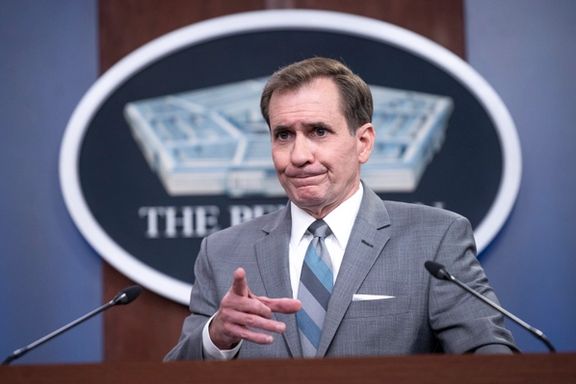
White House national security spokesman John Kirby told reporters Washington was very concerned about the "deepening and burgeoning defense partnership" between Iran and Russia, and would work to disrupt that relationship, including on drones.
Earlier, Barbra Woodward, the British envoy to the United Nations said Friday Moscow is seeking hundreds of ballistic missiles from Tehran and offering unprecedented military support in return.
Woodward said Iran had sent hundreds of drones that Russia had used in Ukraine.
Iran has already supplied Kamikaze drones to Russia that have been used to attack civilian infrastructure in Ukraine, including the power grid.
Tehran and Moscow have denied Western accusations that Russia is using Iranian drones to attack targets in Ukraine, where officials warned on Friday of a winter-long power deficit after repeated Russian attacks on its energy infrastructure.
Two senior Iranian officials and two Iranian diplomats told Reuters in October that Iran had promised to provide Russia with surface-to-surface missiles as well as more drones.
Washington was sending a $275 million package of aid to Ukraine to strengthen air defenses and defeat drones, he said.
"Russia is now attempting to obtain more weapons, including hundreds of ballistic missiles," Woodward told reporters. "In return, Russia is offering Iran an unprecedented level of military and technical support."


The United Kingdom ambassador to the United Nations said Friday that Russia was trying to obtain more weapons from Iran, including hundreds of ballistic missiles.
Barbara Woodward’s suggestion came two days after two United States spokesmen said Washington had no evidence that Iran had transferred missiles to Russia for the Ukraine war.
These statements followed Associated Press citing un-named officials “familiar with the matter” that Russia was looking to Tehran to replenish stocks of both military drones and surface-to-surface missiles.
Woodward said Iran’s weapons proliferation poses real and significant threat to international community. She added that Britain is concerned that Russia intends to provide Iran with more advanced military components.
With no sign of talks between the US and Russia to end the conflict, and with American officials suggesting any terms are for Ukraine to decide, both sides in the conflict are looking to replenish spent stocks or gain new weapons.
Both have used drones, or UAVs (unmanned aerial vehicles). Tehran said early November it had supplied a small number to Russia before the current phase of the Ukraine conflict, beginning February, whereas Ukraine has used US and Turkish drones as well as the Soviet-era UAVs used in this week’s attacks deep inside Russia.
US State Department Spokesman Ned Price said Wednesday that while Washington was “voicing concerns” that “Russia could look to Iran for ballistic missile technology,” the US had no “information to share at this point regarding current deliveries of ballistic missiles.”

Canada imposed fresh sanctions on Iran, Russia and Myanmar Friday, citing human rights violations by their governments.
Sanctions were imposed on 22 individuals in Iran, who included senior members of the judiciary, prison system and law enforcement, as well as political leaders, such as senior aides to Iran's Supreme Leader Ayatollah Ali Khamenei and figures in state-directed media outlets, the statement added.
Sanctions on Iran came a day after the Islamic Republic hanged a man convicted in a sham trial of injuring a security guard with a knife and blocking a street in Tehran, the first such execution over recent anti-government unrest. Nationwide protests erupted after the death of 22-year-old Kurdish Iranian woman Mahsa Amini in police custody on September 16.
Western countries have issued repeated statements condemning the government in Tehran for gross disregard of the rights of protesters and have imposed some sanctions on individuals and entities. But they have not imposed more serious economic sanctions or designation of it top leaders for killing of civilians.
The measures also included sanctions against 33 current or former senior Russian officials and six entities involved in alleged "systematic human rights violations" against Russian citizens who protested against Russia's invasion of Ukraine, the Canadian foreign ministry said in a statement.
Since Russia's invasion on Feb. 24, Canada has imposed sanctions on more than 1,500 individuals and entities from Russia, Ukraine and Belarus.
"There is more work to be done, but Canada will never stop standing up for human rights," Canadian Foreign Minister Melanie Joly said.

Two United States spokesmen said Wednesday that Washington had no evidence Iran had transferred missiles to Russia for use in Ukraine.
Comments from White House security spokesman John Kirby and State Department spokesman Ned Price came after Associated Press reported Moscow was “looking to Iran once again to resupply the Russian military with drones and surface-to-surface missiles.”
AP cited “two officials familiar with the matter.” The news agency also quoted a “UN diplomat” who claimed Iran had “plans to sell Russia hundreds of missiles and drones in violations of the 2015 [UN] Security Council resolution that endorsed the nuclear deal between Tehran and six world powers.”
Price spoke Wednesday of the US “voicing concerns” that “Russia could look to Iran for ballistic missile technology” but said Washington had no “information to share at this point regarding current deliveries of ballistic missiles.”
Kirby said that with Russia’s “defense industrial base…being taxed…We know they're having trouble keeping up with that pace…[and] having trouble replenishing specifically precision guided munitions.”
However, Price reiterated US concerns over the close military cooperation between Moscow and Tehran. “We’ve voiced our concerns that Russia could look to Iran for ballistic missile technology. We’ve voiced our concerns that cooperation between Iran and Russia could extend to other realms – sharing knowhow, expertise, I hesitate to say best practices but perhaps worst practices when it comes to the suppression of peaceful protesters.”
Iran support cannot ‘tip the balance’
Price said it was not the US assessment that Iranian military support could “tip the balance” in the Ukraine war, and referred back to the first US claims, made July, that Iran was planning to send “dozens” of drones, or UAVs (unmanned aerial vehicles). Tehran said early November these had been supplied before the current phase of the Ukraine conflict, which began February.
“I’m not in a position to go beyond that,” Price said, “but Iran has indeed provided at least dozens and perhaps much more of these Iranian drones to Russia for use inside of Ukraine. The Ukrainians, using their own capabilities but also using the air defense capabilities that the United States and many of our partners have provided, have in fact been able to…neutralize many of these UAVs.”
Price suggested that Iran should use revenue, which has been depleted by four years of ‘maximum pressure,’ to prioritize “the needs of its own people” rather than make “important contributions to Russia’s war effort.” Iranian drones had helped Moscow’s attempt to “weaponize winter,” Price said, “to turn off the lights, to turn off the water, to attempt to freeze Ukraine and Ukrainians into submission.”
Meanwhile reports this week said the United Nations is also investigating Iran’s delivery of drones and possibly other weapons to Russia to see if they constitute any violations. Reuters quoted Guterres as saying that “any findings will be reported to the Security Council, as appropriate, in due course.”

US defense officials say their forces around the world would soon use a new technology based on artificial intelligence in face of rapidly evolving drone threats.
Schuyler Moore, Chief Technology Officer at US Central Command (CENTCOM), said Wednesday that such ideas are expected to play a much bigger role in bolstering American troops.
CENTCOM is the US combatant command that covers the Middle East and parts of northern Africa and southern Asia.
“This tool is intended to do is to provide the opportunity for the boots on the ground that are closest to the threat and closest to their operational environment to mimic that environment as accurately as possible and to, as well, deploy threats against their base and to train against threats on their base that they see and that they interact with sometimes daily,” said army Sergent Mickey Reeve, who developed the counter-unmanned aerial system training software.
He added that the US will use the Red Sands Integrated Experimentation Center in Saudi Arabia to “pressure test” the new technology, but it will be moving around the region.
Sergeant Reeve noted the technology is not tailored solely towards Iranian-made drones, “but it was built to emulate any sort of Unmanned Aerial Systems.”
CENTCOM said there is an increased urgency for new technologies because of reduced US forces in the Middle East.
US forces regularly face threats due to conflicts in countries like Iran, Syria, and Yemen.

Secretary General Antonio Guterres says the United Nations is examining “available information” about accusations that Iran supplied Russia with drones.
Reuters quoted Guterres as saying that “any findings will be reported to the Security Council, as appropriate, in due course.”
Meanwhile, the Associated Press quoted a UN diplomat as saying that Tehran has plans to sell Moscow hundreds of missiles and drones in violation of the 2015 Security Council resolution that endorsed the nuclear deal between Tehran and the P5+1.
The diplomat, who was speaking on condition of anonymity, added that a key question is what Russia will be giving Iran in return for the drones and missiles.
Last week, Iran International reported that the Islamic Republic has asked Russia for help to quell the popular uprising by supplying anti-riot equipment and training.
White House press secretary Karine Jean-Pierre said Saturday during a joint press briefing with Coordinator for Strategic Communications at the National Security Council in the White House John Kirby that Moscow may be helping the Islamic Republic, drawing on its own experience in suppressing demonstrations.
“The evidence that Iran is helping Russia rage its war against Ukraine is clear and it is public. Iran and Russia are growing closer the more isolated they become,” Jean-Pierre said. “Our message to Iran is very, very clear: Stop killing your people and stop sending weapons to Russia to kill Ukrainians.”