Former US Envoy To UN Calls On Biden To Deny Iran’s President Visa
Nikki Haley, former American ambassador to the United Nations
Nikki Haley, former American ambassador to the United Nations has called on the Biden administration to deny a visa for the Iranian president for attending the UN General Assembly next month.
In an interview with Fox News on Friday, Haley pointed to the Justice Department charges against a member of the Revolutionary Guard (IRGC) for an alleged plot to kill former national security advisor John Bolton and possibly former Secretary of State Mike Pompeo.
"The world’s leading state sponsor of terror attempted to assassinate American officials inside our country. Under no circumstances should the Biden administration allow [Ebrahim] Raisi to set foot in our country," she said, adding, "He should not be allowed to stain American soil.”
A statement from the US Justice Department alleged Shahram Poursafi, also known as Mehdi Rezayi, 45, had attempted to pay “individuals in the United States” $300,000 to carry out the killing. After the US targeted killing of Iran’s Qasem Soleimani in January 2020 in Baghdad, Iran’s top leaders have repeatedly threatened revenge against Trump administration officials, including President Donald Trump himself.
Iranian President Ebrahim Raisi is slated to travel to New York for the 77th session of the UN General Assembly in September. Raisi – who is on the US and European sanctions list -- did not attend the high-level summit in the previous year, and only delivered a video speech.
Earlier in the month, eight US Republican senators, including Tom Cotton, March Rubio, Joni Ernst and Ted Cruz, wrote to President Joe Biden asking him to deny the visa to Raisi.
The suspect in the attack on Salman Rushdie was sympathetic to Shi'ite extremism and Iran's Islamic Revolutionary Guard Corps (IRGC), NBC New York cited law enforcement sources as saying on Saturday.
Rushdie, who spent years in hiding after Iran urged Muslims to kill him over his novel "The Satanic Verses", was stabbed in the neck and torso on stage at a lecture on Friday.
Police have identified the suspect in custody as Hadi Matar, a 24-year-old man from Fairview.
A preliminary law enforcement review of Matar's social media accounts showed he was sympathetic to Shi'ite extremism and IRGC causes, NBC New York reported.
Matar was born in California and recently moved to New Jersey, the NBC New York report said, adding that he had a fake drivers license on him.
NBC New York said the official told it that there were no definitive links established to the IRGC, but the initial assessment indicated the suspect was sympathetic to the Iranian government group.
There has been no official government reaction in Iran to the attack on Rushdie, but several hardline Iranian newspapers expressed praise for his assailant.
Ali Tehfe, mayor of Yaroun in the south of Lebanon, said that the suspect was the son of a man from the town. The suspect's parents emigrated to the United States, and he was born and raised there, the mayor added, but said he had "no information at all" on their political views.
An official from Hezbollah told Reuters that the Iran-backed Lebanese armed group had no additional information on the attack on Rushdie.
Iranian mountain biker Parham Shahsavari who travelled to Switzerland to attend the International Cycling Union’s training camp has said that he will not return to Iran.
The 17-year-old confirmed on his social media accounts in the past few days that he has migrated to the European country.
Hamid Ataollahi, the secretary of Iran’s Cycling Federation, said on Saturday that the International Cycling Union – known as Union Cycliste Internationale (UCI) -- had allocated a berth for a cyclist from Iran but the expenses were supposed to be paid by the cyclist. Shahsavari was introduced to the UCI as a representative from Iran but the federation had not sent him, and he went there on his own, the official added.
A member of Iran’s national rowing team, Ahmad Ahmadi said earlier that a notarized pledge to transfer the property is also signed before any trip abroad, adding that the federation also gets two guarantee-of-return undated checks of about $500 and $1,000 from the athletes.
Around 30 Iranian athletes have defected in recent years, seeking asylum in other countries. Some took part in this year’s Olympics in Tokyo as non-state athletes.
In addition to dress code restrictions, another issue forcing Iranian athletes to defect is Tehran’s policy of not allowing them to compete against Israelis, as was the case for Iranian judoka Olympian, and 2018 world champion Saeid Mollaei.
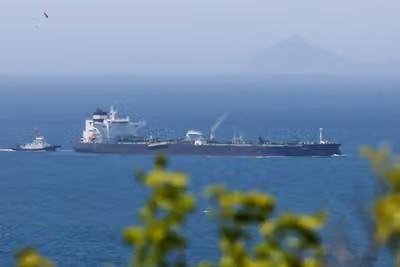
An Iranian-flagged tanker is reloading oil confiscated in April by the United States after Greek authorities approved the release of the cargo.
Iran's embassy in Athens and sources familiar with the matter said on Friday, about two months after Iran's Ports and Maritime Organization (PMO) said the Lana tanker is no longer impounded. The US has sanctioned Iranian oil exports since 2018.
"The operation to transfer Iran's stolen oil to the Lana ... is underway in Greek waters, and the ship will soon depart for our country with a full shipment of oil," Iran's embassy in Greece said on its Twitter account.
"The transfer has started," a source with knowledge of the matter said, while a second source said the process started on Friday and was expected to be completed in days.
Tehran had previously warned of "punitive action" against Athens over the case, which has strained relations between the two countries after the United States hired a ship to transfer the oil from the Lana tanker, when it was anchored off Greece. The US State Department said in July it was "respectful that this case went through the Greek judicial process".
The ship, previously called Pegas and renamed Lana in March, had reported an engine problem in April. It was headed to the southern Peloponnese peninsula to offload its cargo on to another tanker but rough seas forced it to moor just off Karystos where it was seized. The removal of oil from the Iranian tanker prompted Iranian forces in May to seize two Greek tankers in the Persian Gulf.
Flights by all Iranian airlines to Malaysia will completely stop as of Saturday, August 23, due to impact of sanctions on refueling Iranian planes.
Secretary of Iran's Aviation Companies Association Maghsoud Asadi-Samani told ILNA on Friday that the last Iranian flight to Kuala Lumpur will be operated by Mahan Airlines, which was the only airliner apart from flag carrier Iran Air with the capability of direct flights to Malaysia because of the long distance.
The Iranian company Mahan Air was sanctioned by the US in 2008 for links to the Quds (Qods) Force of Iran’s Revolutionary Guard.
Noting that Malaysian airports do not provide fuel to Iranian planes anymore, he said that fueling companies at Malaysian airports work with US companies, and these companies have been informed that they will be subject to punitive measures if they keep fueling the Islamic Republic’s planes.
Describing it as yet another blow that hit the country's aviation industry due to the US sanction, he said domestic airlines will lose the revenues of passenger transportation on this route, and “we will lose one of the bases in Southeast Asia.”
Before the Covid-19 pandemic hit the world, demand for this route was high, and two to three flights were made per week, but during the health crisis, flights to Malaysia were temporarily suspended, and after that, there was only one flight per week.
Iran’s hardliners have fiercely attacked Mir-Hossein Mousavi, who published a scathing attack hinting at plans for Supreme Leader’s son to succeed his father.
In a frontpage note Wednesday, Tehran's hardliner daily Kayhan, linked to Supreme Leader Ali Khamenei, called Mousavi “the delusional old man” and “the leader of sedition” and accused him of giving “all-out backing for Israel and Da’esh” but made no reference to his warning about alleged plans to appoint Khamenei’s enigmatic son Mojtaba as his successor.
Mir-Hossein Mousavi, a prime minister in the 1980s who has been under house arrest since February 2011, warned the nation on Tuesday over the alleged ‘hereditary leadership’ scheme.
Mousavi said there are regime loyalists who have suggested that the Experts Assembly, whose members are to appoint the country’s future leader, will choose Mojtaba Khamenei as the Islamic Republic’s next leader and “leader of the world’s Shiites”, a title born by Khamenei now. “May their tongues dry! Have the 2500-year-old monarchies been revived that [they are now talking about] sons’ succession [to leadership] after their fathers?”
Focusing on Mousavi’s criticism of Iran's support for the Syrian President Bashar Assad and other regional activities, the IRGC-linked Javan newspaperand Tasnim news agency also assailed Mousavi but made no mention of his warning about Khamenei’s succession. Tasnim also demanded that the reformist front and its leaders including former President Mohammad Khatami break their silence and condemn “Mousavi’s terrorist statement”.
Mojtaba Khamenei with the former commander of IRGC Qods Force Qasem Soleimani
Rumors about Mojtaba Khamenei’s ambitions to succeed his father have been circulating for nearly two decades. Khamenei and other officials have never commented on the rumors. “Why don’t they deny the rumors if they are not thinking of Mojtaba’s rise to the throne?” Mousavi asked.
Mousavi’s note has revived rumors about Mojtaba Khamenei’s activities and his alleged ambition to succeed his father for which he direly needs to qualify as an ayatollah by leading sources of emulation (grand ayatollahs). He is still only recognized as a hojjat ol-eslam, a much lower rank in the Shiite clerical hierarchy, among the top clerics of Qom, the center of Iran's religious seminaries where he teaches theology classes.
The 53-year-old Mojtaba is the second eldest of Khamenei’s four sons. He is an enigmatic figure who holds no public office in the government and is rarely seen in public but reportedly wields much more influence than the leader’s other sons in powerful organizations such as his father’s office and the Revolutionary Guards (IRGC) Intelligence Organization. Mujtaba’s close associate Hossein Taeb, a former co-fighter in the Iran-Iraq War (1980-1988), was removed from his positionas chief of SAS in June.
Mojtaba Khamenei also has great influence in the country’s propaganda machine including the state-broadcaster (IRIB), and behind-the-scenes political dealings.
In November 2019, the 40th anniversary of the US embassy hostage crisis, US treasury sanctioned nine individuals in Khamenei’s inner circle, including Mojtaba.
Mousavi, 81, who served as the Islamic Republic's first prime minister from October 1981 to August 1989, under then President Ali Khamenei, was put under house arrest nearly two years after the disputed 2009 presidential elections, when the incumbent Mahmoud Ahmadinejad was announced the winner in suspicious circumstances at the expense of Mousavi.
During the protests that followed, protesters often chanted against Mojtaba Khamenei who they held responsible for meddling with the elections, bringing Ahmadinejad to power and the crackdown on protesters. “Die, Mojtaba, may you never achieve leadership”.