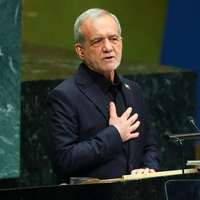
Iranian foreign minister Hossein Amir-Abdollahian in Beirut on March 24, 2022
Iran’s foreign minister says he never suggested giving up Iran’s demand from the United States to remove the Revolutionary Guard (IRGC) from its terrorist list.
Hossein Amir-Abdollahina in an interview had said that IRGC commanders do not object if the government gives up its demand from the US to remove the military organization from its Foreign Terrorist Organization (FTO) list.
"I couldn't have spoken more clearly about the pivotal role of the honorable Revolutionary Guards," Hossein Amir-Abdollahian said in an Instagram post Sundayafter an uproar about his remarks in a televised interview Saturday. "The issue is not compromising or making a concession over red lines. I suggest re-examination of my interview yesterday," he wrote.
Amir-Abdollahian's remarks Saturdaywere widely misunderstood by some media and pundits. Some thought he was declaring that the IRGC had given the green light to the government to make a concession in Vienna nuclear talks and not demand the removal of the IRGC from the US FTO list.
Iran International did report that the Iranian foreign minister was not suggesting a retreat from Tehran's demand in his Saturday remarks.
Amir-Abdollahian did claim on Saturday that senior Revolutionary Guard officials always tell the government that it should do whatever it deems necessary to secure the country's national interests and not to prioritize the issue of the IRGC and called it "self-sacrifice on the part of the IRGC". However, he added that despite having the "permission" from the IRGC, the government continues to consider its removal from the US list of terror organizations a "major issue" in the talks.
This was the first time Amir-Abdollahian clearly referred to IRGC terror listing as a main issue in the talks.
At the Doha Forum Sunday, the US Special Representative for Iran, Robert Malley, said he could not be confident a deal to restore the 2015 nuclear deal, Joint Comprehensive Plan of Action (JCPOA), is imminent.
“We haven’t decided to delist the IRGC. The sooner we get back into the deal -- we think it’s in our interest to be back in a deal and we think Iran’s too -- the more faithfully we can implement it.”
"This is a nuclear deal, we’re lifting those sanctions. It’s not intending to address other issues like Iran’s regional policy and other sanctions," Malley said.
Former foreign minister and Supreme Leader Ali Khamenei’s senior advisor Kamal Kharrazi told the Doha Forum on Sunday that a nuclear deal between Iran and world powers was imminent but insisted that a deal was possible only if US showed "political will" and removed the IRGC from its FTO list. "IRGC is a national army, so its being listed as a terror group is not acceptable," he said.
The misinterpretation, or imprecise quotation, of Amir-Abdollahian's Saturday remarks caused scathing criticism from some hardliners in Iran. The ultra-hardliner chief editor of Kayhan newspaper, Hossein Shariatmadari, harshly attacked Amir-Abdollahian although his remarks were clear enough that the demand to delist the IRGC was still on the table. Shariatmadari, appointed by Supreme Leader Ali Khamenei, said to forgo the IRGC delisting was "surrender", not "sacrifice".
The ultra-hardliner called the foreign minister's remarks "very odd and unexpected". "These remarks could suggest that Iran's foreign minister is not blessed with the adequate and necessary command of current affairs in his domain of responsibility," he wrote and urged IRGC commanders to correct the foreign minister's remarks by offering a "candid and quick explanation.
In an editorial note in January Shariatmadari berated Amir-Abdollahian, as well as the Secretary of the Supreme National Security Council Ali Shamkhani, when they hinted at the possibility of direct talks with the United States. Shamkhani, according to Kayhan, backed down from his position but Amir-Abdollahian did not respond to the criticism.