Nine Million Liters Of Fuel Smuggled Out Of Iran Every Day

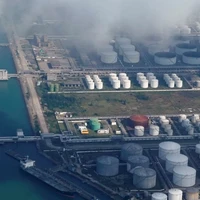
Iran says over nine million liters of fuel is smuggled out of the country every day, citing highly subsidized prices as the main reason for the illicit trade.

Iran says over nine million liters of fuel is smuggled out of the country every day, citing highly subsidized prices as the main reason for the illicit trade.
Mojtaba Mahfouzi, who represents the oil-rich city of Abadan, said during a TV show on Monday that the subsidized price of diesel fuel in Iran is one US cent per lieter, or 60 times less than bulk rates in the Persian Gulf region.
The spokesman for the anti-trafficking taskforce of Iran’s customs administration, Hamidreza Dehghannia, said during the same TV program that there is no exact data but the daily volume of the total petroleum products that are smuggled from the country is about nine million liters (2.37 million gallons).
Mahfouzi then noted such a high volume of smuggling cannot be done by ordinary traffickers, adding that “undoubtedly” there are mafias behind the scenes to get the fuels to the smugglers.
In 2019, a top anti-smuggling official in Iran had put the daily amount of the trafficked gasoline and diesel at around 11 million liters or close to 3 million gallons.
Iranian authorities never offer any explanation on how such a huge volume of fuel can be smuggled out without being detected.
Also on Monday, Oil Minister Javad Owji denied reports that the government intends to raise the gasoline price.
Venezuelan President Nicolas Maduro said on Sunday he will soon visit Iran to finalize new agreements on cooperation, as both countries face tough sanctions.
Venezuela and Iran have strengthened their ties since last year amid deep economic crisis and facing serious challenges.
Maduro's government has received vital equipment for its oil industry from Iran, which in return has received crude and other primary resources from the South American country. Iran has been crucial for Venezuela's rising oil production in 2021.
"I am going to Teheran very soon, for a visit that President (Ebrahim) Raisi offered me, so that we meet in person, to hold conversations and sign new agreements ... and speed up processes of cooperation," Maduro said during an interview with satellite news broadcaster Al Mayadeen in Spanish, which was later broadcast on Venezuelan state television.
Maduro said he has had two telephone conversations with Iran's president, adding that they have agreed to work on new plans, without providing details. He also did not give a date for the visit but described the two countries as "fighters."
The tightening of US sanctions since 2019 has affected Venezuela's ability to sell crude and import fuel, which has exacerbated gasoline shortages across the country.
Reporting by Reuters

Iranian and Omani diplomats have held the eighth meeting of their Joint Strategic Consultation Committee to discuss issues of mutual interest in the region.
Iranian Deputy Foreign Minister for Political Affairs Ali Bagheri-Kani hosted his Omani counterpart, Sheikh Khalifa bin Ali bin Issa al-Harthy, in Tehran on Sunday.
During the meeting, Bagheri pointed to the 50th anniversary of the establishment of mutual relations and called for more efforts to further boost bilateral ties.
He stressed that regional issues should be resolved only by the countries of the region through dialogue.
They also talked about the negotiations over Iran’s nuclear program as well as the crisis in Yemen.
For his part, the Omani under-secretary for diplomatic affairs expressed interest in expanding relations with the Islamic Republic, noting that peace and tranquility in the region are achieved only through peaceful means.
He added that Iranian and Omani ties have influence in the region and beyond.
The visiting Omani official also met with Iranian Foreign Minister Hossein Amir-Abdollahian on Saturday.
The Joint Strategic Consultation Committee was formed with the aim of improving the level of negotiations and drawing a roadmap for all spheres of the Tehran-Muscat relations.

The Saudi-led coalition fighting in Yemen said on Sunday that Iran-backed Lebanese Hezbollah has been training the Houthi rebel forces, including launching armed drones against Saudi Arabia.
Iran-aligned Houthi group had fired 430 ballistic missiles and 851 armed drones at Saudi Arabia since the war started in 2015, killing 59 Saudi civilians, the spokesman for the coalition said.
General Turki al-Malki, said the Iran-aligned movement had been using Sanaa airport as a base to launch attacks on the kingdom, an allegation the Houthis deny. But he shared videos of Hezbollah members training Houthi forces.
Al-Malki said, “The Houthis do not have the ability to make the decision to be part of the political solution in Yemen.” He blamed Iran of spreading sectarian conflict in the region.
Yemen has been mired in violence since 2014 when the Houthis took over the capital Sanaa and ousted the internationally recognized government of Abd-Rabbu Mansour Hadi. Saudi Arabia and the United Arab Emirates intervened against the Houthi movement in 2015 but the war has stalemated for years, killing tens of thousands of Yemenis, mostly civilians.
The conflict is largely seen as another proxy war between Middle East archrivals Saudi Arabia and Iran.
With reporting by Reuters

While Iran says the number of people carrying the highly infectious Omicron variant of the coronavirus is increasing, government travel restrictions seem patchy.
Public relations manager of the Iranian Health Ministry, Mohammad Hashemi, said on Sunday that 14 people are confirmed to be infected with Omicron in several parts of the country.
The number of people with the new variant is probably much higher than 14 because Iranian authorities in the past have been slow in announcing outbreaks. The head of the Medical Sciences University of Semnan province, Kamran Qods, talked about a family of five who caught the virus in less than a day, a case that the government has not reported, as an example for the high rate of Omicron’s contagion.
Iran was the second country after China where the corovirus spread and Covid-19 became an epidemic, but the government was slow to admit the crisis and act to contain it in early 2020.
Iran has announced that it has closed all its land and sea borders to non-Iranians for 15 days, but air travel is still ongoing except from eight African countries and four European ones, namely England, France, Norway and Denmark.
Head of Iran's Roads and Transportation Organization Javad Hedayati said on Sunday that Iranian passengers can cross the borders with their vaccine cards and a negative PCR test.
He added that a travel ban has also been put in place for Iranian tourists who want to visit Turkey, because according to Turkish authorities Omicron accounts for 10 percent of new cases.
If that is the case in Turkey, then Iran should also have hundreds of people infected with Omicron.
However, restrictions, which started with Khuzestan province on Saturday have exempted holders of valid residence permits, student and work visas, students of seminaries and universities, as well investors and medical visas. These groups constitute the major bulk of the people who travel to and from Iran.
More than 6,000 flights have been cancelled worldwide over the Christmas weekend as pilots, flight attendants and other employees are calling in sick or having to quarantine after exposure to COVID-19.
A senior official of Iran’s national Coronavirus headquarters says the new variant will be the dominant type of Covid-19 in Iran in the following weeks, if it is not controlled.
Deputy health minister Kamal Haidari said last week that about 1,800 suspected cases were sent to laboratories for further tests.
Iran, which confirmed the first Omicron case on Sunday, December 19, is one of the worst hit countries in the Middle East by more than 131,000 deaths since February 2020.

Several members of Iran’s parliament have warned that scrapping cheap government dollars for imports of essential goods can lead to even higher prices in soon.
President Ebrahim Raisi’s government has announced plans to stop providing dollars at a seven-fold cheaper exchange rate to importers of essential food staples, animal feed and possibly some medicines, as it faces a revenue crunch amid continuing US sanctions.
The special exchange rate was introduced in 2018 to control inflation when the United States pulled out of the Obama-era nuclear agreement known as JCPOA and imposed crippling sanctions on the Islamic Republic.
However, media and politicians have charged that the cheap dollars led to large-scale corruption as individuals and companies pretended to be importing essential goods while either speculating in the currency market or importing luxury goods.
It is still not clear if the government wants to completely scrap the cheap import dollars, which is essentially a subsidy or maintain support for animal feed and medicines. Prices have been rising alarmingly, leading to warnings of social unrest.
Iran is engaged in talks to resolve its nuclear dispute with the West, which would remove US sanctions, but so far months of negotiations have not led to an agreement.