• العربية
  • فارسی
Brand
  • Iran Insight
  • Politics
  • Economy
  • Analysis
  • Special Report
  • Opinion
  • Podcast
  • Iran Insight
  • Politics
  • Economy
  • Analysis
  • Special Report
  • Opinion
  • Podcast
  • Theme
  • Language
    • العربية
    • فارسی
  • Iran Insight
  • Politics
  • Economy
  • Analysis
  • Special Report
  • Opinion
  • Podcast
All rights reserved for Volant Media UK Limited
volant media logo

Iran Tribunal Hears Of More Atrocities, Amnesty Demands UN Action

Maryam Sinaiee
Maryam Sinaiee

Iran International

Nov 11, 2021, 17:49 GMT+0Updated: 17:27 GMT+1
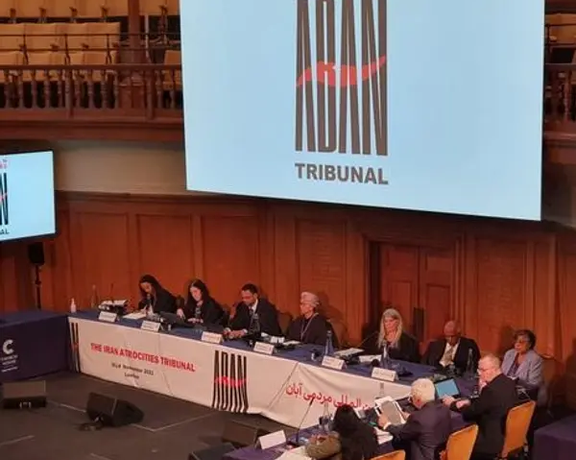
Second day of Iran Atrocities Tribunal in London. November 11, 2021

The second day of the ‘Iran Atrocities Tribunal’ continued Thursday with oral testimonies from anonymous witnesses, including a former police officer and two protesters.

The tribunal, which styles itself a “Russell tribunal” after the late British philosopher Bertrand Russell, convened in London Wednesday to examine the atrocities of violence against protesters in Iran in November 2019. Iran declined an invitation from the organizers to take part.

Social media traffic showed great interest among Iranians in following the proceedings and posting comments.

‘Witness 195,’ who said he was a former major in the Iranian police, testified via video-link disguising his voice to protect his identity, that he had refused a command from an officer in the Revolutionary Guards (IRGC) to deploy his 60 officers to suppress the protests in a city in the west of Iran. He said he had told the police under his command they had “no right to use firearms against unarmed protesters.”

Witness 195 claimed he had seen "plainclothes agents of the IRGC and intelligence ministry spraying the protesters with bullets,” killing 15 on November 19. "Armed [agents] shot at protesters with no purpose other than intimidating them," he said. The witness said that the security forces had destroyed public property and blamed protestors.

Witness 195 said he was arrested a few months later for disobeying an order to shoot at the protesters, held in solitary confinement and subjected to psychological torture. He said he had been sentenced to nearly six years in prison but that the sentence had not been enforced.

‘Witness 128’ testified in person that he had witnessed the killing of two protesters in the southeastern province of Sistan-Baluchestan.

After the tribunal was shown video footage of protests on a road leading to Rask, a city of Sistan-Baluchestan, witness 128 said he had seen IRGC forces 200 meters from where the film was taken, and claimed they had shot at protesters from nearby villages trying to reach Rask by the road.

‘Witness 366,’ testifying via videoconference, displayed an x-ray, which he said was of his chest and showed a bullet, lodged in his spine on November 16, 2019, that had put him in a wheelchair. Witness 366 told the tribunal he was certain he had been shot by security forces and not by armed protestors.

The tribunal on Thursday also heard Raha Bahraini, a researcher at Amnesty International, report that many arrested protesters, including children, had been sexually assaulted, raped, or tortured by hanging and staged executions.

"This people's tribunal is very important," Bahraini told Iran International. "It's a strong initiative against the continued impunity for crimes in Iran," she said. Bahraini said there was no chance of justice through the Iranian judicial system so responsibility fell on the United Nation's Human Rights Council and the United Nations Security Council to bring those responsible for the “atrocities” to justice.

Most Viewed

Iran negotiators ordered to return after internal rift over Islamabad talks
1
EXCLUSIVE

Iran negotiators ordered to return after internal rift over Islamabad talks

2
ANALYSIS

US blockade enters murky phase as tankers spoof signals and buyers hesitate

3
ANALYSIS

Why the $100 billion Hormuz toll revenue is a myth

4

US tightens financial squeeze on Iran, warns banks over oil money flows

5
ANALYSIS

US blockade targets Iran oil boom amid regional disruption

Banner
Banner

Spotlight

  • Hardliners push Hormuz ‘red line’ as US blockade tests Iran’s leverage
    INSIGHT

    Hardliners push Hormuz ‘red line’ as US blockade tests Iran’s leverage

  • Ideology may be fading in Iran, but not in Kashmir's ‘Mini Iran'
    INSIGHT

    Ideology may be fading in Iran, but not in Kashmir's ‘Mini Iran'

  • War damage amounts to $3,000 per Iranian, with blockade set to add to losses
    INSIGHT

    War damage amounts to $3,000 per Iranian, with blockade set to add to losses

  • Why the $100 billion Hormuz toll revenue is a myth
    ANALYSIS

    Why the $100 billion Hormuz toll revenue is a myth

  • US blockade targets Iran oil boom amid regional disruption
    ANALYSIS

    US blockade targets Iran oil boom amid regional disruption

  • Iran's digital economy battered by prolonged blackout
    INSIGHT

    Iran's digital economy battered by prolonged blackout

Tweet unavailable

•
•
•

More Stories

Iran's Currency Continues To Lose Value Against Major Currencies

Nov 11, 2021, 14:29 GMT+0

Iran’s currency, rial has continued to drop against the dollar as the country awaits the resumption of nuclear talks with world powers in less than three weeks.

The rial on Thursday was trading above 284,000 against the US dollar.

There were hopes among Iranians that the national currency can rebound once positive news emerges regarding the resumption of talks to revive the 2015 nuclear agreement, JCPOA. If the nuclear talks succeed, US oil and banking sanctions will be lifted, giving Iran a financial lifeline.

The rial has declined another 2.8 percent in the past seven days, bringing its losses in a month to more than 3 percent and in the past six months to 31.5 percent.

The foreign currency market reaction in Iran can show a lack of optimism about the outcome of the multilateral nuclear talks.

The Iranian rial has lost value ninefold against major currencies since the former US president Donald Trump indicated that he would withdraw from the nuclear deal and impose sanctions. Once he implemented his threat, rial’s fall accelerated in 2018.

Oil exports provide at least half the revenue the Iranian government needs to operate. In the absence of sufficient oil exports, the Central Bank of Iran has been printing money, with liquidity rising rapidly since 2017 and fueling inflation.

Amphibious Assault Ship, Marines' Unit Join US Navy In Sea Of Oman

Nov 11, 2021, 12:53 GMT+0
•
Iran International Newsroom

A US amphibious assault ship and a Marine Expeditionary Unit have deployed to the Sea of Oman, as joint naval exercises with Israel take place in the Red Sea.

The US Navy said that the amphibious assault ship “Essex and the 11th Marine Expeditionary Unit are deployed to the U.S. 5th Fleet area of operations in support of naval operations to ensure maritime stability and security in the Central Region, connecting the Mediterranean and the Pacific through the western Indian Ocean and three strategic choke points.”

In another development, forces from the United Arab Emirates, Bahrain, Israel and the United States Naval Forces Central Command (NAVCENT) began a multilateral maritime security operations exercise in the Red Sea on Wednesday, NAVCENT said on Thursday.

This is the first publicly acknowledged naval exercise between the United States, Israel and the two Gulf Arab countries.

The amphibious assault ship USS Essex (LHD 2) transits the Gulf of Oman, Nov. 8, 2021
100%
The amphibious assault ship USS Essex (LHD 2) transits the Gulf of Oman, Nov. 8, 2021

The new naval and Marines’ forces joining CENTCOM’s theater of operations conducted bilateral interoperability training with the Royal Navy’s aircraft carrier HMS Queen Elizabeth with landing helicopters and fixed-wing aircraft on US F-35 fighters and British aircraft cross-landing on each other’s platforms.

The move coincided with Iranian exercises along the Sea of Oman that began on November 7 and included land, air and naval unites. The army said its drills covered an area of one million sq kilometers or 386,000 sq miles, well over half the territory of Iran. Navy vessels and submarines, as well as old American Phantom fighter-bombers and drones took part.

Tensions are high in the region as Iran tries to flex its muscles following Israeli warnings that it will take action if Tehran gets any closer to nuclear capability. An Israeli official told Iran International on October 25 that attacking Iran was now the Israeli air force’s top priority.

The United States has also warned that “other option” could be considered if Iran does not seriously negotiate over its nuclear program.

Iran’s new hardliner government left multilateral talks over reviving the 2015 nuclear agreement in June, delaying resumption of negotiations for five months. New talks are finally scheduled to resume at the end of November, but Iran has been hardening its posture.

Iran also claimed last week that it had a confrontation with the US Navy and prevented the seizure of Iranian oil in the Sea of Oman. The US denied any confrontation and said Iran seized a Vietnam-flagged tanker in October and the Navy was simply observing the incident. Iran finally released the tanker on Tuesday.

Commodore Steve Moorhouse, commander of the United Kingdom’s Carrier Strike Group, was quoted as sayingabout joint drills, “The force development work we have been undertaking with the U.S. Navy has been ground breaking. We are all comfortable with helicopters lilly-padding from one deck to another but doing it with fixed wing aircraft is a whole new game. This level of interoperability goes far beyond anything we have exercised before with any partner and offers a degree of flexibility and agility that Commanders have long dreamt of.”

The US 5th Fleet area of operations covers about 2.5 million square miles of water area and includes the Arabian Gulf, Gulf of Oman, Red Sea and parts of the Indian Ocean. The area encompasses 20 countries and includes three chokepoints, including the Strait of Hormuz, critical to the free flow of global commerce.

Iran's New Population Law Raises Concerns Over Women's Rights

Nov 11, 2021, 11:46 GMT+0
•
Maryam Sinaiee

A prominent doctor warned Thursday that new legislation designed to boost population growth in Iran would increase sexually transmitted disease by restricting access to condoms.

"[This law] will not only lead to an increase in unwanted pregnancies and sexually transmitted diseases but also a hike in HIV positive cases," said Dr Masoud Mardani, a member of the National HIV/Aids committee and professor at Shahid Beheshti medical university.

The legislation, passed by parliament in March and approved by the constitutional watchdog Guardian Council last week, outlaws tubectomy, vasectomy, and the free dispensation of contraceptives other than where pregnancy would threaten a woman's health. The health ministry has instructed family health clinics to advise women over-35 to wait only a year before again becoming pregnant and under-35s to wait six months.

The legislation reflects concern at declining population growth in Iran. The annual population growth rate, according to government figures, has dropped to 1.23 percent from 4.21 percent in 1984 five years after the 1979 Revolution, a decline due both to better family planning and growth in women’s education. Iran’s annual growth is now below Saudi Arabia at 1.6 percent, Israel at 1.8 percent, Pakistan at 2 percent and Iraq at 2.3 precent.

To encourage population growth, the law obliges the government to offer incentives, including a 7.5-fold increase in child-benefit payments to government employees, interest-free loans, and the free allocation of 150-200 square meters of land to urban families with more than three children.

The reformist Etemad newspaper on Thursday called the new law "populistic" in using financial incentives. "It will bear consequences and damages that have been ignored," the newspaper said. Etemad linked the issue to the ‘populism’ of reducing fuel subsidies – which disproportionately benefit the better-off – in favor of cash hand-outs to the less well off.

Tara Sepehri Far, Beirut-based researcher in the Middle East and North Africa division of Human Rights Watch, attacked the new law for undermining “the rights, dignity, and health of half of the country’s population, denying them access to essential reproductive health care and information.” Sepehri Far said that trying to increase population growth through “restricting the right to health and privacy” was "a delusional understanding of policymaking."

In 2014 Supreme Leader Ali Khamenei announced that Iran should aim to increase the population – which is now around 85 million – to 150 million by 2050.

While the new law does not include a ban on pre-natal screening, doctors have been advised not to encourage it. The legislation has not taken up plans drawn up by the parliament's Special Committee for Population and Family to ban screening for Downs Syndrome, Trisomy 18, Trisomy 13, which have been compulsory and generally free in public clinics since 2001.

'Address Election Complaints', Iran's Quds Commander Tells Iraqis

Nov 11, 2021, 10:11 GMT+0

The commander of IRGC Quds Force has told Iraqi leaders that Iran would support the final results of Iraq’s elections, but all complaints should be addressed.

General Esmail Ghaani visited Iraq immediately after a drone attack on Prime Minister Mustafa al-Kadhimi’s residence on Sunday and met with several senior officials and Shiite militia commanders to contain a possible crisis in relations.

The drone attack that did not harm al-Kadhimi is believed to have been launched by Iran-backed militias whose political blocs lost in recent parliamentary elections and are contesting the results. They have been holding protests to change the election outcome.

Iran’s ambassador to Baghdad, Iraj Masjedi told Al Alam television that Ghaani reaffirmed Iran’s support for the election results but demanded that complaints and protests to be dealt with according to the law.

Iran has been building a network of political and military support within Iraq since the overthrow of Saddam Hussein’s regime in 2003, but since 2019, many Iraqis have been protesting Tehran’s influence, complaining that it contributes to corruption and mismanagement. Iraq witnessed large anti-government protests in 2019 and 2020.

'Jobs For The Boys' Riles Iran Parliament, Raisi Supporters

Nov 11, 2021, 08:51 GMT+0
•
Iran International Newsroom

Nepotism has become such a characteristic feature of the Raisi government that even Iran's hardline parliament is protesting appointments based on kinship.

One of the latest cases of nepotism in the Raisi administration is the nomination of Massoud Fayazi, a close relative of Tehran's mayor Alireza Zakani as education minister.

Iran International TV's correspondent Mojtaba Pourmohsen has revealed Fayazi's debatable academic credentials in an investigative report which he summarized in a tweet on November 10. These include a Ph.D. degree awarded by a committee that is not linked to any official academic institution. Even his earlier diploma in the area of civil engineering is also reportedly not quite sound.

According to the Iranian Labor News Agency (ILNA) several lawmakers expressed their opposition to Fayazi's nomination when Majles Speaker Mohammad Bagher Ghalibaf announced it on Tuesday.

The Majles has already rejected Raisi's first choice for Minister of Education Hossein Baghgoli, a relative of the President's wife, in August. Members of the Cultural Committee of the Majles told reporters on Wednesday that they will try to make sure Fayazi also does not win the parliament's vote of confidence.

Earlier, Raisi's brother-in-law Ali Alamolhoda who was appointed as the chancellor of Payam Noor University resigned his post and Zakani was forced to fire his son-in-law under pressure from the press and social media a few days after he was appointed as his own deputy.

Nepotism was also a problem that led to scandals for Hassan Rouhani and Mahmoud Ahmadinejad's administrations, but the problem appears to be even more widespread under President Ebrahim Raisi.

During the past weeks, several media reports accused Health Minister Bahram Einollahi, Economy Minister Ehsan Khandouzi and Oil Minister Javad Owji of giving key posts to their own or other officials' relatives in their agencies. Raisi, pressed on several occasions including during his meeting last week with reformist journalists, was forced to say that he would look into the matter. But subsequently he ordered his cabinet ministers to refute reports about appointing their relatives if such reports are not true.

Mohammad Saleh Jokar, an MP for Yazd told Khabar Onlinethat nepotism will lead to corruption and that he did not expect such things to happen in President Raisi's government. Meanwhile, according to the news agency of the Iranian parliament, Jalil Rahimi Jahanabadi, a conservative lawmaker close to Raisi, told reporters that appointing Fayazi as the Minister of education and ignoring capable individuals as candidates for the post would be an insult to Iranian teachers and cultural figures.

Another hardline lawmaker, Esmail Kowsari, criticized President Raisifor his failure to give key posts to well-qualified individuals and acknowledged that appointments based on kinship with top officials will inevitably lead to corruption.

Reformist figure Zahra Nejadbaharam also said that "appointing officials' in-laws to key posts is a disgrace for the Raisi administration and Raisi needs to intervene in the matter. This is an undesirable practice that damages the country's prestige."

According to Khabar Online, vice president for parliamentary affairs Mohammad Hosseini called on state officials to revoke nepotism-based appointments as the government's critics are likely to use them against the Raisi administration.

This latest bout of attacks on the new president adds to criticism about Raisi’s appointments in general. Many top officials are not qualified for their posts and after one hundred days, the government has done little to improve the economy and other crises gripping the country.