US Sanctions Iranian Companies, Officers Related To Drone Program

The US Treasury Department on Friday announced new sanctions related to Iran’s Unmanned Aerial Vehicle (UAV) program of the IRGC and its Qods (Quds) Force.

The US Treasury Department on Friday announced new sanctions related to Iran’s Unmanned Aerial Vehicle (UAV) program of the IRGC and its Qods (Quds) Force.
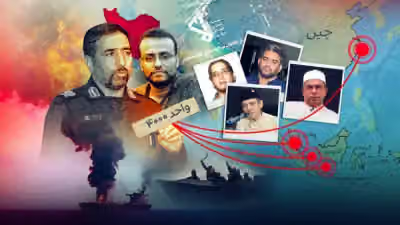
A statement said that the Office of Foreign Assets Control (OFAC) sanctioned a group of companies and individuals as well as IRGC’s UAV force commander Saeed Aghajani.
US forces in southern Syria were targeted by pro-Iran militias using drones last week, similar to attacks on US bases in Iraq. Although the US did not name Iran directly at the time, unnamed officials later said that Washington believed Iran resourced and encouraged the attack.
“The IRGC-QF has used and proliferated lethal UAVs for use by Iran-supported groups, including Hizballah, HAMAS, Kata’ib Hizballah, and the Houthis, and to Ethiopia, where the escalating crisis threatens to destabilize the broader region. Lethal UAVs have been used in attacks on international shipping and on U.S. forces,” the statement said.
Besides Aghajani, US sanctioned Kimia Part Sivan Company (KIPAS), Abdollah Mehrabi an IRGC official and Mado Company.
The new sanctions come as the US is trying to revive the Iran nuclear deal (JCPOA), while Tehran is making more demands for the removal of previous sanctions.

Iran’s foreign minister has said Tehran will decide soon on when to return to nuclear talks, and has again requested US unfreeze $10 billion to show good will.
Speaking to reporters in Tehran after a conference on Afghanistan, Hossein Amir-Abdollahian said Iran would decide on when to return to nuclear talks in Vienna after discussions in Brussels between Deputy Foreign Minister Ali Bagheri-Kani and the European Union’s Enrique Mora, who coordinates the Vienna process.
After meeting Mora, Bagheri tweeted from Brussels that they had reached agreement to resume negotiations before the end of November, with the exact date confirmed “next week.”
Not too far away
Amir-Abdollahian put as “not too far away” the date for resuming talks with the “4+1” – the five world powers without the US, which takes part in Vienna indirectly – and said this date would be set “Wednesday night or after [Bagheri-]Kani’s return to Iran, if we need more consultations.”
Amir-Abdollahian added, “We do not want to return to negotiations from the point of an impasse at Vienna talks, but we accept the format of the Vienna talks.”
Amir-Abdollahian said Iran’s need for clarification with the EU had involved discussing “how all the parties who return to the agreement will demonstrate that JCPOA sanctions against Iran would be fully lifted.” Iran did not, he explained, want to “return to negotiations from the point of an impasse at Vienna talks, but we accept the format of the Vienna talks.”
Iran suspended in June its participation in the Vienna talks, aimed at reviving its nuclear 2015 deal with world powers, first for the presidential election and then so new president Ebrahim Raisi (Raeesi) could prepare for the talks. But almost three months after Raisi’s inauguration, Tehran has stalled over agreeing a date to return to Vienna.
Concerned over delays
The three European signatories of the agreement – the JCPOA, Joint Comprehensive Plan of Action – and to a lesser extent Russia and China have expressed concerned over the delay. After the US left the JCPOA in 2018, Iran began exceeding the deal’s nuclear limits and is now enriching uranium to 20 and 60 percent purity, reducing the time needed to acquire 90-percent-purified uranium for a nuclear device.
Amir-Abdollahian also referred to a looming trip to Tehran of Rafael Mariano Grossi, head of the International Atomic Energy Agency, as “certain” although the date was “not important.” Grossi has requested an urgent meeting to revolve disagreement over IAEA access to the Karaj site where Iran makes centrifuges, which are used to enrich uranium.
While many diplomats involved in the Vienna process felt progress was made, there was difficulty agreeing which US sanctions contravened the JCPOA and exactly how the expanded and improved Iranian atomic program should be brought back within the JCPOA.
Tehran has argued that some US sanctions ostensibly on grounds other than the nuclear program impede its ability to benefit from the JCPOA and that it needs guarantees that Washington would not again withdraw from the agreement as previous president Donald Trump did in 2018.
“[President Joe] Biden must demonstrate his will about returning to JCPOA,” Amir-Abdollahian said. “We are not so eager for America’s return to the JCPOA for the sake of returning. The important issue is the result, if it is to Iran’s benefit or not. Would America return in order to lift sanctions, or to impose new limitations?”
Unfreezing $10 billion of Iran’s funds – this is money owed to Iran by third countries fearing US punitive action – would, Amir-Abdollahian said, “show that Americans are serious about lifting the sanctions.”

Iranian state TV's clip of one military officer slapping another during a public ceremony led to a deluge of speculation, theorizing, cheers, and condemnation.
On Saturday [Oct. 23], while Brigadier General Abedin Khorram, dressed in civilian clothes, was beginning his inauguration speech in Tabriz, IRGC colonel Alizadeh (no first name has been published), also in civilian clothes, approached him on the podium and calmly slapped him hard in the face. A half-dozen people rushed to the stage, and he was ushered out of the hall by security guards.
In an odd occurrence, the state television's news channel IRINN, not only carried the footage of the attack but also posted it on its Telegram channel so that more people could watch or share it on social media.
IRGC-linked Tasnim news agency immediately carried a story to justify what had happened by allegedly fabricating a story that said Alizadeh attacked the governor after he found out that his wife was vaccinated by a member of the opposite sex. The Iranian social media did not believe this story.
On Monday, reformist daily Arman condemned the incident as "how bad the appointment of security and military commanders as civilian officials can turn out to be." During the past weeks, many have criticized Interior Minister (IRGC general) Ahmad Vahidi for appointing all of the provincial governors from among IRGC commanders.
A senior reporter Masoud Noori who has worked with many news outlets including the official news agency IRNA, wrote in an October 23 tweet, "So far, at least 22 senior officials including cabinet ministers and governors have been chosen from among current or former IRGC commanders. Government posts have been given to military officials in all previous governments too. But what is taking place in the current administration is unprecedented. It is no longer clear who runs this administration, President Ebrahim Raisi or the IRGC?"
Minister Vahidi reacted on Twitter in a way to save face for the governor and the IRGC. He wrote: "An official in the sacred regime of Islamic Republic does not fear insults or a slap in the face as he is serving the people to satisfy God almighty." Hundreds of users dismissed his comment.

Meanwhile, praising the governor, Ahmad Alirezabeigi, an MP for Tabriz told reporters that Khorram was such a good officer that when ISIS took him hostage in Syria, former President Mahmoud Ahmadinejad paid a hefty ransom of $57 million to secure his freedom. In fact, some say it was the Emir of Qatar who paid the ransom to free 57 hostages, including Khorram, for one million dollars per person.
Cleric Mohammad Ali Abtahi, the chief of staff of former reformist president Mohammad Khatami, wrote: "They say they appoint military figures as governor to control tension in the provinces. But they failed to control the tension at the governor’s inauguration ceremony."
Ehsan Mazandarani, a journalist, wrote: "What is more important than a slap in the face of a governor…, is the fact that it made many people happy. What do citizens think of a manager that a slap in their face makes so many happy?"
Another journalist, Elham Naddaf, wrote: "He slapped the governor general in the face and everyone said, 'Well Done!' before even knowing why he attacked the official."
Arman wrote that the country's elite had warned Raisi to avoid appointing military personnel to civilian posts and he promised that his appointments will be free from political and other influences, but his Interior Minister appoints the governor with security paramount in his mind.
Iran analysts abroad, including Morad Vaisi have told Iran International TV that the government appoints IRGC commanders as governor because officials fear the repetition of massive protests as a result of economic hardships, similar to unrest in 2018 and 2019.
In Aftab Yazd daily, an MP for Maragheh, Ali Alizadeh said the two protagonists in the slapping story had some personal grudge against each other. Others said that Khorram had prevented the attacker's promotion within the ranks of the IRGC. Meanwhile, sociologists speaking to Aftab Yazd, said the people's reaction was more important than the incident, and “it shows their anger and distrust toward state officials.”

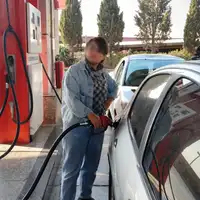
Iran’s oil refining capacity has declined by 11 percent in 8 years and its share of global refining is just 2 percent, despite its large reserves of crude oil.
Meanwhile, its regional rival Saudi Arabia has been investing billions of dollars in setting up new refineries with the ability to produce more feed for petrochemicals, a sector that aspires to make up for projected reductions in the consumption of fossil fuels in coming decades.
Iran Student News Agency (ISNA) in an article expresses hope that the new government of President Ebrahim Raisi (Raeesi) would pursue plans to expand Iran’s refining capacity. But the biggest hurdle would be Iran’s lack of resources for making the necessary investments amid a deep economic crisis.
Amid US sanctions and deep disputes with Western countries, the chance to secure foreign investments is almost non-existent. If Iran’s ally China shies away from openly doing business with Tehran. Although Beijing is buying some illicit Iranian oil, it has shifted its purchases to other countries, including Saudi Arabia.
Iran might be missing the boat in significant ways to shift from a crude oil exporter to provider of refined products and feed for petrochemicals, as other countries plan for a shift with green technologies bound to reduce fossil fuel consumption.
Iranian media and politicians have been arguing that the country should reduce its dependence on crude exports for two reasons. First, crude oil is vulnerable to sanctions, as the reality with stringent US sanctions have shown since 2018. Iran’s crude exports dropped from a height of 2.5 million barrels a day in 2017-2018 to around 200,000 bpd in the second half of 2019, when Washington imposed full sanctions. But the US never sanctioned Iran’s gasoline exports.
Second, exporting crude oil has much less profit than exporting refined products such as gasoline, Iranian officials say. But daily refining capacity has dropped to 2.1 million barrels of crude, even according to Iranian officials who usually boast about production. That can produce around 800,000 barrels of gasoline, when daily domestic consumption is 550,000 barrels. This leaves relatively little to export and make money.
If Iran exports the remaining gasoline, it is difficult to estimate how much money it makes. There are no official records of buyers, who cannot pay Iran through regular banking channels, again because of US third-party sanctions on banks that deal with Iran. If international gasoline prices would be any guide, Iran could fetch more than $20 million a day by exporting its remaining 10 million gallons, but in this case the real prices would be much lower.
Nevertheless, Iran makes a few billion dollars a year by selling gasoline and diesel in the region to buyers who find ways to pay for the discounted fuel. This has helped Tehran in getting much needed foreign currency when crude oil export, its main source of revenues, has been slashed.
If US sanctions are lifted and Iran is able to return to its previous level of crude exports, perhaps it can make some investments in its refining capacity. But to seriously prepare for the coming decades it would need billions of dollars to compete in modern refining. This level of resources would need foreign investments, since Iran’s oil revenues are barely able to feed an inefficient, centrally mismanaged economy.

Contradicting trade officials, the IRGC-linked Fars news agency has once again insisted that Iran is selling more than a million barrels p/d of oil to China.
In a report Sunday, Fars accused officials of the Tehran Chamber of Commerce of wrongfully declaring that Iran's crude oil exports to China have dropped to around 1,000 bpd, because they are allegedly opposed to "neutralization of [US] oil sanctions". Fars also accused the chamber of sabotaging Iran's relations with China.
In a tweet Saturday, Chairman of the Tehran Chamber of Commerce Masoud Khansari said Iran's oil exports to China "drastically dropped" in the first seven months of the current Iranian calendar year which began 21 March. According to Khansari in the first seven months of 2021 Iran exported just $11 million of crude oil to China in comparison with $9.5 billion in 2018 before Donald Trump imposed sanctions on Iranian oil in November of that year.
Since then, Khansari said, other countries in the region, presumably Saudi Arabia, which is now exporting more oil to China, have taken Iran’s market sahre. "With the continuation of sanctions, the Iranian economy will lose more [trade] opportunities," he argued.
"Why does an entity such as the Tehran Chamber of Commerce which is fully aware of the [extent of the] Iran, China oil trade try to sabotage the relations between Iran and China in the domestic sphere with such wrong information?" Fars asked in a section of its report under the subhead "Tehran Chamber of Commerce's Conflict of Interest with Expansion of Iran, China Cooperation in Neutralizing Oil Sanctions".
Fars also alleged that reports published by the Tehran Chamber of Commerce on the subject "all of a sudden spread suspiciously in the society by certain news websites".
Fars also argued that data from OPEC, tanker-tracking companies and government reports prove that the total crude and natural gas condensates that Iran exports to China still exceed one million barrels a day.
In fact, observers believe that the oil shipments are not directly going from Iran to Chinese buyers. Middlemen buy the oil and through illicit means sell it to China claiming a different origin for the oil.
China is a diplomatic ally of the Islamic Republic but so far it has avoided openly challenging US sanctions. China might be indeed clandestinely importing hundreds of thousands of barrels of crude a day via third party channels, but Iran gains little from this trade as intermediaries take most of the profits and often deliver goods instead of cash.
Official figures released by China's Customs show no direct oil purchase from Iran in 2021. But in March Bloomberg claimed that details from third-party sources indicated that Iranian oil was often re-branded as purchases from other countries and such exports had even surged.
There have also been reports recently that China is enforcing US sanctions on Iranian shipping. According to some officials, Chinese vessels now avoid Iranian ports and Iranian ships are not allowed into Chinese ports.
The news about China’s compliance with US sanctions might be embarrassing for hardline supporters of Supreme Leader Ali Khamenei who have been trumpeting Iran’s “Looking East” policy. Khamenei promulgated the policy in 2018, saying that Iran should adopt an Eastern orientation of relying on China and Russia for business and commerce in the face of US sanctions.

The Secretary of Iran’s National Security Council threatened Sunday that an Israeli attack on his country’s nuclear sites will be met by a “devastating” response.
Ali Shamkhani, who has the rank of an admiral in the IRGC Navy, tweeted in Persian and Arabic referring to new reports that Israel has appropriated an additional $1.5 billion budget to confront Iran’s nuclear threat.
Shamkhani wrote that instead of spending the money on “mischief” Israel should prepare to spend tens of billion of dollars to rebuild after a “decisive” attack by Iran.
Israel media had reported on October 18 that the additional money set to be approved by the government in November, would pay for aircraft, intelligence-gathering drones and armaments needed for a strike against hardened Iranian nuclear targets.
Iran has suspended negotiation with world power over restoring the 2015 nuclear agreement knowsn as JCPOA since June as it enriched uranium and building a stockpile that could reduce the time for building a nuclear device.
Israeli officials have warned on several occasions since August that if no options are left they would "go it alone" to stop Iran from acquiring nuclear weapons.