• العربية
  • فارسی
Brand
  • Iran Insight
  • Politics
  • Economy
  • Analysis
  • Special Report
  • Opinion
  • Podcast
  • Iran Insight
  • Politics
  • Economy
  • Analysis
  • Special Report
  • Opinion
  • Podcast
  • Theme
  • Language
    • العربية
    • فارسی
  • Iran Insight
  • Politics
  • Economy
  • Analysis
  • Special Report
  • Opinion
  • Podcast
All rights reserved for Volant Media UK Limited
volant media logo

Iran judge says asset seizures will weaken diaspora’s anti-regime protests

Jun 9, 2026, 07:05 GMT+1

Confiscations of assets belonging to exiled Iranians will weaken their protests in front of the Islamic Republic’s embassies overseas, a judge said on Tuesday.

“When an expatriate sees that a home, shop or any other asset they owned in Tehran, Isfahan or any other Iranian city has been seized, anti-Iran gatherings outside embassies of European and American countries clearly become emptier, weaker and more hopeless,” said the head of Isfahan province’s judiciary, according to judiciary-linked Mizan News.

Asadollah Jafari described the seizures as a judicial tool to counter what he called “the enemy’s economic and media war.”

Continue reading

Banner

Spotlight

  • Iranian teens say rising costs turn simple wishes into distant dreams
    VOICES FROM IRAN

    Iranian teens say rising costs turn simple wishes into distant dreams

  • Faith in diplomacy further dented by Iran-Israel exchange
    INSIGHT

    Faith in diplomacy further dented by Iran-Israel exchange

  • Tehran seeks to draw a line around Lebanon
    INSIGHT

    Tehran seeks to draw a line around Lebanon

  • 'Nothing is over':  Iran-Israel conflict enters a new phase
    ANALYSIS

    'Nothing is over': Iran-Israel conflict enters a new phase

  • Delayed burial, absent successor: Questions over post-Khamenei Iran

    Delayed burial, absent successor: Questions over post-Khamenei Iran

  • Inside Rasht's bloody crackdown: witnesses detail secret removals of bodies
    EXCLUSIVE

    Inside Rasht's bloody crackdown: witnesses detail secret removals of bodies

Banner
•
•
•

More Stories

Iran judge says asset seizures will weaken diaspora’s anti-regime protests

Jun 9, 2026, 06:47 GMT+1
Iran judge says asset seizures will weaken diaspora’s anti-regime protests
100%
Iranian expatriates rally against the Islamic Republic and in support of exiled Prince Reza Pahlavi on the National Mall, in Washington, DC, on March 29, 2026.

Confiscations of assets belonging to exiled Iranians will weaken their protests in front of the Islamic Republic’s embassies overseas, a judge said on Tuesday.

“When an expatriate sees that a home, shop or any other asset they owned in Tehran, Isfahan or any other Iranian city has been seized, anti-Iran gatherings outside embassies of European and American countries clearly become emptier, weaker and more hopeless,” said the head of Isfahan province’s judiciary, according to judiciary-linked Mizan News.

Asadollah Jafari described the seizures as a judicial tool to counter what he called “the enemy’s economic and media war.”

Iranian judicial authorities have been ordering the seizure of assets belonging to dozens of people, many living abroad, over allegations of cooperation with Israel and actions against national security.

Since the January protests, Iranians abroad have held regular demonstrations outside Iran’s embassies and consulates in Europe, North America and elsewhere, in support of protesters inside Iran and against the Islamic Republic’s crackdown.

Jafari said the confiscation of assets belonging to expatriates are aimed at having a “deterrent effect.”

Trump says pilots in Hormuz helicopter incident are safe

Jun 9, 2026, 05:39 GMT+1
Trump says pilots in Hormuz helicopter incident are safe
100%
US President Donald Trump looks on, as he returns after attending Game 3 of the NBA Finals, at John F. Kennedy International Airport in New York on June 8, 2026.

US President Donald Trump said on Tuesday that the pilots involved in an incident in the Strait of Hormuz were fine and that the United States would issue a report on the incident.

"The pilots are fine... We are going to issue a report tomorrow, but the pilots are fine," he said en route to White House.

Trump said he had a “very good conversation” with Israeli Prime Minister Benjamin Netanyahu and did not blame him for hitting back after Israel was attacked by Iran.

“We had a very good conversation and he was hit and he hit back. And I can't blame him for that,” Trump said. “They were going back and forth and now they both agreed, through me, to stop.”

He added that the United States was close to reaching a deal with Iran, arguing that an agreement would be more effective than further bombing.

“If we go and bomb, which we can do very easily if we want, and we spend another two or three weeks bombing, they’ll have nothing left whatsoever,” Trump said.

“But you won’t have the strait open for months,” he said. “If we do the bombing, a lot of people are going to be killed. Who wants to do that? I don’t.”

US did not join Israel strikes on Iran, Lebanon - FT

Jun 9, 2026, 05:27 GMT+1

US forces did not join Israel’s latest attacks on Iran and Lebanon, the Financial Times reported, citing a US defense official.

The official said the United States did launch interceptors to defend its troops in Israel.

The report described the move as a sign of "Washington’s displeasure at the last strikes on Lebanon and Iran."

US Apache goes down near Strait of Hormuz, crew rescued - NYT

Jun 9, 2026, 05:10 GMT+1

A US Army Apache helicopter went down near the Strait of Hormuz on Monday and its two crew members were safely rescued, The New York Times reported, citing two people briefed on the incident.

The cause was not immediately clear, with one of the people saying the helicopter may have been shot down by Iranian fire, suffered mechanical failure or encountered another problem.

The incident came after days of escalating and easing hostilities in the region, as Israel and Iran exchanged strikes before stepping back.

The Trump administration had not disclosed the incident by the time the Times contacted the White House for comment, the report said.

"The AH-64 Apache gunship, which is armed with Hellfire missiles, is one of the most fearsome types of aircraft operating in the region. They patrol the strategic waterway in part to deter small-boat attacks and to shoot down drones," read the report.

Faith in diplomacy further dented by Iran-Israel exchange

Jun 9, 2026, 04:40 GMT+1
•
Behrouz Turani
Faith in diplomacy further dented by Iran-Israel exchange
100%
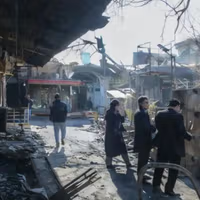
A woman stands among the rubble of her house, which was damaged in a US and Israeli strike in March, in Tehran, Iran June 7, 2026.

The brief exchange of strikes between Iran and Israel revealed a reality that weeks of ceasefire and diplomacy between Tehran and Washington had obscured: neither side appears willing to absorb a blow without responding, even if doing so risks a return to wider war.

In Tehran, the episode triggered a noticeable shift in tone across much of the media landscape. Hardline outlets portrayed Iran's missile strike as proof that its warnings carried weight, while moderates questioned whether diplomacy can survive repeated cycles of escalation.

The shift comes as US President Donald Trump continues to project confidence in negotiations.

After the exchange, Trump publicly urged restraint and sought to keep diplomatic channels alive, while reports emerged that he had warned Israeli Prime Minister Benjamin Netanyahu against steps that could further complicate negotiations.

Yet the events of recent days highlighted how narrow the path to a broader agreement remains.

The immediate trigger was Israel's decision to proceed with strikes in Beirut's southern suburbs despite repeated Iranian warnings that attacks on Dahiyeh would be viewed as a violation of the broader post-war understanding that emerged after the US-Iran ceasefire.

Tehran repeatedly linked stability in Lebanon to the durability of any future understanding with Washington and signalled that attacks on Hezbollah strongholds would not go unanswered.

When Iran responded with a missile strike on Israel, state-affiliated outlets portrayed the move less as an escalation than as the enforcement of a red line. Parliament Speaker Mohammad Bagher Ghalibaf, who has emerged as one of the central figures in Tehran's diplomacy and wartime decision-making, argued that the episode had created a "new reality" and warned that similar responses could follow future violations.

Israel's retaliation the following day reinforced a different lesson: that it was prepared to respond militarily regardless of diplomatic considerations. The result was a brief but significant exchange that left both sides claiming deterrence while simultaneously exposing the fragility of the ceasefire framework.

The media reaction inside Iran reflected these competing interpretations.

Hardline outlets such as Kayhan, Tasnim and state broadcaster IRIB framed the exchange as evidence that Iran's deterrence strategy remained intact despite military pressure and economic sanctions.

Their coverage emphasised resolve, resistance and the need to resist what they described as attempts to impose new realities on Iran and its allies.

Even more moderate publications supported the response to Israel's actions in Lebanon, although their commentary often focused on the risks of miscalculation and the possibility that another cycle of escalation could rapidly overwhelm diplomatic efforts.

This more anxious mood had already been building in recent weeks. Even before the exchange, moderate outlets increasingly reflected concerns about economic exhaustion, public frustration and the country's ability to absorb further instability.

The latest confrontation appeared to reinforce those fears rather than dispel them.

What was striking was the degree to which most voices in Tehran appeared to share a concern: that the current diplomatic opening is far more fragile than many had assumed.

The exchange lasted less than a day. Yet it altered perceptions in Tehran.

For hardliners, it demonstrated that threats still carry weight and that Iran remains willing to defend what it sees as its core regional interests. For more pragmatic voices, it underscored how quickly months of diplomacy can be placed at risk by events on the ground.

The result is a political atmosphere that is simultaneously more defiant and more anxious than it was a week ago—one in which support for negotiations persists, but confidence in their staying power has visibly weakened.