Israel to strike Dahieh and test Iran response over Hezbollah fire - Ynet
Israel will strike Beirut’s Dahieh district for any Hezbollah fire aimed at Israeli communities and test Iran’s response, Ynet reported, citing senior political-security cabinet officials.
"We have ordered the military to maintain the equation we set for Hezbollah, and this will be the test. For any fire intended to cross the fence, toward our communities – we will fire at Dahieh, and we'll see what Iran does," a senior cabinet official was quoted as saying.
Ynet said Israeli officials pointed out that Iran had not responded or intervened on Hezbollah's behalf despite continued Israeli strikes in southern Lebanon, particularly in Tyre.
Tourism businesses report empty rooms, mounting losses and growing pressure to cut jobs as rising living costs push travel out of reach for many households.
Tourism businesses in Iran are struggling to survive as economic hardship and a sharp decline in travel leave eco-lodges empty, operators facing bankruptcy and workers at risk of losing their jobs, according to a report by Shargh newspaper.
Once promoted as a way to boost local economies and preserve traditional lifestyles, eco-lodges across Iran are now grappling with falling visitor numbers, rising costs and mounting financial pressure.
"The damage caused by the war will take months to repair, and tourism will need a long time to return to previous levels," Yavar Abiri, head of Iran's Association of Eco-Lodge Professional Societies, told Shargh.
Abiri said many Iranians have shifted their priorities from travel to basic survival as economic uncertainty deepens.
"People are saving whatever money they have for essential needs in case another war breaks out," he said.
Travel slips down household priorities
Tourism operators say domestic travel had already been weakening before the latest economic shocks.
Official statistics cited by Shargh showed that nearly half of Iranian households did not take a single trip during the spring of 2024. Industry representatives say rising prices have forced many families to either cancel travel altogether or cut costs by camping, avoiding restaurants and reducing leisure spending.
Officials have also questioned whether travel remains a priority for many households.
Traditional Iranian rice dishes served at an eco-lodge restaurant
Hani Rastegaran, secretary of the National Travel Services Coordination Headquarters, previously described declining domestic travel as a warning sign for the tourism sector and called for an assessment of whether economic pressure had pushed travel out of family budgets.
Eco-lodges face closures
Mahlagha Mahdavi, who operates an eco-lodge in Shiraz and has worked in the sector for a decade, said the downturn has intensified over the past year.
"We faced a sharp drop in visitors and had to offer significant discounts because people simply could not afford to travel," Mahdavi told Shargh.
She said many eco-lodge employees are women and heads of households, prompting operators to avoid layoffs despite worsening finances.
"We do not know how long we can continue without reducing staff," she said.
Many former tourism operators, according to Mahdavi, have already left the industry, while the profile of travelers has changed. Visitors who once belonged largely to the middle class have been replaced by wealthier Iranians who can no longer justify foreign trips but continue to travel domestically.
Revenue collapses, costs soar
Operators in other provinces described similar challenges. Abas'ad Sharafkhani, who runs an eco-lodge in Hamedan province, said revenue between January and April amounted to only a fraction of what he had expected.
"Out of the income I had projected, I earned only about 10 percent, and even that barely covered operating costs," he told Shargh.
Sharafkhani said many eco-lodges are nearing complete bankruptcy and that some properties sustained physical damage during the conflict.
He criticized authorities for failing to provide meaningful support or compensation.
Rising prices force cutbacks
Ahmad Kazemi, an eco-lodge operator in Khorasan Razavi province, said inflation has transformed the economics of the business.
"When we started in 2019, a sack of high-quality Iranian rice cost three million rials ($1.8). Now it costs 64 million rials (about $36)," Kazemi told Shargh.
He said accommodation packages that once cost 4000,000 rials ($2.2) now cost between forty and fifty million rials ($22-28), even after operators reduce their profit margins.
To cope with rising expenses, Kazemi said his lodge has removed lunch and dinner services and now offers only accommodation and breakfast.
A traditional courtyard at an eco-lodge in central Iran
"People are not traveling for leisure the way they used to," he said. "Many now choose short local trips because they are cheaper."
Iran's minimum monthly wage is currently equivalent to about $90–$110, depending on exchange-rate movements, while labor experts estimate that many workers earn around $150 per month on average.
Industry operators told Shargh that without financial support and an improvement in household purchasing power, many of Iran's eco-lodges may be unable to continue operating, threatening jobs and a sector that was once viewed as a growing part of the country's tourism economy.
Two US Army crew members were rescued after their AH-64 Apache helicopter went down near the coast of Oman while patrolling regional waters, US Central Command said on Tuesday.
CENTCOM said the crew members were rescued by American forces within about two hours and were in stable condition.
The cause of the incident was under investigation, it said.
"Rescue efforts were led by US Naval Forces Central Command and the 82nd Airborne Division, with support from US Air Force and Navy units including US 5th Fleet’s Task Force 59," CENTCOM said.
Simple pleasures, personal goals and everyday purchases have become out of reach for many Iranian teenagers, who told Iran International that economic hardship is reshaping their lives and dimming their hopes for the future.
Messages sent by teenagers described a growing gap between what they need and what their families can afford, with some saying even routine activities and modest purchases now feel unattainable.
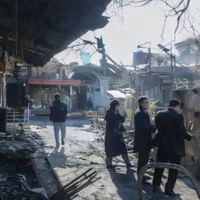
Funeral ceremonies were planned on Tuesday for two air defense personnel killed in Israeli strikes on Iran a day earlier, state media reported.
The two were identified as Bahman Hosseini and Alireza Abiri. According to the reports, they died while “carrying out their mission of defending the country’s skies."
Iranian officials had not previously reported any fatalities from the attacks.
Iranian lawmaker Mahmoud Nabavian called for revenge over their deaths, saying, “Avenging the blood of these two must not be forgotten.”
Iranian youth use their mobile phones as they walk at a park in Tehran
Simple pleasures, personal goals and everyday purchases have become out of reach for many Iranian teenagers, who told Iran International that economic hardship is reshaping their lives and dimming their hopes for the future.
Messages sent by teenagers described a growing gap between what they need and what their families can afford, with some saying even routine activities and modest purchases now feel unattainable.
One teenager said upgrading a computer has become unrealistic after the price of an 8GB DDR5 memory module rose to around 500 million rials (over $280).
Iran's minimum monthly wage is currently worth around $90-$110, depending on exchange-rate fluctuations, while estimates from labor experts put average monthly earnings for many workers at roughly $150.
"With these conditions, buying or upgrading a computer has become a dream," the teenager said.
Another wrote that a mobile phone purchased for 500 million rials (over $280) in February is now worth 930 million rials (over $520).
Others pointed to the disappearance of simple recreational activities from their lives. A 15-year-old said swimming pool fees have more than doubled since early April, while another said that a bicycle that once cost 300 million rials (around $170) now sells for 620 million rials (about $350).
"We Iranian teenagers and young people have reached a point where eating one good meal makes us happy, while our peers in other countries have many things to enjoy," one message said.
Embarrassed to ask
Several teenagers said financial pressure has not only reduced their expectations but also left them feeling ashamed to express their needs.
They described watching their parents struggle with rising living costs and choosing to remain silent about things they want or need.
An 11-year-old girl said her birthday falls in September but she is embarrassed to ask her father to organize a celebration.
She questioned why having a birthday party should be considered a wish rather than a normal part of childhood.
A group of teenagers sit on a bench with skateboards, looking at their phones and talking outside a building.
A 14-year-old wrote: "Whenever I ask my parents for something, they say they don't have the money. I feel ashamed when I sit at the dinner table."
Another 15-year-old said gym membership fees had tripled.
"I feel guilty asking for things I need because I know dealing with these prices is not easy for my parents," the teenager wrote.
Some others said they increasingly feel like a burden on their families. One wrote that their parents regularly give up their own wishes to provide for their children, while another said the feeling of being an extra weight on the family has become constant.
A 14-year-old girl said she feels guilty whenever her parents buy something for her and has become pessimistic about her future.
Adult worries replace childhood concerns
Some said their attention has shifted from hobbies, friendships and future plans to concerns about war, economic conditions and daily news.
"Whenever I think about war and ceasefires, I cry," one teenager wrote. "Why can't I enjoy life like other teenagers or go to school wearing what I want?"
A 12-year-old asked why children should be preoccupied with current events instead of enjoying their free time.
Several said the issues occupying their minds resemble adult concerns rather than those usually associated with adolescence.
"I should be thinking about having fun and playing, not working or worrying about politics and the price of gold and dollars," one teenager wrote.
Comparisons with teenagers abroad appeared frequently in the messages.
A 16-year-old girl said she works instead of pursuing leisure activities and is often too exhausted to remain on her feet.
A university entrance exam candidate wrote that seeing graduation celebrations in other countries leaves the strongest sense of longing.
Growing uncertainty about the future
Several teenagers said they struggle to imagine a future for themselves at a stage in life when they should be exploring talents, setting goals and pursuing ambitions.
An 18-year-old said the country's conditions have left little motivation even for ordinary daily life, let alone planning for the future.
Another wrote that, despite being only 18, they are already watching their hopes and ambitions fade.
A 15-year-old said economic pressure, exhaustion and disappointment have become part of everyday life and make long-held aspirations feel impossible to achieve.
Some said uncertainty is even shaping major life decisions.
A ninth-grade student wrote that although they would like to choose an academic path based on personal interests, the future feels so unpredictable that passion has become a luxury.
Instead of focusing on dreams, the student said thoughts are dominated by rising prices, war and the memory of those who have died, creating a sense of being trapped with no clear path forward.