Related Articles
Russia and China have asked the UN Security Council to vote on a draft resolution on Friday that would delay the reinstatement of international sanctions on Iran by six months, Reuters reported citing diplomats.
Iran and European powers held last-ditch talks in New York on Tuesday to try to prevent the revival of UN sanctions on Tehran, though diplomats on both sides cautioned that chances of success remain slim.
Last week, a UN Security Council resolution on whether to permanently lift UN sanctions on Iran was voted down.
All UN sanctions on Iran will be reimposed at 8 p.m. EDT Friday (0000 GMT Saturday) after the UK, France and Germany triggered a 30-day process accusing Tehran of violating the 2015 nuclear deal aimed at preventing it from developing nuclear weapons.

The death of a female Iranian political prisoner in hospital following a series of seizures has sparked outrage from Iran's two Nobel laureates and right groups who have labeled her death a state-sponsored murder.
Somayeh Rashidi died after several days in hospital following her transfer from Qarchak Prison near Tehran, Iran’s judiciary-affiliated Mizan news agency reported on Thursday.
Rashidi, born in 1983, was detained in April for allegedly writing anti-government graffiti slogans in Tehran’s Javadieh district. Initially held in Evin Prison, she was transferred to Qarchak after an Israeli strike on the facility in June.
Nobel Peace laureates Narges Mohammadi condemned her death in custody, describing it as part of a pattern of abuse in detention.
“This devastating loss of Somayeh Rashidi is not an accident but the result of a systematic policy of neglect and cruelty inside Iranian prisons,” Mohammadi said in a post on X.
'Evident torture'
Rights groups and activists including Nobel laureate Shirin Ebadi had previously raised alarm about Rashidi’s deteriorating condition, highlighting her urgent need for medical attention.
“Neglecting her health, ignoring her repeated seizures in prison, is clear evidence of torture and deliberate negligence,” Ebadi posted on Instagram.
“Somayeh Rashidi’s state-sponsored murder must be a wake-up call—a slap in the face to human rights defenders, freedom fighters, and equality advocates who still choose silence or compromise, and to an opposition caught in internal disputes.”
Iran International reported earlier this month that Rashidi’s condition had severely declined, with doctors holding little hope for her recovery.
An informed source, speaking anonymously to Iran International for safety, said that under Iran’s criminal laws Rashidi’s death constitutes intentional murder.
“The prison’s health deputy, warden, Qarchak court, Tehran prison director, case investigator and prison supervisor all played a role. They could have ordered an immediate transfer or declared the prison unfit to hold her,” the source said.
“When a prisoner is evaluated and has a known condition, authorities can refuse detention due to lack of capacity. Admitting they knew and still detained her means deliberate neglect leading to intentional murder.”
Death for graffiti
Iranian rapper Toomaj Salehi, who faced a death sentence and torture in prison but was ultimately released, called Rashidi’s death a deliberate act to suppress dissent.
“Such deliberate disregard for political prisoners is an example of silent, systematic suppression and elimination of dissenters. Why should anyone be arrested for graffiti?” Salehi posted on X.
Former political prisoner and women’s rights defender Hasti Amiri said Rashidi’s case showed deliberate neglect.
“She had a medical history and her family could not afford bail, yet authorities denied release and delayed her transfer. This is intentional murder under Article 290 of the Penal Code meaning intentional murder,” she wrote on X.
Motahereh Gooneyi, another former political prisoner, recalled collapsing half-conscious during a hunger strike after being transferred to Qarchak following Israeli strikes on Evin and said the life of political prisoners in Iran is “worthless,” adding the hashtag #SomayehRashidi in Persian on X.
Solidarity protest in prison
Sources speaking anonymously to Iran International alleged that security officials pressured Rashidi’s family to describe her hospitalization as a suicide attempt, intensifying accusations of a cover-up.
According to information received by Iran International, a group of female political prisoners in Qarchak Prison, staged a sit-in in the prison yard to protest Rashidi's death, chanting anti-government slogans.
The sources said the prisoners chanted that her death was a “silent state murder” and accused the judiciary, prison authorities and other government officials of complicity in her death.
Qarchak deaths mount
Human rights groups including the Norway-based Iran Human Rights (IHR) have publicly called for the closure of Qarchak, describing it as “one of the darkest symbols of systematic human rights violations in the Islamic Republic.”
Rashidi death comes less than a week after another prisoner, Maryam Shahraki, died in Qarchak last Friday.
According to Norway-based rights group Hengaw Organization, three women have already died in this facility this year due to lack of adequate medical care — Jamileh Azizi on September 19, Shahraki on September 13, and Farzaneh Bijanipour on January 11.
Iran likely carried out a secret missile test at the Imam Khomeini Spaceport in Semnan, according to satellite images analyzed by the Associated Press.
Photos taken on September 24 show a scorched launch pad, indicating a launch took place around September 18.
On the same day, social media users reported seeing a rocket contrail over Semnan, though officials in Tehran have remained silent.
The images reveal distinct scorch marks typical of a solid-fuel missile launch, along with evidence of a blast deflector.
The purpose of the launch is unclear. The contrail suggests the attempt may have failed, and no new satellites have been detected in orbit.
Analysts say the incident underscores Iran’s determination to advance its missile program despite Western pressure.
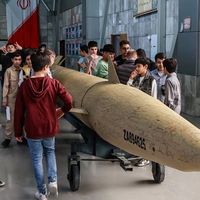
Iranian lawmaker Mohsen Zanganeh said on state television this week that a test had been carried out involving an intercontinental ballistic missile—potentially exceeding the 2,000-kilometer range limit set by Supreme Leader Ali Khamenei.
Iran’s President Masoud Pezeshkian said the country is fully prepared to face any scenario and will adjust its policies if UN sanctions are reinstated.
"We hope such a process does not take place; nevertheless, the Islamic Republic of Iran is fully prepared to face any scenario and condition," state media quoted Pezeshkian as saying in a meeting with Bolivia's president on the sidelines of the United Nations General Assembly.
"And it is obvious that the nature of our interactions and policies will also be adjusted in accordance with the new situation," he added.
Indian officials visiting Washington this week requested permission to import US-sanctioned Iranian and Venezuelan crude to make up for a shortfall from Russia, Bloomberg reported on Thursday citing sources.
The Trump administration has slapped New Delhi with steep tariffs for its brisk purchases of US-sanctioned Russian crude and ties between the two vast democracies have hit a low point over the impasse.
A delegation told US officials that blocking supplies from the three oil exporters could pressure Indian refiners and drive up global oil prices, Bloomberg reported.