A senior Iranian lawmaker said on Tuesday that Tehran should retaliate if its vessels are inspected following the activation of the UN snapback sanctions mechanism.
Ahmad Bakhshayesh Ardestani, a member of parliament’s national security committee, told domestic media that Iran’s Revolutionary Guard and navy should board and inspect ships belonging to the opposing parties in response.
A conservative Iranian lawmaker said on Tuesday that Tehran should move toward building a nuclear weapon as a deterrent, according to local media.
Jalil Mirmohammadi told Dideban Iran, "As a deterrent we must move towards building a nuclear weapon."
He added: "The Libya experience is before our eyes and Iran will never become Libya."
"We will not accept zero enrichment," he pointed out.
An Iranian lawmaker said on Tuesday that President Masoud Pezeshkian would likely shake hands and exchange greetings with US President Donald Trump if the two encountered each other in the corridors of the United Nations during this week’s General Assembly in New York.
Ahmad Bakhshayesh Ardestani, a member of parliament’s national security committee, said Pezeshkian “would not hide” unlike some previous leaders.
He referred to reports from 1998 that then-president Mohammad Khatami avoided meeting US President Bill Clinton at the UN General Assembly.
At the time, Iranian and international media reported that Khatami’s team changed backstage routes to prevent a meeting.
Some accounts even suggested Khatami briefly hid in a restroom to avoid a chance encounter with Clinton.
An Iranian lawmaker said on Tuesday that a meeting was being planned between President Masoud Pezeshkian and US President Donald Trump during the UN General Assembly in New York.
Bijan Nobaveh, a member of parliament from Tehran, told domestic media the talks would focus on resolving disputes over Iran’s uranium enrichment and missile programme.
Neither Iranian nor US officials have confirmed such a meeting.
Iraqi Foreign Minister Fuad Hussein warned on Tuesday that Europe’s reimposition of sanctions on Iran would lead to a “dangerous dead end” and risk destabilizing the Middle East.
Speaking to Asharq News on the sidelines of the UN General Assembly, Hussein described renewed sanctions as harsh.
“Mounting pressure over the Palestinian issue and the wider Middle East adds to the strain on Iran, which could trigger major problems,” he said.
He added that Israeli threats toward Tehran “could further escalate tensions and create serious challenges.”
On Iraq, Hussein said the country’s geography and airspace had become a “battlefield” in the confrontation between Iran and Israel, but voiced hope that diplomacy could help ease the crisis.
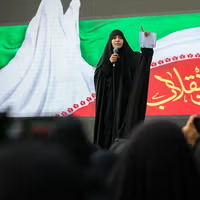
Iran’s government spokesperson Fatemeh Mohajerani said on Tuesday that Tehran has presented a “logical, balanced and reasonable” proposal to European powers to prevent the activation of the UN snapback sanctions mechanism.
“We welcome any opportunity for dialogue, but dialogue is a two-way act, not dictating terms,” Mohajerani told reporters in Tehran.
She accused European states of failing to offset the impact of US withdrawal from the 2015 nuclear deal, saying Iran had faced “severe pressures” as a result.
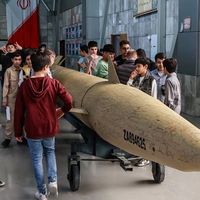
Mohajerani added that Tehran’s missile program and defense capabilities would not be subject to negotiations. “We do not seek anyone’s permission to defend our people. Security is not for sale, and missiles are part of that security,” she said.
Mohajerani added that Iran’s inventory of highly enriched uranium is buried under rubble following US and Israeli strikes on the country's nuclear facilities in June.