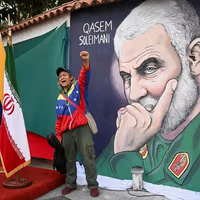
Iranian President Masoud Pezeshkian said on Tuesday he would not engage in talks with powers that “bully or act maliciously,” ahead of his trip to New York for the UN General Assembly.
He called the forum “a very good opportunity” to present Iran’s positions, and condemned Israel’s actions in Gaza, saying the killing of children through bombardment, hunger and lack of medicine was unimaginable.
Iran’s hardline Kayhan daily, overseen by a representative of Supreme Leader Ali Khamenei, said on Tuesday that “the shadow of war will never be lifted by negotiations,” citing Israeli media and officials.
“The experience of the 12-day war showed that Iran-US talks not only failed to prevent a military attack but in fact aided surprise and became part of the assault,” the paper wrote.
In response to calls by some Iranian figures for President Masoud Pezeshkian to meet Donald Trump during his trip to the United States, Kayhan added that Pezeshkian was “a resilient personality who naturally has no inclination toward political showmanship in New York, though some with special motives in his circle are trying to make this trip exceptional.”
The United States has denied visas to most members of Iranian President Masoud Pezeshkian’s media team for his trip to the UN General Assembly in New York, Iran’s semi-official Fars news agency reported on Tuesday.
Fars, which is affiliated with the Revolutionary Guards, said only the president’s public relations chief and deputy were granted visas, leaving no official photographers or cameramen to cover the visit.
The agency added that the two officials now bear sole responsibility for reporting on “the large number of events” during Pezeshkian’s trip.
It also said that under travel restrictions imposed by the administration of US President Donald Trump, Iranian delegates in New York need permits even to buy items such as fountain pens, classified as “luxury goods.”
The spokesman for Iran’s parliamentary energy committee said on Tuesday that the revival of UN sanctions under the snapback mechanism would carry mostly psychological effects on the economy rather than add new restrictions.
“The return of sanctions does not introduce anything new, but if not properly explained by the authorities, the psychological effect could impact the economy,” Esmail Hosseini, a lawmaker from Shiraz, was quoted as saying by Iranian media.
He called for public messaging to neutralize the impact and said parliament was reviewing options, including withdrawal from the Nuclear Non-Proliferation Treaty (NPT). Hosseini also described the reimposition of sanctions as “legally invalid.”
Earlier in August, Iran’s intelligence ministry warned in a confidential letter that snapback could halt oil sales, fuel major economic and security crises, increase unemployment and stoke social unrest.

Condom purchases in Iran jumped 26% during the country’s 12-day conflict with Israel in June, according to data from the country’s largest e-commerce platform Digikala.
The report on consumer behavior showed a surge in demand for a range of health-related products during the war, including sanitary pads, disinfectants, blood glucose test strips, medical bandages, nail extension supplies, blood glucose monitors, adult diapers, and sanitary underpads.
The report comes three months after Israel launched a surprise military campaign on June 13, striking military and nuclear facilities in Iran. Air attacks killed nuclear scientists along with hundreds of military personnel and civilians. Iran retaliated with drone and missile attacks which killed 31 Israeli civilians and one off-duty soldier.
The United States joined the conflict on June 22, conducting strikes on major nuclear sites including Fordow, Natanz and Isfahan, before brokering a ceasefire on June 24.
Global perspective
Similar spikes in condom sales have been reported in other countries during times of conflict or crisis. After North Korea’s nuclear test in October 2006, South Korean convenience stores recorded a surge, with condom sales averaging 1,930 per day, compared to about 1,508 per day previously.
In Russia, following the invasion of Ukraine in March 2022, major retailers reported sharp increases. The pharmacy chain Rigla noted a 26% rise, while online marketplace Wildberries saw sales climb by about 170% year-on-year, a surge linked to consumer fears of shortages and price hikes.
Similar behavior was documented in the United States during the early months of the COVID-19 pandemic, when condom makers such as Reckitt Benckiser reported sales jumps linked to consumer uncertainty and supply chain fears but not necessarily increased use.
Iran and European powers will hold last-ditch talks in New York on Tuesday to try to prevent the revival of UN sanctions on Tehran, though diplomats on both sides cautioned that chances of success remain slim, Reuters reported.
Foreign ministers of Iran, Britain, France and Germany – the so-called E3 – are due to meet on the sidelines of the UN General Assembly, joined by EU foreign policy chief Kaja Kallas, amid warnings that a 30-day “snapback” process to reimpose sanctions will expire on September 27.
“Iran has been in contact with E3/EU officials and (the UN nuclear chief Rafael) Grossi since this morning at the UN Different ideas have been raised and discussed,” a senior Iranian official told Reuters on Tuesday.
“Iran’s top diplomat will meet with the E3 foreign ministers and EU foreign policy chief Kallas tomorrow and will continue the discussions.”
Another Iranian official said “everyone seems to be trying” to find a resolution. Two European diplomats confirmed the Tuesday meeting.