The vote counting process has started in polling stations across the country, and the results are expected to be announced gradually by the Interior Ministry, the Election Headquarters spokesman said.
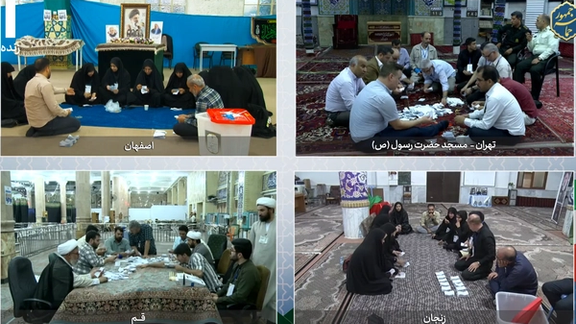
The vote counting process has started in polling stations across the country, and the results are expected to be announced gradually by the Interior Ministry, the Election Headquarters spokesman said.


Polls closed at midnight but voters queuing outside polling stations in some constituencies including Tehran were allowed to enter and wait for their votes to be taken.
As in many previous elections, many voters often turn up at polling stations in the late afternoon and evening hours to avoid the daytime heat. The interior ministry extended the voting time in three stages after 18:00 local time by two hours.
A high turnout in the later hours of the polls has usually benefitted the candidate backed by the reform faction of the Islamic Republic, in this case Masoud Pezeshkian facing hardliner Saeed Jalili.
There are no exit polls in Iran. Results are expected to be announced by morning.
None of the two candidates has claimed a major incident of vote rigging but some irregularities have been reported.
Supreme Leader Expresses Hope in High Turnout
Supreme Leader Ali Khamenei cast his vote soon after the opening of the polls. "I heard that the people's enthusiasm and interest is more than before. I hope this is true. It will be heartwarming if it is,” the 85-year-old Iranian leader who has always insisted that a high turnout is proof of the legitimacy of the Islamist government said.
Khamenei admitted in a speech Wednesday that the turnout in the first round had been “less than expected but attributed it to people’s “lack of time” rather than their disenchantment with the government and refusal to participate in its elections.
Turnout
According to the Interior Ministry over 30 million votes were cast by the official end of the polling time at midnight. Any official tally around 50% will be questioned in coming days as eyewitness reports throughout the day spoke of empty polling stations.

In the first round, just under 40 percent of Iran's around 61.5 million eligible voters went to the polls, casting 42.4 percent of their votes for Pezeshkian and 38.6 percent for Jalili. 4.3 percent of the remaining ballots were blank, void, or for the two other candidates.
Citizens from various cities and towns across Iran including the capital Tehran have sent dozens of videos and photos of empty polling stations to Iran International TV or posted them on social media.
Various political groups and activists as well as many ordinary Iranians, both outside and inside Iran, continued to urge the electorate to boycott the elections which they consider neither fair nor free and “engineered” to prevent Khamenei from “usurping” their participation and using it as proof of the legitimacy of his rule.
Dissidents Protests in Major Cities Across the World Outside Polling Stations
As in the first round of the elections, dissidents protested in major cities outside Iranian embassies and polling stations including in London, Stockholm, Sidney, and Bonn. Minor clashes were reported in some places between the protesters and those who had turned up to vote.
Pezeshkian Supporters Accuse Government of “Dissuading” Voters with Text Messages
Last Friday, the interior ministry sent a text message to all Iranians a few hours before the official closing of the poll in which it quoted Khamenei as saying every vote was a vote for the ruling establishment. The ministry sent this and similar text messages to all citizens in the afternoon of the runoff polls again.
Many, including former Foreign Minister Mohammad-Javad Zarif who has relentlessly campaigned for Pezeshkian, have interpreted the text message as a deterrent to the voting of those who fear their votes being used as proof of the legitimacy of the Islamic Republic.
In thinly veiled terms in a short video posted on social media Friday afternoon, Zarif referred to such messages and urged people not to be discouraged from voting by them.
Voting/Abstention of Political Figures
Former President Mohammad Khatami who is widely considered as the leader of the 'reformists' had abstained from voting in the March parliamentary elections but voted in the first round. He voted again in the runoff but refused to speak to the state television after voting.
The leader of the Green Movement Mir-Hossein Mousavi and his wife Zahra Rahnavard who have been under house arrest since 2011 refused to accept a ballot box to be taken to their home to vote. Mehdi Karrubi, also a Green Movement leader under house arrest since 2011 voted at his home and urged Iranians to vote for Pezeshkian.
Photos of former President Mahmoud Ahmadinejad who after being barred from standing in the 2017 elections has assumed the role of an opposition figure were posted on social media indicating that he was abroad and not voting. The photos that showed him at a mosque in Istanbul, Turkey, emerged on social media after an account linked to him announced Friday that he was not endorsing any of the two candidates.
As in the first round of the elections, most prominent imprisoned dissidents including the reformist Mostafa Tajzadeh and Nobel Peace Laureate Narges Mohammadi refused to vote in prison.
As in the first round, prominent political prisoners in various prisons refused to vote.